A rod or ladder can't be treated as a single point — it has length, and different forces act at different places along it. This lesson introduces moments as the extra tool needed to handle equilibrium of rigid bodies, through the classic rod-and-peg and ladder-and-wall setups.
13 min read2 worked examples
Beyond particles: rigid bodies
So far, every object has been modelled as a particle — small enough that its size and shape don't matter, and every force can be treated as acting at a single point. A uniform rod or ladder is different: it has length, and forces can act at different points along it. Force equilibrium alone ($\sum F=0$) is no longer enough to solve every unknown — you also need moments.
For a uniform rod or ladder, the weight acts at its midpoint (its centre of mass). Taking moments about a well-chosen point — usually one where an unknown force acts — eliminates that force from the equation entirely, often turning a problem with three unknowns into a single, solvable equation.
Moments about a point
For a rigid body in equilibrium, the sum of the clockwise moments about any point equals the sum of the anticlockwise moments about that same point. Taking moments about a point where an unknown force acts is usually the fastest way to find a different unknown, since that force then contributes zero moment.
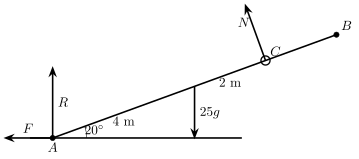
A uniform rod resting on rough ground, held up against a smooth peg. Since the peg is smooth, its reaction N is perpendicular to the rod itself.
Worked example 1
A rod against a smooth peg
A uniform rod $AB$, of weight $25g\ \text{N}$ and length $8\ \text{m}$, rests with end $A$ on rough horizontal ground and against a smooth peg at $C$, where $AC=6\ \text{m}$, with the rod at $20^\circ$ to the horizontal. Find (a) the reaction $N$ at the peg, and (b) the coefficient of friction at $A$, given the rod is in limiting equilibrium. Take $g=9.8\ \text{m s}^{-2}$, and give your answers to 3 significant figures.
Method (a)Take moments about A
1
Since the peg is smooth, $N$ acts perpendicular to the rod at $C$. Taking moments about $A$ eliminates both unknown forces $R$ and $F$, which act at $A$.
Choosing the moment point at $A$ removes two of the three unknowns from the equation at once.
2
The moment of $N$ about $A$ is $N\times AC=6N$, since $N$ is perpendicular to the rod, so its perpendicular distance from $A$ is simply $AC$.
A force perpendicular to a rod, applied at a point on it, has a moment about any other point on the rod equal to (force) × (distance along the rod).
3
The moment of the weight about $A$ is $25g\times(4\cos20^\circ)$, since the weight acts vertically at the midpoint $G$, $4\ \text{m}$ from $A$, and its horizontal distance from $A$ is $4\cos20^\circ$.
Only the horizontal distance from the pivot matters for a vertical force's moment.
Solve directly for the one unknown remaining in the moment equation.
Method (b)Resolve to find R and F, then use limiting friction
1
$N$ acts perpendicular to the rod, at $20^\circ+90^\circ=110^\circ$ to the horizontal, so it has components $N\cos110^\circ$ horizontally and $N\sin110^\circ$ vertically.
Rotating the rod's own direction by 90° gives the direction perpendicular to it.
The peg's reaction and the ground's normal reaction together support the full weight.
3
Resolving horizontally: $F=N\sin20^\circ=153.48\sin20^\circ=52.5\ \text{N}$ (3 s.f.) (using $\cos110^\circ=-\sin20^\circ$, so the required friction has magnitude $N\sin20^\circ$).
Friction at $A$ must balance the horizontal component of the peg's reaction.
4
Since the rod is in limiting equilibrium, $F=\mu R \Rightarrow \mu=\dfrac{52.49}{100.77}=0.521$ (3 s.f.).
Limiting equilibrium is exactly the condition that lets you solve for μ once F and R are both known.
▪ solved
The ladder problem
The most common rigid-body setup is a ladder against a wall. When the wall is smooth, its reaction is horizontal, which makes taking moments about the base of the ladder especially clean — the wall's reaction is the only unknown force with a moment about that point, other than any weights on the ladder itself.
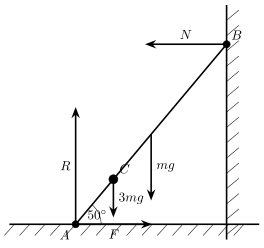
A ladder against a smooth wall, carrying an extra point load. Taking moments about A gives N directly, since R and F both act at A.
Worked example 2
A ladder against a smooth wall, carrying a load
A uniform ladder $AB$, of weight $mg$ and length $4a$, rests with end $A$ on rough ground and end $B$ against a smooth vertical wall, with the ladder at $50^\circ$ to the horizontal. A load of weight $3mg$ is attached to the ladder at $C$, where $AC=a$. Given the ladder is in limiting equilibrium, find the coefficient of friction $\mu$ between the ladder and the ground, to 3 significant figures.
MethodTake moments about A, then resolve
1
Since the wall is smooth, the reaction $N$ at $B$ is horizontal. Taking moments about $A$: the perpendicular distance from $A$ to the (horizontal) line of action of $N$ is the height of $B$, which is $4a\sin50^\circ$.
For a horizontal force, the perpendicular distance from any point is simply that point's vertical distance below the force's line of action.
2
The weight $mg$ acts at the midpoint, horizontal distance $2a\cos50^\circ$ from $A$; the load $3mg$ acts at $C$, horizontal distance $a\cos50^\circ$ from $A$.
Both weights are vertical, so only their horizontal distances from A contribute to their moments.
The length $a$ cancels completely — only the ratio of the weights and the angle matter.
5
Resolving vertically: $R=mg+3mg=4mg$, since $N$ is horizontal and contributes nothing vertically.
The ground's normal reaction simply supports the ladder's total weight, unaffected by the wall.
6
Resolving horizontally: $F=N=1.05mg$. Since the ladder is limiting, $\mu=\dfrac{F}{R}=\dfrac{1.0489mg}{4mg}=0.262$ (3 s.f.).
Friction at A is the only other horizontal force, so it must exactly balance N.
▪ solved
Common mistake
Taking moments about the wrong point and ending up with three unknowns in one equation instead of one. Before writing any moment equation, check which forces act at your chosen point — those vanish from the equation automatically, which is the entire reason for choosing that point.
Check yourself
A uniform ladder of weight $W$ rests with one end on rough ground and the other against a smooth vertical wall, at $60^\circ$ to the horizontal, with no additional load. Find the minimum possible coefficient of friction $\mu$ between the ladder and the ground for equilibrium, to 3 significant figures.
Taking moments about the base (length $L$, weight at the midpoint): $N\cdot L\sin60^\circ = W\cdot\tfrac{L}{2}\cos60^\circ \Rightarrow N=\dfrac{W}{2\tan60^\circ}$.
Resolving: $R=W$, $F=N$, so $\mu_{\min}=\dfrac{F}{R}=\dfrac{1}{2\tan60^\circ}=0.289$ (3 s.f.).