With equilibrium fully covered, this final lesson returns to Newton's second law on a slope — combining friction with inclined-plane resolving to find the acceleration of a particle that's actually in motion, whether sliding down under gravity or pushed up by an external force.
12 min read2 worked examples
From equilibrium back to motion
Every problem so far in this chapter has involved equilibrium — zero acceleration. This final lesson returns to Newton's second law, $F=ma$, combining it with friction and inclined-plane geometry to find the acceleration of a particle that's actually moving, rather than merely on the point of moving.
The method is unchanged from earlier work on friction: resolve perpendicular to the plane to find $R$, then apply Newton's second law along the plane, using $F=\mu R$ since the particle is actually sliding (friction is always limiting once motion has started).
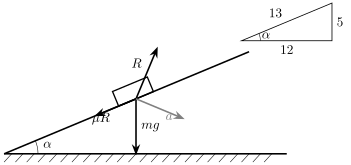
A particle released from rest on a rough incline, sliding down under gravity, opposed by friction acting up the slope.
Worked example 1
Released from rest on a rough incline
A particle of mass $m$ is released from rest on a rough plane inclined at angle $\alpha$ to the horizontal, where $\sin\alpha=\tfrac{5}{13}$ and $\cos\alpha=\tfrac{12}{13}$. The coefficient of friction between the particle and the plane is $\tfrac14$. Find (a) the acceleration of the particle as it slides down the plane, and (b) the distance it travels in the first $2$ seconds. Take $g=9.8\ \text{m s}^{-2}$, and give your answers to 3 significant figures.
MethodResolve perpendicular for R, then apply F = ma along the slope
1
The particle slides down, so friction acts up the slope, opposing the motion. Resolving perpendicular to the plane: $R=mg\cos\alpha=\tfrac{12}{13}mg$.
There's no acceleration perpendicular to the plane, so these components balance exactly as before.
2
Since the particle is sliding, friction is limiting: $F=\mu R=\tfrac14\times\tfrac{12}{13}mg=\tfrac{3}{13}mg$.
Motion has already started, so friction takes its maximum possible value.
3
Newton's second law down the slope: $mg\sin\alpha-F=ma \Rightarrow \tfrac{5}{13}mg-\tfrac{3}{13}mg=ma$.
Gravity's component down the slope drives the motion; friction, acting up the slope, opposes it.
The mass $m$ cancels throughout, as it always does when the only forces are weight, normal reaction and friction.
5
Since the particle starts from rest with constant acceleration, using $s=ut+\tfrac12at^2$ with $u=0$, $t=2$: $s=\tfrac12(1.5077)(2)^2=3.02\ \text{m}$ (3 s.f.).
"Released from rest" means $u=0$, and the acceleration found in part (a) is constant throughout, so SUVAT applies directly.
▪ solved
Pushing a particle up a rough slope
The same method applies when a particle is pushed up a slope by an external force, rather than sliding down under gravity — the only change is that friction now opposes the upward motion, acting down the slope, and every applied force needs resolving into its components parallel and perpendicular to the incline.
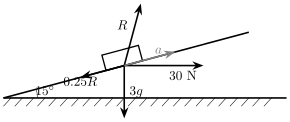
A box pushed up a rough incline by a horizontal force. Friction now acts down the slope, opposing the upward motion.
Worked example 2
Pushed up a rough incline by a horizontal force
A box of mass $3\ \text{kg}$ is pushed by a horizontal force of magnitude $30\ \text{N}$ up a rough plane inclined at $15^\circ$ to the horizontal, where the coefficient of friction between the box and the plane is $0.25$. Find the acceleration of the box, to 3 significant figures. Take $g=9.8\ \text{m s}^{-2}$.
MethodResolve the horizontal force into components along and perpendicular to the slope
1
The $30\ \text{N}$ force is horizontal, not parallel to the slope, so it must be resolved: its component up the slope is $30\cos15^\circ$, and its component into the plane (increasing the normal reaction) is $30\sin15^\circ$.
Only forces already parallel or perpendicular to the incline can be used directly — anything else needs resolving first.
2
Resolving perpendicular to the plane: $R=3g\cos15^\circ+30\sin15^\circ=28.40+7.76=36.2\ \text{N}$ (3 s.f.).
Both the weight and the horizontal push contribute to pressing the box onto the surface.
3
The box moves up the slope, so friction acts down the slope: $F=\mu R=0.25\times36.163=9.04\ \text{N}$.
Friction is limiting since the box is actually sliding, and it always opposes the direction of motion.
4
Newton's second law up the slope: $30\cos15^\circ - 3g\sin15^\circ - F = 3a$.
The driving component of the push, minus gravity's component down the slope, minus friction, gives the resultant force producing the acceleration.
Divide the resultant force along the slope by the mass, exactly as in any other application of $F=ma$.
▪ solved
Common mistake
Resolving an applied force that isn't already parallel to the incline as if it were — for instance, using the full $30\ \text{N}$ directly in the along-slope equation instead of $30\cos15^\circ$. Any force not already aligned with your chosen axes must be split into components first, exactly as with weight.
Check yourself
A particle of mass $2\ \text{kg}$ is released from rest on a rough plane inclined at angle $\alpha$ to the horizontal, where $\sin\alpha=\tfrac35$ and $\cos\alpha=\tfrac45$. The coefficient of friction between the particle and the plane is $0.2$. Find the acceleration of the particle as it slides down the plane, to 3 significant figures. Take $g=9.8\ \text{m s}^{-2}$.