Pure Mathematics · Graphs & Transformations · Year 1
Reciprocal Graphs
A graph that never touches two particular lines, no matter how far it travels — asymptotes turn "getting closer forever" into a genuine sketching tool.
10 min read5 worked examples
The graph of y = k/x
The simplest reciprocal function is $y = \dfrac{k}{x}$. Since division by zero is undefined, $x=0$ is never allowed — the graph splits into two separate branches, one for $x>0$ and one for $x<0$, and never actually crosses the $y$-axis.
Asymptotes — lines the curve approaches but never reaches
As $x \to 0$ (from either side), $\dfrac{k}{x}$ grows without bound — the curve shoots off toward $+\infty$ or $-\infty$, getting arbitrarily close to the line $x=0$ without ever touching it. This is a vertical asymptote. As $x \to \pm\infty$, $\dfrac{k}{x} \to 0$ — the curve flattens toward the line $y=0$, a horizontal asymptote. Every basic reciprocal graph has exactly these two asymptotes: the axes themselves.
The sign of $k$ decides which pair of quadrants the two branches sit in. For $k>0$: one branch in the top-right (both $x,y>0$), one in the bottom-left (both $x,y<0$). For $k<0$: one branch top-left, one bottom-right.
Shifted reciprocal graphs
A graph like $y = \dfrac{a}{x-p} + q$ is the basic reciprocal graph translated: the vertical asymptote moves from $x=0$ to $x=p$ (wherever the denominator would be zero), and the horizontal asymptote moves from $y=0$ to $y=q$. Finding the asymptotes of any reciprocal graph is simply a matter of finding what value of $x$ makes the denominator zero, and what constant sits outside the fraction.
The graph of y = a/x²
Squaring the denominator changes the shape completely. In $y=\dfrac{a}{x^2}$, the output $x^2$ is always positive (for $x\neq0$), so every value of $y$ has the same sign as $a$ — the curve never crosses to the other side of the $x$-axis at all. Both branches sit above the $x$-axis when $a>0$, or both sit below when $a<0$.
The asymptotes work the same way as before: $x=0$ is still a vertical asymptote (division by zero), and $y=0$ is still a horizontal asymptote (as $x\to\pm\infty$, $\frac{a}{x^2}\to0$). The difference is entirely in how the two branches are arranged — because $y=\frac{a}{x^2}$ is an even function ($f(-x)=f(x)$), the graph is symmetric about the $y$-axis, giving it a distinctive "double-hump" shape rather than the diagonal symmetry of $y=k/x$.
y = k/x vs. y = a/x² — spot the difference
Both have asymptotes at the two axes. But $y=k/x$ has rotational symmetry about the origin (one branch top-right, one bottom-left, for $k>0$), while $y=a/x^2$ has reflective symmetry about the $y$-axis (both branches on the same side, mirror images of each other). Checking whether the power on $x$ is odd or even tells you instantly which symmetry to expect.
Worked example 1
Sketching a basic reciprocal graph
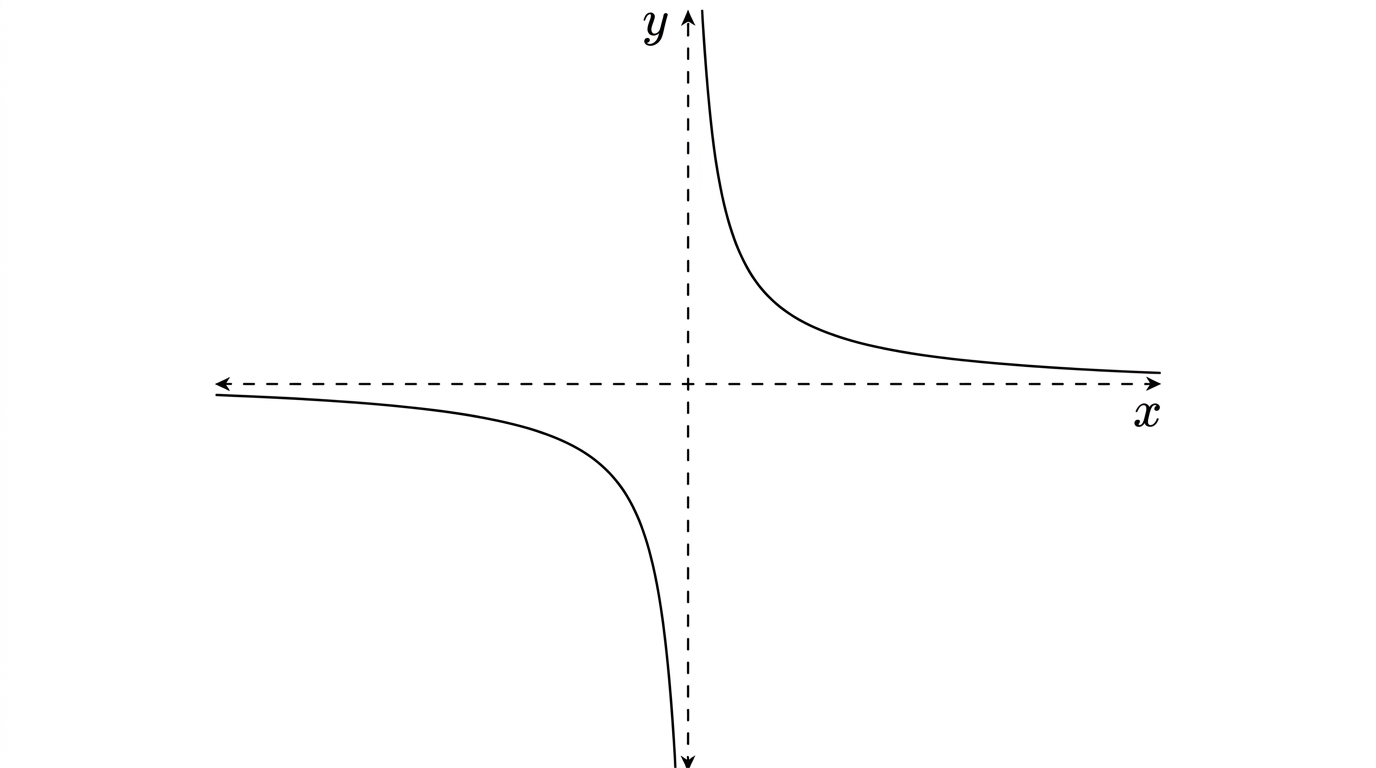
Sketch $y = \dfrac{1}{x}$, stating its asymptotes and the quadrants each branch occupies.
y = k/x for k > 0: two branches, each approaching but never touching the dashed asymptotes.
MethodIdentify the asymptotes, then the sign of k
1
Vertical asymptote at $x=0$ (denominator zero); horizontal asymptote at $y=0$ (as $x\to\pm\infty$).
The standard reciprocal asymptotes.
2
$k=1>0$, so one branch sits in the top-right quadrant, one in the bottom-left.
Positive k rule.
3
A few points confirm the shape: at $x=1$, $y=1$; at $x=2$, $y=0.5$; at $x=-1$, $y=-1$; at $x=-2$, $y=-0.5$.
Plot a couple of points on each branch.
4
Each branch curves in toward its asymptotes on both ends, without ever crossing $x=0$ or $y=0$.
Both branches hug the axes.
▪ sketched
Examiner's eye
Always draw asymptotes as dashed lines on a sketch, and label them explicitly ($x=0$, $y=0$, or whatever they've shifted to) — a reciprocal graph without labelled asymptotes is usually marked as incomplete.
Worked example 2
A shifted reciprocal graph
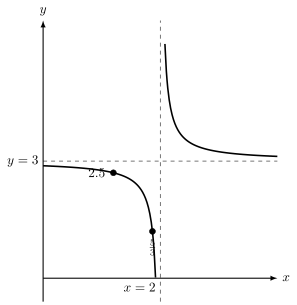
Sketch $y = \dfrac{1}{x-2} + 3$, stating its asymptotes.
$y=\dfrac{1}{x-2}+3$ — asymptotes $x=2$, $y=3$; intercepts at $2.5$ and $\tfrac53$.
MethodRead the shift directly from the equation
1
The denominator is zero when $x=2$, so the vertical asymptote is $x=2$.
Where the fraction is undefined.
2
As $x\to\pm\infty$, $\dfrac{1}{x-2}\to0$, so $y\to3$ — the horizontal asymptote is $y=3$.
The fraction vanishes, leaving just the +3.
3
$k=1>0$ (the numerator), so relative to the new asymptotes, one branch sits in the region above-right of $(2,3)$, the other below-left.
Same sign rule as the basic graph, applied about the new centre.
4
$y$-intercept: at $x=0$, $y = \dfrac{1}{-2}+3 = 2.5$. For the $x$-intercept, set $y=0$: $\dfrac{1}{x-2}=-3 \Rightarrow x-2=-\tfrac13 \Rightarrow x=\tfrac53$.
Substitute x=0, then separately substitute y=0 and solve.
▪ sketched
The key insight
The whole graph of $y=\frac{1}{x}$ has simply been translated by the vector $\begin{pmatrix}2\\3\end{pmatrix}$ — right 2, up 3. Every feature (asymptotes, branch positions, general shape) moves together with the translation; nothing about the curve's fundamental shape changes.
Worked example 3
Finding intercepts of a shifted reciprocal graph
The curve $y = \dfrac{4}{x+1} - 2$ has asymptotes and crosses both axes. Find the coordinates of both intercepts.
MethodSubstitute x = 0 and y = 0 in turn
1
Asymptotes: $x=-1$ (denominator zero) and $y=-2$ (as $x\to\pm\infty$).
Read directly from the equation.
2
$y$-intercept: at $x=0$, $y = \dfrac{4}{1} - 2 = 2$. So $(0, 2)$.
Substitute x=0.
3
$x$-intercept: set $y=0$: $0 = \dfrac{4}{x+1}-2 \Rightarrow \dfrac{4}{x+1}=2$.
Rearrange before solving.
4
Cross-multiply: $4 = 2(x+1) \Rightarrow 4=2x+2 \Rightarrow x=1$. So $(1,0)$.
Solve the resulting linear equation.
▪ solved
Common mistake
Never substitute $x=-1$ to look for a "point" on the curve — that's exactly the excluded value where the vertical asymptote sits, and the function is undefined there. Always check a proposed $x$-value doesn't coincide with an asymptote before using it.
Worked example 4
Finding a reciprocal equation from its features · Challenge
A reciprocal curve of the form $y = \dfrac{a}{x-p} + q$ has asymptotes $x=3$ and $y=-1$, and passes through the point $(5, 1)$. Find the values of $a$, $p$ and $q$.
The asymptotes give $p$ and $q$ immediately; only the numerator $a$ needs the extra point.
MethodRead p and q from the asymptotes, then solve for a
1
The vertical asymptote $x=3$ means $p=3$ (the denominator is $x-3$).
Vertical asymptote occurs at x = p.
2
The horizontal asymptote $y=-1$ means $q=-1$.
Horizontal asymptote occurs at y = q.
3
So $y = \dfrac{a}{x-3}-1$. Substitute the point $(5,1)$: $1 = \dfrac{a}{5-3}-1 = \dfrac{a}{2}-1$.
Use the given point to find a.
4
Solve: $\dfrac{a}{2} = 2 \Rightarrow a=4$.
Add 1, then multiply by 2.
5
So $a=4$, $p=3$, $q=-1$, giving $y=\dfrac{4}{x-3}-1$.
Final equation.
▪ solved
Look deeper — asymptotes are read, not calculated
Unlike most curve-fitting problems, the asymptotes of a reciprocal graph don't need algebra to find — they're visible directly from the equation's structure. Only the "size" of the curve (the numerator $a$) is a genuine unknown requiring a data point to resolve.
Worked example 5
Sketching y = a/x²
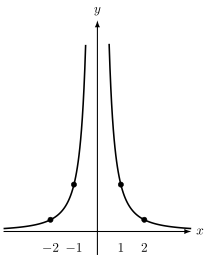
Sketch $y = \dfrac{2}{x^2}$, stating its asymptotes, symmetry and the sign of $y$ throughout.
$y=\dfrac{2}{x^2}$ — symmetric about the $y$-axis, both branches above the $x$-axis.
MethodUse evenness to fix the symmetry, then plot a few points
1
Vertical asymptote at $x=0$ (denominator zero); horizontal asymptote at $y=0$ (as $x\to\pm\infty$).
Same rule as any reciprocal graph.
2
$a=2>0$ and $x^2>0$ always, so $y>0$ for every $x\neq0$ — the whole curve lies above the $x$-axis.
a/x² takes the sign of a, always.
3
$f(-x) = \dfrac{2}{(-x)^2} = \dfrac{2}{x^2} = f(x)$, so the graph is symmetric about the $y$-axis.
Even function test.
4
A few points: at $x=1$, $y=2$; at $x=2$, $y=0.5$; at $x=-1$, $y=2$; at $x=-2$, $y=0.5$ — mirror images either side of the $y$-axis.
Plot symmetric pairs.
5
Both branches rise steeply toward $+\infty$ as $x\to0$, and both flatten toward $y=0$ as $x\to\pm\infty$ — an even, "double-hump" shape sitting entirely above the axis.
Combine the asymptote and symmetry information.
▪ sketched
Common mistake
A reciprocal graph's two branches are separate curves — never draw a single continuous line joining them across the vertical asymptote. The function is undefined exactly at the asymptote, and the two branches genuinely never meet.
Check yourself
State the asymptotes of $y = \dfrac{2}{x+4} + 1$, and find its $y$-intercept. (Hint: the vertical asymptote is where the denominator is zero; the horizontal asymptote is the constant added outside the fraction.)