Pure Mathematics · Graphs & Transformations · Year 1
Quartic Graphs
One extra degree past a cubic changes the ends completely: both sides of a quartic now point the same way, and the middle can hold up to three separate turns.
9 min read4 worked examples
The shape of a quartic
A quartic function has the form $y=ax^4+bx^3+cx^2+dx+e$, with $a\neq0$. Just as with cubics, the far-left and far-right behaviour is fixed by the sign of the leading coefficient $a$ — but because the power is even, both ends now point the same way.
$a>0$: both ends point up — the curve looks like a wide, possibly wobbly, U. $a<0$: both ends point down — an upside-down version.
Why even powers give matching ends
For very large $|x|$, a quartic behaves like $y=ax^4$. Since $x^4$ is positive whether $x$ is large and positive or large and negative (an even power always removes the sign), both ends of the curve move in the same direction — determined purely by the sign of $a$. This is the key difference from a cubic, where the odd power $x^3$ keeps the sign of $x$, sending the two ends in opposite directions.
Roots and turning points
The same crossing/touching rules from cubic graphs extend directly: a single factor $(x-p)$ crosses the axis, a repeated factor $(x-p)^2$ touches and turns back, and so on. A quartic can have up to four real roots and up to three turning points — though it may have fewer of either, since not every factor need be a simple real linear one.
When a quartic has fewer than four real roots
Some quadratic factors never cross the $x$-axis at all — for instance $x^2+1$ is always positive, since $x^2 \geq 0$ means $x^2+1 \geq 1 > 0$ for every real $x$. A quartic like $y=(x-1)(x+2)(x^2+1)$ therefore only crosses the axis twice, at $x=1$ and $x=-2$, even though it's degree 4 — the $(x^2+1)$ factor contributes no real roots at all.
Worked example 1
Sketching from four distinct roots
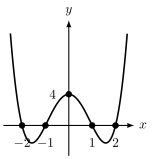
Sketch the graph of $y = (x+2)(x+1)(x-1)(x-2)$, marking all axis intercepts.
$y=(x+2)(x+1)(x-1)(x-2)$ — four distinct roots, $y$-intercept $4$, both ends point up.
MethodRoots, y-intercept, then join respecting both ends pointing up
1
Leading term is $+x^4$, so $a>0$: both ends point up.
Four x's multiplied give x⁴ with positive coefficient.
2
Four single roots: $x=-2,-1,1,2$ — the curve crosses the axis at each.
All factors appear once.
3
$y$-intercept: at $x=0$, $y=(2)(1)(-1)(-2)=4$.
Substitute x=0.
4
From bottom-left (curve pointing up), descend, cross at $-2$, rise to a local max, fall, cross at $-1$, dip to a local min at the centre, rise, cross at $1$, rise to a local max, fall, cross at $2$, then rise away to top-right.
Four crossings force a W-like shape with three turning points.
▪ sketched
Examiner's eye
Four distinct real roots and a positive leading coefficient always produce this "W" shape — three turning points alternating max, min, max. Symmetry in the roots (here, $\pm1$ and $\pm2$) often makes the middle minimum sit exactly on the $y$-axis, worth checking as a sketch sanity check.
Worked example 2
A repeated root
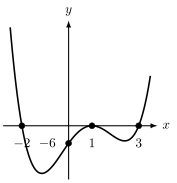
Sketch the graph of $y = (x-1)^2(x+2)(x-3)$, marking all axis intercepts.
$y=(x-1)^2(x+2)(x-3)$ — crosses at $-2,3$, touches at $1$, $y$-intercept $-6$.
MethodIdentify the touching root among the crossings
1
Leading term is $+x^4$: both ends up.
a > 0.
2
$x=1$ is repeated (power 2): touches the axis. $x=-2$ and $x=3$ are single roots: the curve crosses at each.
Different factor powers, different behaviour.
3
$y$-intercept: at $x=0$, $y=(-1)^2(2)(-3)=(1)(2)(-3)=-6$.
Substitute x=0.
4
From bottom-left, descend, cross at $-2$, rise to a local max, fall to touch the axis at $x=1$ (turning back without crossing), continue falling to a local min, then rise, crossing at $x=3$, up to top-right.
One touch plus two crossings, three turning points total.
▪ sketched
The key insight
Even with a touch instead of a crossing, this quartic still has three turning points — the touch at $x=1$ counts as a turning point (a local max or min sitting exactly on the axis), it just doesn't cross through. Counting "how many times the curve meets the axis" and "how many times it turns" are related but not identical questions.
Worked example 3
A quartic with only two real roots
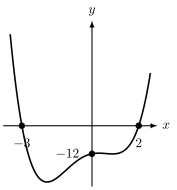
Sketch the graph of $y=(x-2)(x+3)(x^2+2)$, marking the axis intercepts.
$y=(x-2)(x+3)(x^2+2)$ — only two real roots, $-3$ and $2$; $y$-intercept $-12$.
MethodRecognise the always-positive factor, then sketch the remaining roots
1
$x^2+2$ is never zero for real $x$ (since $x^2 \geq 0$ means $x^2+2 \geq 2$), and is always positive.
No real roots come from this factor.
2
So the only real roots come from $(x-2)(x+3)$: $x=2$ and $x=-3$, both single, both crossings.
The quadratic factor contributes no axis crossings.
3
Leading term is $+x^4$ (from $x \cdot x \cdot x^2$): both ends up.
a > 0.
4
$y$-intercept: at $x=0$, $y=(-2)(3)(2) = -12$.
Substitute x=0.
5
From bottom-left, descend, cross at $x=-3$, dip to a local min, rise, cross at $x=2$, then rise to top-right — only one turning point needed between the two crossings (a simpler shape than examples 1–2, since there are only two real roots).
Fewer crossings means a simpler curve is sufficient.
▪ sketched
Common mistake
Don't assume a degree-4 polynomial always crosses the axis four times — always check whether any quadratic factor can be zero for real $x$ before counting roots. A factor like $x^2+k$ with $k>0$ never contributes a real root.
Worked example 4
Finding a quartic's equation from its graph · Challenge
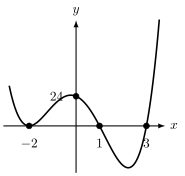
A quartic curve touches the x-axis at $x=-2$, crosses it at $x=1$, crosses it again at $x=3$, and passes through the point $(0, 24)$. Find the equation of the curve in factorised form, including the value of the leading coefficient, and state the direction of both ends.
A touch contributes a squared factor, and each crossing contributes a single factor — together these already account for all four degrees, so the only unknown is the overall scaling constant.
$y=2(x+2)^2(x-1)(x-3)$ — touches at $-2$, crosses at $1,3$, $y$-intercept $24$.
MethodBuild the factorised form from the root behaviour, then find k
1
Touching at $x=-2$ gives a repeated factor $(x+2)^2$. Crossing at $x=1$ and at $x=3$ each give a single factor: $(x-1)$ and $(x-3)$.
Touch = power 2, each crossing = power 1.
2
Degrees add to $2+1+1=4$, exactly a quartic, so $y = k(x+2)^2(x-1)(x-3)$ for some constant $k$.
No further factors are needed or allowed.
3
Use the point $(0,24)$: $24 = k(2)^2(-1)(-3) = k(4)(3) = 12k$.
Substitute x=0: (0+2)²=4, (0-1)=-1, (0-3)=-3.
4
Solve: $k=2$.
Divide both sides by 12.
5
So $y = 2(x+2)^2(x-1)(x-3)$. Since $k=2>0$, both ends of the curve point up.
Positive leading coefficient, even degree.
▪ solved
Look deeper — counting degrees before introducing a constant
Checking that the root multiplicities already add up to the full degree (here, $2+1+1=4$) confirms no extra factor is hiding — so a single unknown constant $k$ is all that's left, found from just one extra point. If the multiplicities hadn't summed to 4, an additional factor (possibly with no real roots) would have been needed instead.
Common mistake
Assuming both ends of a quartic always point the same direction as a cubic's right-hand end is a common confusion — always re-derive the end behaviour from the sign of the leading coefficient and the even power, rather than pattern-matching to cubic graphs.
Check yourself
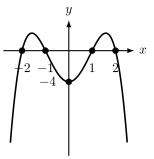
Sketch $y=-(x-1)(x+1)(x-2)(x+2)$, marking all intercepts and stating the direction of both ends. (Hint: find the sign of the leading term first — note the overall minus sign out front.)
$y=-(x-1)(x+1)(x-2)(x+2)$: both ends point down — the mirror image of a positive quartic with the same roots.
Method
1
Leading term: $-x^4$ (the minus sign out front flips the usual $+x^4$), so $a<0$: both ends point down.
2
Four single roots at $x=-2,-1,1,2$, all crossings.
3
y-intercept: $x=0$ gives $y=-(-1)(1)(-2)(2)=-4$.
Substitute and include the overall minus sign.
4
An upside-down "W" (an "M" shape): both ends down, rising and falling between the four crossings.
Mirror image of a positive quartic with the same roots.