Pure Mathematics · Graphs & Transformations · Year 1
Points of Intersection
Wherever two graphs meet, both equations are simultaneously true — so every intersection problem is really a simultaneous equations problem wearing a graph's clothing.
11 min read4 worked examples
The core idea
A point where two curves $y=f(x)$ and $y=g(x)$ cross satisfies both equations at once — so at that point, $f(x)=g(x)$. Setting the two expressions equal and solving for $x$ finds every $x$-coordinate where the curves meet; substituting back into either original equation gives the matching $y$-coordinate.
Strategy — always eliminate down to one equation in one variable
However complicated the two curves look, the method never changes: set the expressions for $y$ equal, rearrange everything to one side, and solve the resulting equation in $x$ alone. What varies is only what kind of equation results — linear, quadratic, cubic — and therefore which technique (factorising, the quadratic formula, the factor theorem) finishes the job.
Using the discriminant for a line and a curve
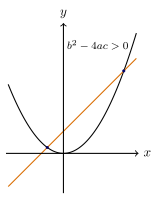
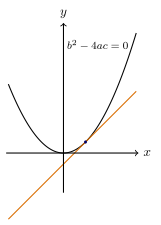
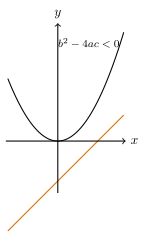
When a line meets a quadratic curve, eliminating $y$ leaves a quadratic in $x$. The discriminant $b^2-4ac$ of that quadratic tells you how many times they meet, without solving it fully: two solutions ($b^2-4ac>0$) means the line crosses the curve twice; one repeated solution ($b^2-4ac=0$) means the line is a tangent, touching at exactly one point; no real solutions ($b^2-4ac<0$) means the line misses the curve entirely.
b² − 4ac > 0: two distinct real roots, so the line crosses the curve at two separate points.b² − 4ac = 0: one repeated root, so the line is a tangent — touching the curve at exactly one point without crossing it.b² − 4ac < 0: no real roots, so the line misses the curve entirely.
Worked example 1
A line and a quadratic curve
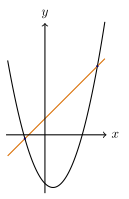
Find the coordinates of the points where the line $y = x+1$ meets the curve $y = x^2-x-3$.
A line meeting a parabola at two points, where both equations are satisfied simultaneously.
MethodSet the expressions equal, then solve the resulting quadratic
1
Set the two expressions for $y$ equal: $x+1 = x^2-x-3$.
Both equal y at an intersection point.
2
Rearrange to one side: $x^2-2x-4=0$.
Subtract x and 1 from both sides.
3
This doesn't factorise nicely, so use the quadratic formula: $x = \dfrac{2\pm\sqrt{4+16}}{2} = \dfrac{2\pm\sqrt{20}}{2} = 1\pm\sqrt5$.
a=1, b=-2, c=-4.
4
Find the matching $y$-values using $y=x+1$: at $x=1+\sqrt5$, $y=2+\sqrt5$; at $x=1-\sqrt5$, $y=2-\sqrt5$.
Substitute into the simpler (linear) equation.
▪ solved
Examiner's eye
Always substitute back into the linear equation to find $y$, never the quadratic — it's less arithmetic and less error-prone. Both equations give the same answer, but one route is shorter.
Worked example 2
Finding a tangent condition · using the discriminant
Find the value of $k$ for which the line $y = 2x+k$ is a tangent to the curve $y = x^2+3x+5$.
MethodForm the quadratic in x, then set the discriminant to zero
1
Set the expressions equal: $2x+k = x^2+3x+5$.
Points of contact satisfy both equations.
2
Rearrange: $x^2+x+(5-k)=0$.
Collect everything on one side.
3
Tangent means exactly one solution, so the discriminant is zero: $1^2-4(1)(5-k)=0$.
A tangent line doesn't just "touch" a curve in a vague visual sense — algebraically, it's the exact condition that the intersection equation has a repeated root. The discriminant, first met when counting the roots of a quadratic, is doing precisely the same job here: counting how many times two graphs meet.
Worked example 3
A line and a cubic curve
Find the $x$-coordinates of the points where the line $y=4x$ meets the curve $y=x^3-x$.
Eliminating $y$ here leaves a cubic — which needs the factor theorem, not the quadratic formula.
MethodForm the cubic, find one root by inspection, then factorise
1
Set equal: $4x = x^3-x$.
Both equal y at intersection.
2
Rearrange: $x^3-5x=0$.
Subtract 4x from both sides.
3
Factorise out $x$: $x(x^2-5)=0$.
x is a common factor of every term.
4
So $x=0$ or $x^2=5 \Rightarrow x=\pm\sqrt5$.
Solve each factor separately.
5
Three intersection points, at $x=0,\ \sqrt5,\ -\sqrt5$.
A cubic can meet a line up to three times.
▪ solved
Common mistake
Dividing both sides of $x^3-5x=0$ by $x$ to get $x^2-5=0$ silently loses the solution $x=0$ — always factorise out the common $x$ instead of dividing by it, so every root is captured.
Worked example 4
A line and a reciprocal curve · Challenge
Find the coordinates of the points where the line $y=x-1$ meets the curve $y=\dfrac{6}{x}$.
With a reciprocal curve involved, clearing the fraction first turns this into a familiar quadratic problem — but the excluded value $x=0$ needs checking at the end.
MethodClear the fraction, solve the quadratic, then check validity
1
Set equal: $x-1 = \dfrac{6}{x}$.
Both equal y at intersection.
2
Multiply both sides by $x$ (valid since $x\neq0$ on the reciprocal curve anyway): $x(x-1) = 6$.
Clears the fraction.
3
Expand and rearrange: $x^2-x-6=0$, which factorises to $(x-3)(x+2)=0$.
Standard quadratic factorising.
4
So $x=3$ or $x=-2$ — neither equals the excluded value $x=0$, so both are valid.
Always check against the curve's domain restriction.
5
Find $y$ using $y=x-1$: at $x=3$, $y=2$; at $x=-2$, $y=-3$. Intersection points: $(3,2)$ and $(-2,-3)$.
Substitute into the simpler equation.
▪ solved
Look deeper — why multiplying by x was safe here
Multiplying an equation by a variable can introduce false solutions if that variable could be zero — but since $y=\frac{6}{x}$ is undefined at $x=0$, no genuine intersection point could ever have $x=0$ anyway, so no false solution is possible here. Whenever a reciprocal curve is involved, this check is worth stating explicitly rather than assumed.
Common mistake
After finding $x$-values, always find the matching $y$-values too — a point of intersection is a coordinate pair, not a single number. Marks are routinely lost for stopping at the $x$-solutions.
Check yourself
Find the value of $c$ for which the line $y=6x+c$ is a tangent to the curve $y=3x^2$. (Hint: form the quadratic in x from the two equations, then set its discriminant to zero.)