Logarithms & Their Laws
A logarithm undoes an exponential: it finds the power. Three laws — all restated index rules — let you combine, split and solve.
A logarithm is the inverse of an exponential
Exponentials raise a base to a power. A logarithm runs that backwards: it answers the question "what power do I raise the base to, to get this number?" In symbols,
Read $\log_a n$ as "log, base $a$, of $n$". The two statements say exactly the same thing — one is just the other rearranged. For instance $\log_2 8 = 3$ because $2^3 = 8$, and $\log_{10} 1000 = 3$ because $10^3 = 1000$. Every logarithm question is secretly an index question wearing different notation.
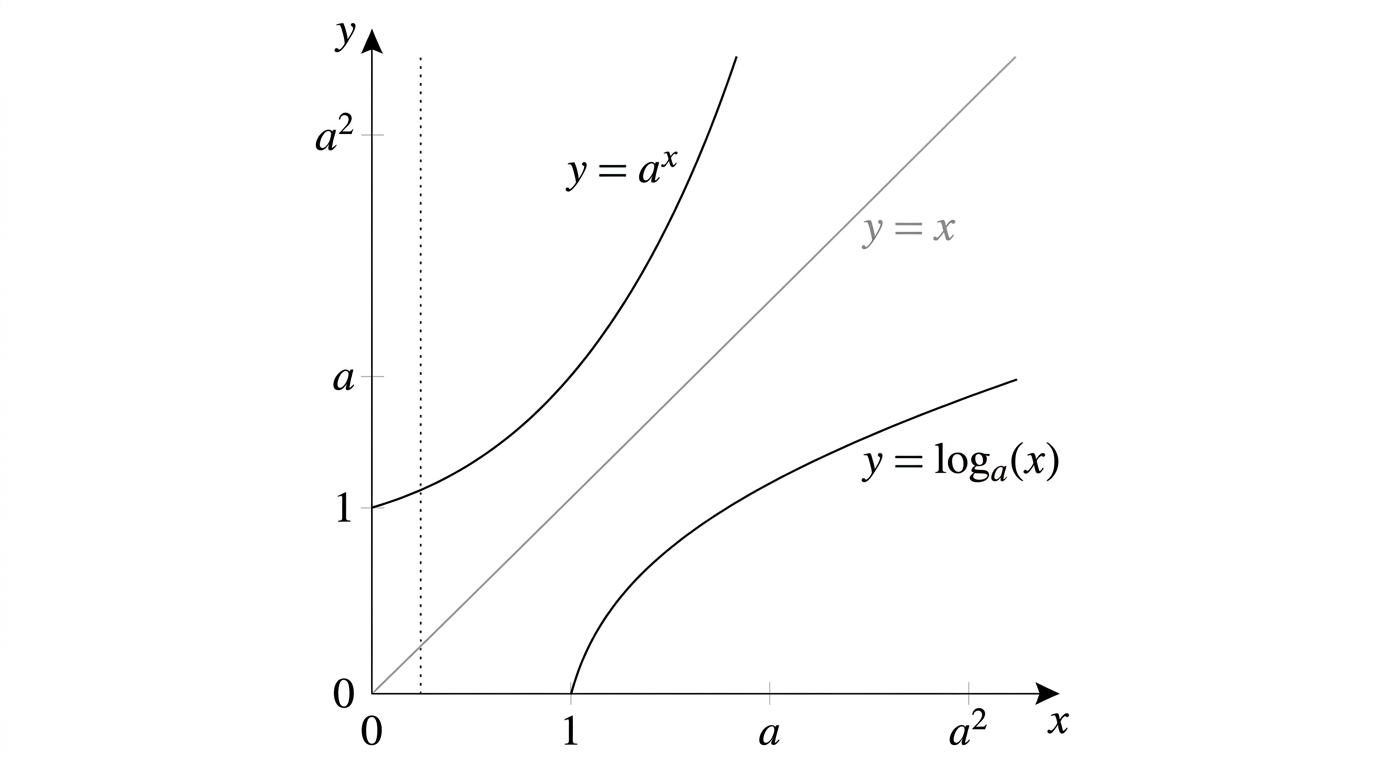
Because a logarithm undoes an exponential, their graphs are reflections in the line $y = x$ — the signature of any function and its inverse. This instantly gives the log graph's features from the exponential's: $y=a^x$ passes through $(0,1)$, so $y=\log_a x$ passes through $(1,0)$; the exponential's horizontal asymptote $y=0$ becomes the logarithm's vertical asymptote $x=0$. And since $a^x$ is only ever positive, you can only take the log of a positive number — $\log_a x$ is undefined for $x \le 0$.
The logarithm you'll meet constantly
$\log_{10}$ — base $10$ — is often written just $\log$ with no base shown; it's your calculator's "log" button, and the base used for change of base below. There's a second special base worth its own lesson: $e$, whose logarithm is the natural logarithm, $\ln$ — that's next.
The laws of logarithms
Three laws let you combine and split logs. Each one is simply an index law translated into log language — which is why they're worth understanding rather than memorising blindly.
Three special values fall straight out of the definition: $\log_a a = 1$ (since $a^1 = a$), $\log_a 1 = 0$ (since $a^0 = 1$), and $\log_a a^k = k$.
Write $x = a^m$ and $y = a^n$, so $\log_a x = m$ and $\log_a y = n$. Then $xy = a^m \times a^n = a^{m+n}$ by the index law for multiplying powers. Taking the log, $\log_a(xy) = m + n = \log_a x + \log_a y$. The product law is the "add the indices" rule seen from the other side. The quotient and power laws come the same way from "subtract the indices" and "multiply the indices".
Change of base
To evaluate a log whose base isn't on your calculator, convert it:
Choosing $b = 10$ or $b = e$ lets you compute any log. For example $\log_2 5 = \dfrac{\ln 5}{\ln 2} = \dfrac{1.609}{0.693} \approx 2.32$.
Worked example 1
Every one of these is solved by rewriting the number as a power of the base. If you can spot that $125$, $3$ and $\tfrac18$ are $5^3$, $9^{1/2}$ and $2^{-3}$, the logs read straight off. No calculator needed — and these "exact value" logs are common in the non-calculator parts of papers.
Worked example 2
Order matters for tidiness: deal with any coefficients first using the power law (turning $2\log_a 3$ into $\log_a 9$), because the product and quotient laws only apply to plain logs with a coefficient of $1$. Once everything is a bare $\log_a(\ldots)$, combine with $+\to\times$ and $-\to\div$. Getting this order wrong is the most common slip examiners see.
There is no law for the log of a sum: $\log_a(x + y)$ does not equal $\log_a x + \log_a y$. The product law is about $\log_a(xy)$, a product inside. Likewise $\dfrac{\log x}{\log y} \neq \log\dfrac{x}{y}$ — dividing two separate logs is change-of-base, whereas the quotient law is $\log\dfrac{x}{y} = \log x - \log y$. Keep "what's inside one log" separate from "two logs combined".
Check yourself
(a) Evaluate $\log_4 64$ without a calculator. (b) Write $3\log_a 2 + \log_a 5 - \log_a 4$ as a single logarithm.
(Hint: for (b), deal with the coefficient first using the power law.)
As before: coefficients first (power law), then combine what's left with the product and quotient laws.