Exponential Functions & e^x
Functions with the variable in the exponent grow in a way powers never can — and one special base, e, is its own rate of change.
What an exponential function is
An exponential function has the form $y = a^x$, where the variable sits in the exponent and the base $a$ is a positive constant. This is a completely different beast from a power function like $x^2$: there the variable is the base and the power is fixed; here the power is the variable. That single swap changes everything about how the function grows.
Every exponential graph $y=a^x$ (for $a>0$, $a\neq 1$) shares the same skeleton: it passes through $(0, 1)$ — since $a^0 = 1$ for any base — it is always positive, and it has the $x$-axis as a horizontal asymptote on one side. If $a>1$ the curve grows as $x$ increases; if $0<a<1$ it decays.
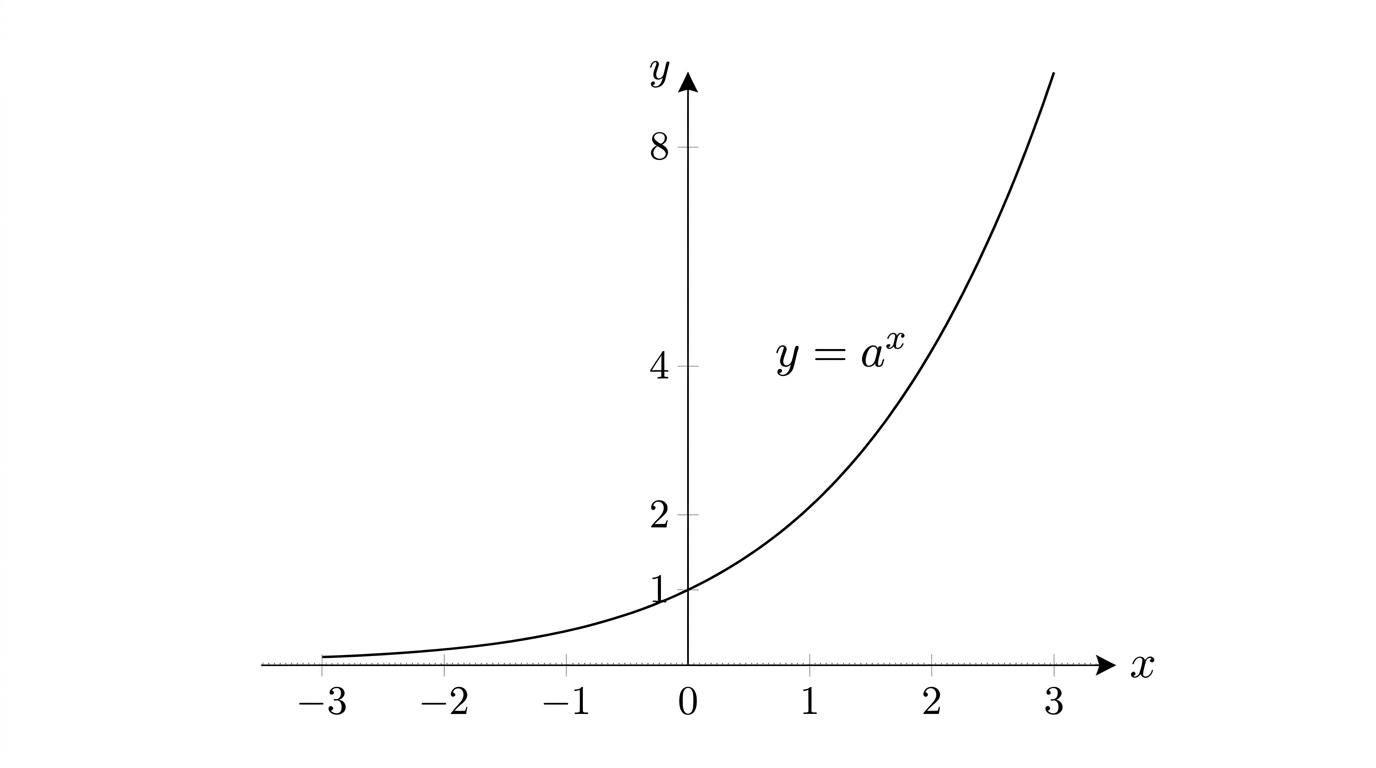
Whatever the base, $a^0 = 1$ — so at $x=0$ every exponential curve has height $1$. That's the one point they all have in common. And because a positive base raised to any power stays positive, $a^x$ can never be zero or negative: the curve hugs the $x$-axis as $x\to-\infty$ (for $a>1$) but never reaches it, which is exactly what "horizontal asymptote" means.
The special number e
Among all possible bases, one is so useful it earns its own symbol: $e \approx 2.71828$, an irrational constant like $\pi$. What makes $e$ special is a property of its graph: for $y = e^x$, the gradient at every point equals the height of the curve at that point. The function is its own rate of change.
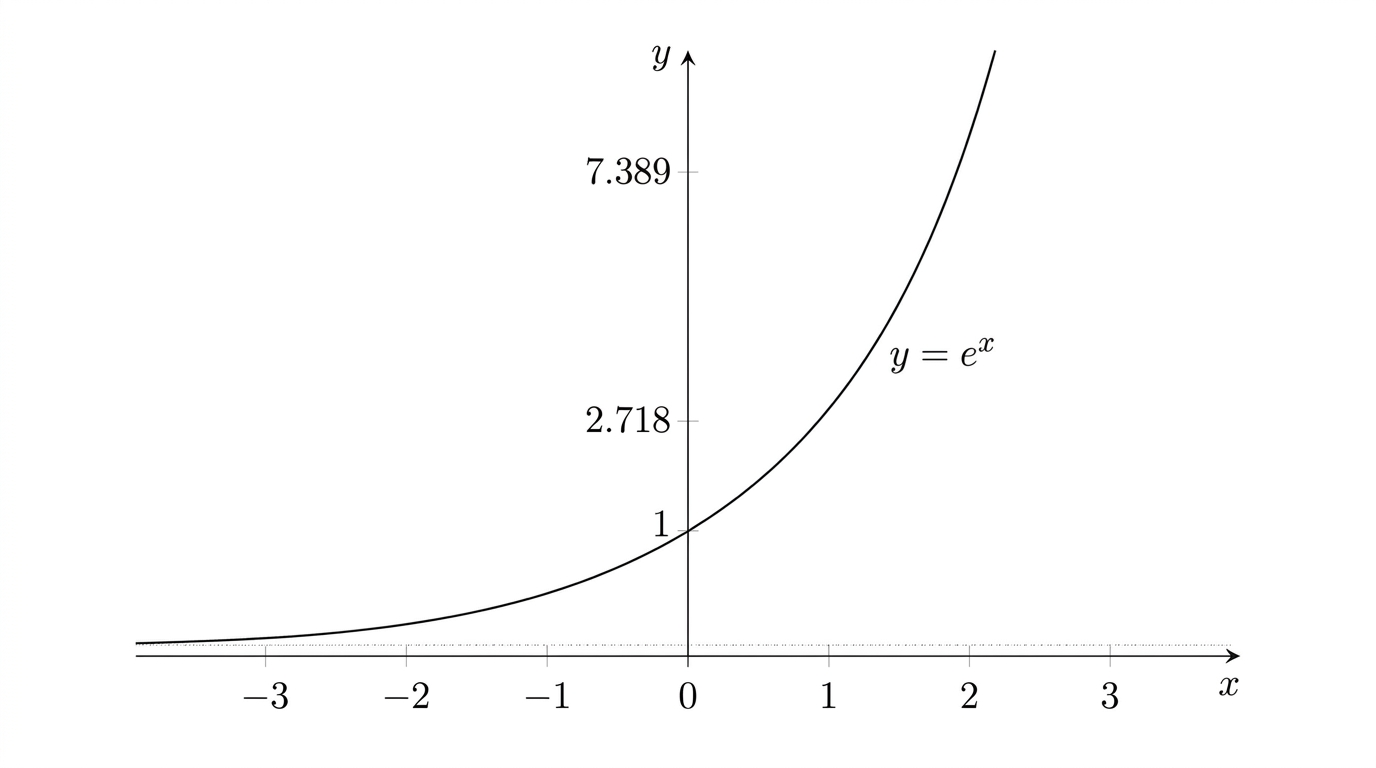
For a general base, the graph of $a^x$ has a gradient proportional to its height, but with an awkward constant of proportionality. The number $e$ is precisely the base for which that constant is exactly $1$: $\dfrac{d}{dx}\!\left(e^x\right) = e^x$. This is why $e$ appears everywhere that something grows at a rate proportional to its current size — populations, radioactive decay, continuously compounded interest. You'll use this derivative constantly once you reach calculus.
Transformations of exponential graphs
The graph of $y = e^x$ can be shifted and stretched using the same transformation rules as any function. Two appear constantly:
Stretching the exponent scales the gradient by the same constant: $\dfrac{d}{dx}\!\left(e^{kx}\right) = k\,e^{kx}$. This follows from the self-derivative property of $e^x$ — every time the exponent's rate of change is $k$ instead of $1$, that same $k$ carries over and multiplies the whole derivative. You'll meet this again, justified more formally, once the chain rule is introduced in Year 2.
Worked example 1
Notice $f(-1) = \tfrac13$ is positive, not negative — a negative exponent gives a reciprocal, never a negative value. Exponentials with a positive base are positive everywhere, which is why the curve stays above the $x$-axis.
Worked example 2
Adding a constant to an exponential shifts both the curve and its asymptote by the same amount. Because the asymptote moved to $y=-4$, the curve now dips below the $x$-axis near the left, which is why it has an $x$-intercept at all — the untransformed $y=e^x$ never crosses the axis. Solving $e^x = 4$ needs the logarithm, the subject of the next lesson.
Worked example 3
Writing $2^{-x} = \left(\tfrac12\right)^x$ shows the second is just an exponential with base $\tfrac12$ — a decay curve. The two are mirror images in the $y$-axis.
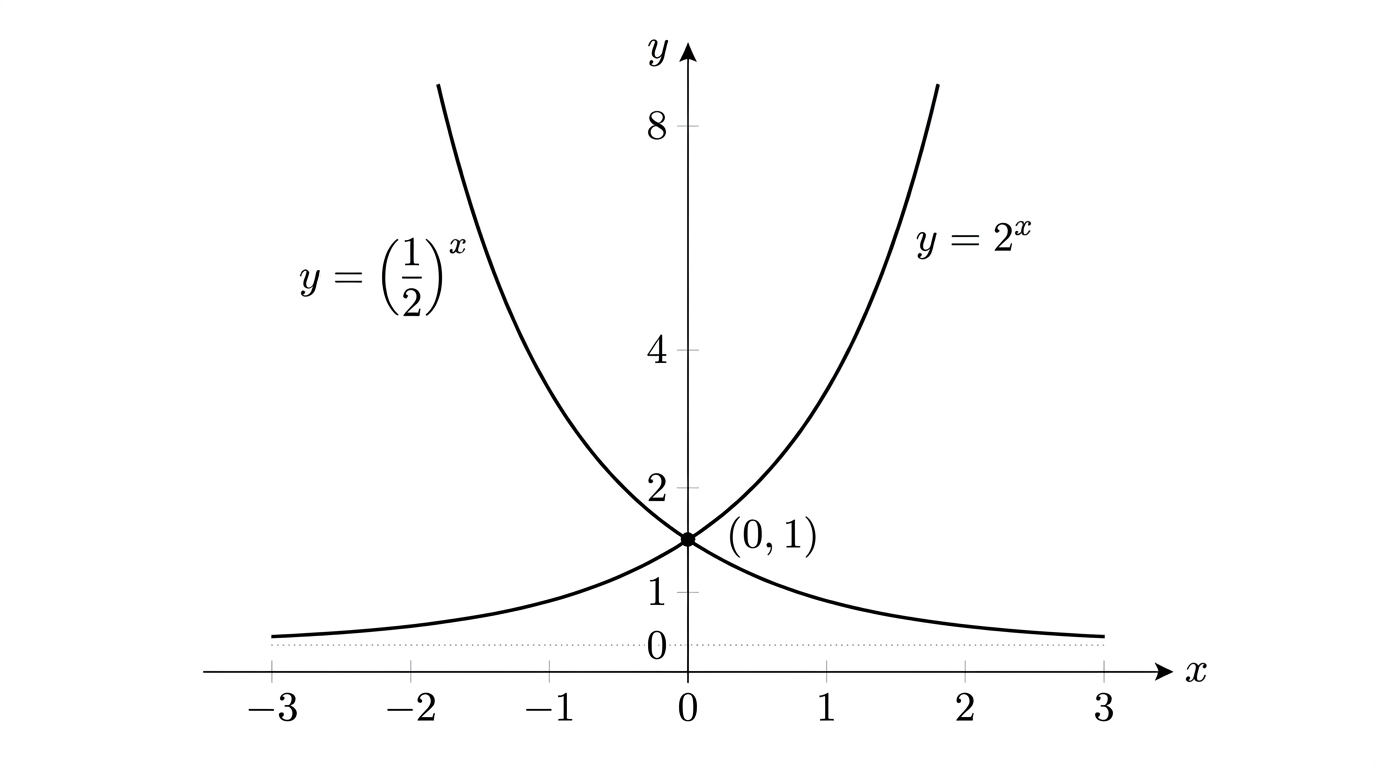
A "decay" exponential is just a "growth" one with a negative exponent, or equivalently a base below $1$. Recognising $a^{-x} = \left(\tfrac1a\right)^x$ means you never have to treat decay as a separate case — it's growth viewed in a mirror. This same reflection trick reappears when you model decay processes in the growth-and-decay lesson.
$a^x$ is not the same as $a \times x$, and it is not $x^a$. The exponential $3^x$ at $x=4$ is $3^4 = 81$, not $3\times4=12$ and not $4^3=64$. Keep the variable in the exponent. Also, $e$ is a specific number ($\approx 2.718$), not a variable — treat $e^x$ exactly as you would $2^x$ or $10^x$, just with that particular base.
Check yourself
The curve $y = 5 e^{x}$ is drawn. Write down its $y$-intercept and the equation of its asymptote. Then find the exact value of $x$ for which $y = 15$.
(Hint: put $x=0$ for the intercept; for the last part solve $5e^x = 15$ using $\ln$.)
The factor of $5$ stretches the curve vertically so it passes through $(0,5)$, but it doesn't move the asymptote — only an added constant would do that.