Pure · Trigonometric Identities and Equations · Year 1
Trigonometric Equations
A trig equation has infinitely many solutions — the calculator gives one, and sketching the graph finds the rest. The real skill is catching every solution inside the range you're given.
10 min read4 worked examples
Solving $\sin\theta = 0.5$ isn't like solving $2x = 6$. A linear equation has one answer; a trig equation has infinitely many, because the graph oscillates — it hits any given height over and over as $\theta$ increases. So the real question is never just "what's the angle?" but "which angles, within the range I've been given?"
Your calculator only ever hands you one solution (the "principal value"). The skill is sketching the graph and reading off its symmetry to find all the others in the required interval. Miss one and you lose marks, so the method is systematic.
Why one calculator answer is never the whole story
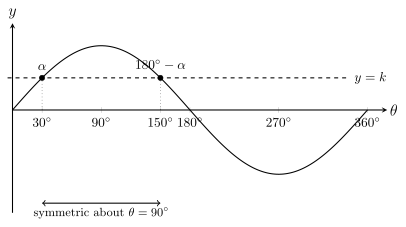
When you press $\sin^{-1}(0.5)$ and get $30°$, the calculator has quietly chosen one of infinitely many valid angles. Picture the horizontal line $y = 0.5$ cutting across the sine wave: it crosses the curve again and again. Every crossing inside your interval is a solution. The calculator gives you a foothold — one crossing — and the graph's own symmetry generates the rest. Understanding this is the difference between finding one answer and finding all of them.
The reliable method
1. Get the equation to the form $\sin\theta = k$ (or $\cos$, or $\tan$). 2. Sketch the graph of that ratio across the given range (widened if the argument is transformed, e.g. $2\theta$), and draw the horizontal line $y = k$ across it. 3. Take the inverse to find one solution — the first point where the line crosses the curve — and mark it on your sketch. 4. Read the sketch's own symmetry to find the curve's other crossing(s) within one period, then repeat every full period ($360°$ for sin/cos, $180°$ for tan) to catch every crossing inside the given range.
Sketch the curve and the line y = k together: the first crossing α comes from the calculator, and the curve's symmetry about its peak at 90° gives the second crossing, 180° − α, for free.
Strategy — write the range down first
Before solving, write the interval (e.g. $0° \le \theta \le 360°$) at the top of your working and keep checking every candidate against it. Most lost marks in this topic aren't wrong angles — they're missed ones, or extra ones outside the range. The interval is the checklist.
Worked example 1
A sine equation · find all solutions in a range
Solve $\sin\theta = 0.5$ for $0° \le \theta \le 360°$.
MethodSketch the curve and line, then read off the symmetry
1
Sketch $y=\sin\theta$ for $0° \le \theta \le 360°$ together with the horizontal line $y=0.5$.
See the whole picture before computing anything.
2
Principal value: $\theta = \sin^{-1}(0.5) = 30°$ — this is the line's first crossing with the curve. Mark it on the sketch.
The calculator's first solution.
3
The sine curve is symmetric about its peak at $\theta=90°$, so the second crossing is the mirror image of $30°$ in that line: $180°-30°=150°$.
Read the mirror point straight off the sketch.
4
Both $30°$ and $150°$ lie in $[0°,360°]$, and the sketch shows the curve dips below $y=0.5$ for the rest of the range — so there are no more crossings.
The picture confirms the count.
5
Solutions: $\theta = 30°$ and $\theta = 150°$.
Both crossings of $y=0.5$ in one cycle.
▪ solved
Examiner's eye
Two solutions is exactly what the sketch predicts: the horizontal line clearly crosses the sine hump twice between $0°$ and $180°$, and the curve stays negative for the rest of the range, so there's nothing more to find. Sketching first tells you how many solutions to expect before you compute a single one.
Worked example 2
A cosine equation with a negative value
Solve $\cos\theta = -0.4$ for $0° \le \theta \le 360°$, giving answers to 1 d.p.
MethodSketch the curve, find one crossing, then mirror it
1
Sketch $y=\cos\theta$ for $0° \le \theta \le 360°$ together with the horizontal line $y=-0.4$.
The negative value sits below the axis on the sketch.
2
Principal value: $\theta = \cos^{-1}(-0.4) = 113.6°$ — the calculator handles the negative directly. Mark this crossing on the sketch.
The line's first crossing with the curve.
3
The cosine curve is symmetric about $\theta=180°$ (its minimum), so reflecting the first crossing in that line gives the second: $360° - 113.6° = 246.4°$.
Read the mirror point straight off the sketch.
4
Both $113.6°$ and $246.4°$ lie in $[0°, 360°]$, and the sketch shows no further crossings in range.
Check against the range.
5
Solutions: $\theta = 113.6°$ and $\theta = 246.4°$ (1 d.p.).
Two solutions, symmetric about 180°.
▪ solved
The key insight
A negative value just means the horizontal line sits below the axis — the sketch handles it exactly the same way as a positive one. Both crossings sit symmetrically either side of the curve's minimum at $\theta=180°$. You don't need a separate method for negative values: find one crossing, mirror it in the sketch, and check the range.
Here the variable is $2\theta$, not $\theta$. The safe method: solve for $2\theta$ first over a doubled range, then divide every solution by 2 at the end.
MethodWiden the range, sketch, then divide
1
Let $u = 2\theta$. As $\theta$ runs $0°$ to $360°$, $u$ runs $0°$ to $720°$ — so sketch $y=\sin u$ over this wider interval, with the line $y=\tfrac{\sqrt3}{2}$ across it.
Double the range with the argument.
2
Principal value: $u = \sin^{-1}\!\left(\tfrac{\sqrt3}{2}\right) = 60°$ — the first crossing. The curve's symmetry about its peak at $u=90°$ gives the mirror crossing in the same hump: $u=180°-60°=120°$.
Two crossings in the first cycle.
3
The sketch repeats every $360°$, so a full cycle later gives two more crossings inside the widened range: $60°+360° = 420°$ and $120°+360° = 480°$.
Reading a second hump off the extended sketch.
4
So $u = 60°, 120°, 420°, 480°$. Divide each by 2: $\theta = 30°, 60°, 210°, 240°$.
Undo the substitution.
5
All four lie in $[0°,360°]$ — the solutions are $\theta = 30°, 60°, 210°, 240°$.
Four solutions, as the doubled range predicted.
▪ solved
Look deeper — why the range must double
Because $2\theta$ moves twice as fast as $\theta$, it sweeps through two full cycles while $\theta$ does one — so a $\sin 2\theta$ equation has roughly twice as many solutions. If you solved only over $0°$–$360°$ for $u$ and then divided, you'd find just two of the four answers. Widening the range to match the argument before solving is what guarantees you catch them all. The rule generalises: for $\sin(n\theta)$, multiply the range by $n$.
Common mistake
With a multiple angle like $\sin 2\theta = k$, never take $\sin^{-1}$ and immediately divide the range down — solve fully for $2\theta$ over the widened interval first, then divide each solution by 2. Dividing too early throws away half the answers, and those missing solutions are guaranteed marks lost.
Worked example 4
A quadratic in sinθ · treat the ratio as the unknown
This isn't a new type of trig equation — it's a quadratic equation wearing $\sin\theta$ as its variable. Substituting $s = \sin\theta$ turns it into ordinary algebra, and the trig only comes back at the very end.
MethodSubstitute, factorise, then solve each resulting trig equation
1
Let $s = \sin\theta$. The equation becomes $2s^2 + s - 1 = 0$.
A genuine quadratic in s.
2
Factorise: $2s^2+s-1 = (2s-1)(s+1) = 0$.
Standard quadratic factorising.
3
So $s = \tfrac12$ or $s = -1$, i.e. $\sin\theta = \tfrac12$ or $\sin\theta = -1$.
Undo the substitution — two separate trig equations to solve.
4
For $\sin\theta=\tfrac12$: sketching $y=\sin\theta$ with the line $y=\tfrac12$ gives the principal crossing $30°$, and its mirror about the peak at $\theta=90°$: $180°-30°=150°$.
The usual sketch-and-mirror approach.
5
For $\sin\theta=-1$: this is the single minimum point of the graph, giving exactly one solution, $\theta=270°$.
±1 are the extreme values of sine — only one crossing, not two.
6
All lie in $[0°,360°]$: $\theta = 30°, 150°, 270°$.
Three solutions in total.
▪ solved
The key insight
A quadratic in $\sin\theta$ (or $\cos\theta$, or $\tan\theta$) usually produces two separate equations to solve, each with its own set of solutions — don't stop after solving just one factor. And watch for values like $\pm1$: because they sit exactly at a peak or trough of the graph, they give only one solution per cycle instead of the usual two.
Check yourself
Solve $\tan\theta = 1$ for $0° \le \theta \le 360°$. (Hint: sketch $y=\tan\theta$, find the first crossing, then remember tan repeats every $180°$, not $360°$.)
Method
1
Principal value: $\theta = \tan^{-1}(1) = 45°$ — the line $y=1$'s first crossing with $y=\tan\theta$.
2
The sketch repeats every $180°$, so the next crossing is $45° + 180° = 225°$.
The 180° period of tan, read off the sketch.
3
Adding another $180°$ gives $405°$, outside the range. So stop.
Check against $[0°,360°]$.
4
Solutions: $\theta = 45°$ and $\theta = 225°$.
Two solutions, 180° apart.
▪ solved
Tangent's shorter $180°$ period is the whole point here: unlike sin and cos, its second solution comes from repeating the sketch every $180°$, not from mirroring within the same cycle.