Increasing & Decreasing Functions
The sign of the derivative doesn't just find turning points — it describes whole stretches of a curve as rising or falling, and turns "show this function is always increasing" into an algebra problem.
What increasing and decreasing mean
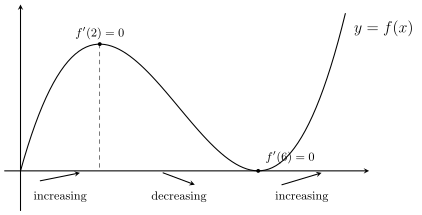
A function is increasing on an interval if its curve rises as you move left to right across it; it's decreasing if the curve falls. Because the derivative measures gradient, this is entirely a question about the sign of $f'(x)$:
Stationary points — where $f'(x)=0$ — are exactly the boundaries where the behaviour can switch from one to the other.
Testing the sign without checking every point
You never need to test every value of $x$. Once you know where $f'(x)=0$ (or, for a curve with a restricted domain, where it's undefined), those points split the number line into a handful of intervals. On each interval, $f'(x)$ keeps a single sign throughout — so testing one convenient value from each interval tells you the sign for the whole interval.
(1) Differentiate to find $f'(x)$. (2) Solve $f'(x)=0$ to find the critical x-values. (3) These split the domain into intervals — pick one test value inside each. (4) Substitute each test value into $f'(x)$ and record the sign. (5) State the intervals of increase ($f'>0$) and decrease ($f'<0$).
Proving a function is always increasing
A different flavour of question asks you to prove a function is increasing (or decreasing) for every value of $x$ — not just on some interval. If $f'(x)$ is a quadratic, this becomes a discriminant argument you've already met.
If $f'(x)$ is a quadratic with a positive leading coefficient and a negative discriminant ($b^2-4ac<0$), it has no real roots — so its graph never touches the x-axis and stays entirely above it. That means $f'(x)>0$ for every real $x$, so $f$ is increasing everywhere, with no exceptions to check. The same idea with a negative leading coefficient proves "always decreasing."
Worked example 1
The critical values $x=-1$ and $x=2$ are the same points that would be classified as stationary points in an optimisation question — here they're simply used as the boundaries of a sign chart. A quick sketch of the upward parabola $f'(x)=6x^2-6x-12$ (roots at $-1$ and $2$, positive outside, negative between) confirms the pattern without needing three separate substitutions.
Worked example 2
No test values were needed anywhere in this proof — the discriminant argument settles every $x$ at once. This only works because $f'(x)$ is a quadratic; for higher-degree derivatives you'd need a different argument (such as completing the square, or writing $f'(x)$ as a sum of squares plus a positive constant).
Worked example 3
This question nests two layers of the same idea: first, "always increasing" translates into a discriminant condition on $f'(x)$ (an inequality involving $k$); second, that condition is itself a quadratic inequality in $k$, solved with a sign diagram exactly like a normal "solve $x^2-3x\le 0$" question. Spotting that $k$ plays the role $x$ usually plays is the only new skill here.
Don't confuse a stationary point with a point where the function is decreasing — $f'(x)=0$ at a single point says nothing about behaviour either side of it on its own; you still need the sign either side (or, for a "prove always increasing" question, you need the discriminant to be negative, not just non-positive, unless the question allows the boundary case). Also watch strict versus non-strict inequalities: "increasing for all $x$" usually allows $f'(x)=0$ at isolated points, so the discriminant condition is $\le 0$, not $<0$.
Check yourself
Find the set of values of $x$ for which $f(x) = x^3 - 6x^2 + 9x + 1$ is a decreasing function.
(Hint: differentiate, solve $f'(x)=0$ to split the domain, then test the sign of f′ in each interval.)
The critical values $x=1,3$ split the line into three pieces; only the middle one has $f'<0$. This is the same sign-test method as Worked Example 1.