Tangents & Normals
A gradient plus a point makes a line. Differentiate for the gradient, take the negative reciprocal for the perpendicular, and the tangent and normal equations follow.
From gradient to line equation
The derivative gives the gradient of a curve at any point — and a gradient plus a point is exactly what you need to write down a straight line. That's the whole of this lesson: two of the most common exam tasks, finding the tangent and the normal to a curve at a given point, are just the straight-line lesson powered by a derivative.
The tangent at a point is the line that touches the curve there, matching its gradient. The normal is the line perpendicular to the tangent at that same point. Both pass through the point of contact; they differ only in gradient.
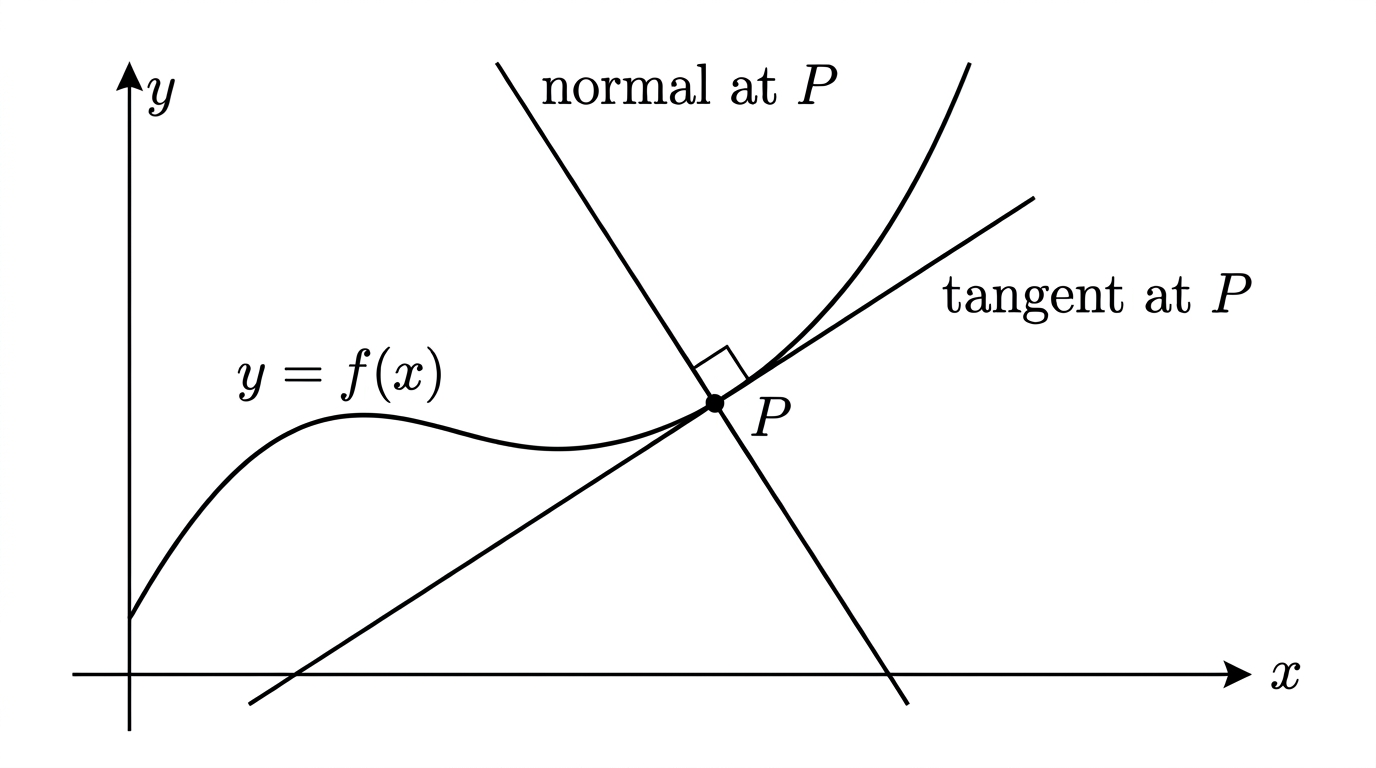
The tangent's gradient is the curve's gradient at that point: $m = f'(x)$, found by differentiating and substituting. The normal is perpendicular to the tangent, and — straight from the coordinate-geometry lesson — perpendicular gradients multiply to $-1$. So the normal's gradient is the negative reciprocal, $-\dfrac{1}{m}$. Everything reduces to one derivative evaluation plus the perpendicular rule you already know.
The method
(1) Differentiate to get $f'(x)$. (2) Substitute the $x$-coordinate of the point to get the tangent gradient $m$. (3) If you want the normal, take the negative reciprocal $-\tfrac1m$. (4) Use point–gradient form $y - y_1 = m(x - x_1)$ with the point of contact. The only extra care: make sure you have the point's $y$-coordinate — if only $x$ is given, substitute into the original curve (not the derivative) to find it.
Worked example 1
Step 3 is the one students skip: the point of contact needs both coordinates, and you get the $y$ by substituting into the curve, not the derivative (the derivative gives gradients, not heights). With the full point $(3,4)$ and gradient $3$, point–gradient form finishes it in one line.
Worked example 2
The point $(2,4)$ was given in full, so no $y$-substitution was needed — but it's worth checking it lies on the curve: $2^3 - 2(2) = 8 - 4 = 4$ ✓. The one distinctively "normal" step is taking the negative reciprocal of the tangent gradient: $10 \to -\tfrac{1}{10}$. Everything else is identical to finding a tangent.
Worked example 3
The only wrinkle here was the reciprocal: $\dfrac{4}{x}$ had to become $4x^{-1}$ before the power rule applied, giving $-4x^{-2}$. After that it's the standard recipe. When a question demands the form $ax+by+c=0$, do the point–gradient step first, then tidy — collecting everything on one side with whole-number coefficients as the final move.
Don't use the normal's gradient when the question asks for the tangent, or vice versa — read carefully which line is wanted. And when only the $x$-coordinate is given, find $y$ from the original curve, never from the derivative. A frequent slip is substituting $x$ into $f'(x)$ and treating the result as the $y$-coordinate; that number is the gradient, not a height on the curve.
Check yourself
Find the equation of the normal to the curve $y = x^2 + 1$ at the point where $x = 1$, giving your answer in the form $y = mx + c$.
(Hint: differentiate, find the tangent gradient at $x=1$, take the negative reciprocal, then use the point.)
The tangent gradient $2$ flips to a normal gradient of $-\tfrac12$; the point $(1,2)$ comes from the curve. Point–gradient form then gives $y = -\tfrac12 x + \tfrac52$.