Tangent & Chord Properties
Two right angles hidden inside every circle — tangent ⟂ radius, and the perpendicular from the centre bisecting any chord — turn curved problems into the straight-line algebra you already know.
Every point on a circle sits the same distance from the centre — that single symmetry forces two right angles to exist, wherever a tangent or a chord appears. Spot either one, and a right angle is waiting to be used.
Property 1 — a tangent is perpendicular to the radius
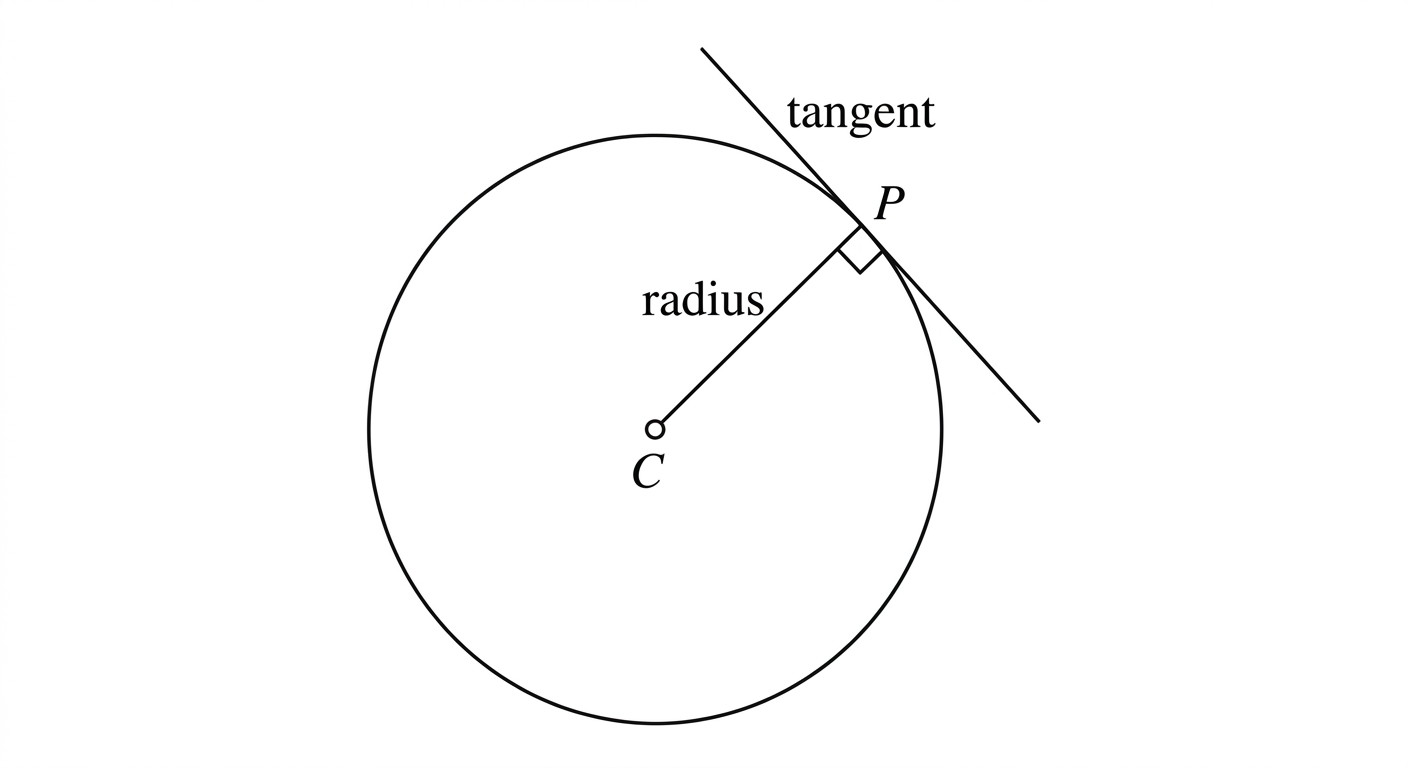
A tangent touches the circle at exactly one point. At that point of contact, the tangent is always perpendicular to the radius. Why must this be? The radius is the shortest distance from the centre to the tangent line, and the shortest line from a point to a line is always the perpendicular one. Any other line from the centre to the tangent would have to cut through the circle, hitting it twice — so it wouldn't be a tangent.
"Tangent ⟂ radius" converts a circle problem into a straight-line problem. If you know the point of contact and the centre, you know the radius's gradient, so the tangent's gradient is its negative reciprocal. The circle's curved geometry collapses into gradients and perpendicular lines you already handle with ease.
Property 2 — the perpendicular from the centre bisects a chord
A chord is any segment joining two points on the circle. Drop a perpendicular from the centre to a chord, and it always lands exactly at the chord's midpoint — splitting the chord into two equal halves. This creates a right-angled triangle linking three quantities: the radius $r$, the perpendicular distance $d$ from centre to chord, and the half-chord length.
Since the radius to either end of the chord is the hypotenuse of a right-angled triangle with legs $d$ (centre to chord) and half the chord's length: $$\left(\frac{\text{chord}}{2}\right)^2 + d^2 = r^2$$ Given any two of $r$, $d$, and the chord length, this finds the third — no coordinates or line equations required.
Worked example 1
The whole solve is the straight-line lesson wearing a circle costume: find one gradient, take the negative reciprocal, use point–gradient form. The only "circle" step is knowing the tangent is perpendicular to the radius — everything after is pure straight-line work.
Worked example 2
Recognising $5$–$12$–$13$ as a Pythagorean triple makes this instant, but the method works identically with any numbers — it's Pythagoras on a triangle you can always draw: the perpendicular, the half-chord, and the radius to one end.
Worked example 3
This could be solved by substituting the line into the circle and finding both intersection points — but knowing the radius and the perpendicular distance from the centre to the line is faster.
This geometric route sidesteps solving a quadratic entirely — one distance calculation and one application of Pythagoras replaces substituting the line into the circle and finding two exact intersection points. Reach for it whenever you only need the chord's length, not the coordinates of where it meets the circle.
When using "tangent ⟂ radius", it's easy to take the negative reciprocal of the tangent's gradient by mistake, or to measure the radius from the origin rather than the centre. Always compute the radius gradient from centre to contact point first, then flip-and-negate for the tangent. And in the chord triangle, remember $d$ and the radius are the two legs feeding into $r^2$ — it's $r$ that's the hypotenuse, not the chord itself.
Check yourself
A circle has radius $25$. A chord has length $48$. Find the perpendicular distance from the centre to the chord.
(Hint: halve the chord first, then use the chord–distance–radius triangle.)
A $7$–$24$–$25$ Pythagorean triple — the same right-angled triangle idea as every chord-length question in this lesson, just solved for a different unknown.