Intersections of Lines & Circles
Substitute a line into a circle's equation and a quadratic falls out — and its discriminant tells you, before you even solve it, whether the line cuts through, glances off, or misses the circle entirely.
A point where a line meets a circle has to satisfy both equations at once. So the method is always the same: rearrange the line to isolate one variable, substitute it into the circle's equation, and simplify. What's left is a quadratic in a single variable — and everything you know about quadratics, especially the discriminant, now tells you about the geometry.
A quadratic has two roots, one repeated root, or no real roots depending on the sign of $\Delta = b^2-4ac$ — and each case is a different geometric picture. $\Delta>0$: two distinct roots, so the line cuts the circle at two points (a secant). $\Delta=0$: a repeated root, so the line touches the circle at exactly one point — it's a tangent. $\Delta<0$: no real roots, so the line misses the circle completely.
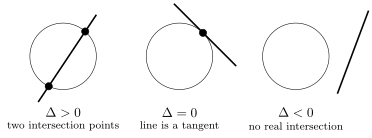
Rearrange the line so that whichever variable has a coefficient of $1$ is on its own — that's the one to substitute. A line given as $y=mx+c$ is already ready to substitute for $y$. A line like $3x+4y=48$ is easier to rearrange for $x$ or $y$ depending on which has the tidier coefficient; either works, since the algebra just runs through the other variable instead.
Worked example 1
Always substitute back to find both coordinates — finding $x$ alone and stopping is the single most common lost mark in this topic. A quick check: $(-4)^2+(-3)^2=16+9=25$ ✓ and $3^2+4^2=9+16=25$ ✓, confirming both points genuinely sit on the circle.
Worked example 2
This is purely algebraic — no gradients, no "tangent ⟂ radius" reasoning needed. A repeated root is the definition of tangency here: the line meets the circle at one point counted twice. It's worth checking this matches the geometric approach — the radius to $(3,4)$ has gradient $\tfrac43$, and the tangent's gradient from $3x+4y=25$ is $-\tfrac34$, and indeed $\tfrac43 \times -\tfrac34 = -1$ ✓.
Worked example 3
Now the line has an unknown constant $c$ built in — the condition "tangent" translates directly into "discriminant equals zero", which becomes an equation in $c$ to solve.
Both $c=10$ and $c=-10$ give genuine tangents — a line of a fixed gradient touching a circle almost always has two tangent positions, one on each side. Picture a family of parallel lines $y=2x+c$ sweeping across the plane: most miss the circle, exactly two graze it (one on each side), and the rest cut straight through. A "find $c$" tangency question should usually make you expect a pair of values, not one.
Expanding $(2x+c-2)^2$ incorrectly is the most frequent slip — treat $(c-2)$ as a single bracket and use $(A+B)^2=A^2+2AB+B^2$ with $A=2x$, $B=(c-2)$, rather than trying to expand everything in one pass. It's also easy to forget that "tangent" always means $\Delta=0$, not $\Delta>0$ or $\Delta<0$ — write down which case you need before starting the algebra.
Check yourself
Find the coordinates of the points where the line $y = x - 1$ meets the circle $x^2+y^2=13$.
(Hint: substitute, form a quadratic in x, then don't forget to recover y for each solution.)
Check: $3^2+2^2=9+4=13$ ✓ and $(-2)^2+(-3)^2=4+9=13$ ✓ — both points genuinely lie on the circle.