Circles & Triangles
Every triangle has a circle running through all three of its vertices, and a diameter always sees the rest of the circle at a right angle. Together, these two facts turn triangle problems into circle problems, and back again.
The angle in a semicircle is 90°
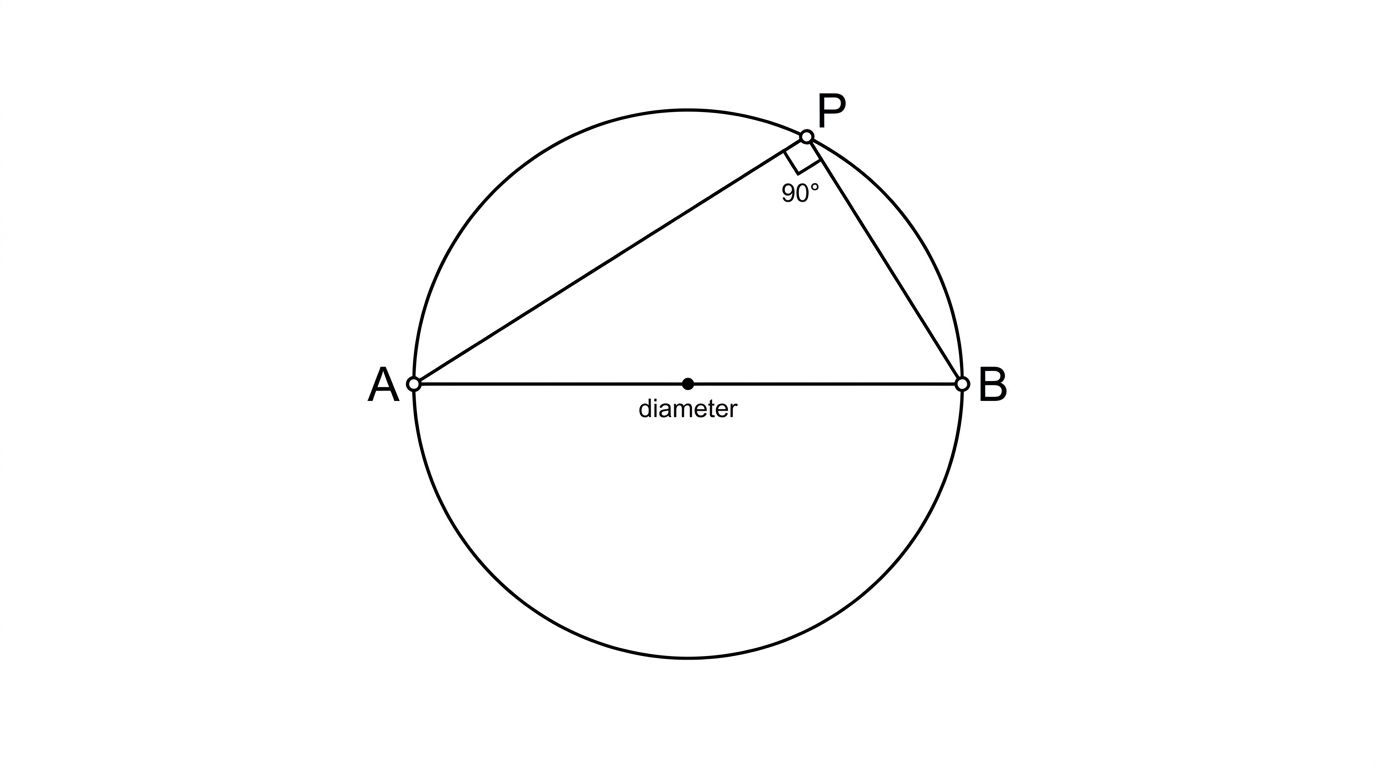
If $AB$ is a diameter and $P$ is any other point on the circle, then the angle $\angle APB$ is always a right angle — no matter where $P$ sits. This means: if three points lie on a circle and one pair is a diameter, the triangle they form is right-angled at the third point.
This property runs both ways. If $\angle APB = 90°$, then $AB$ must be a diameter of the circle through $A$, $P$ and $B$ — there's no other possibility. That converse is what makes right-angled triangles special: spotting a $90°$ angle at one vertex instantly tells you the opposite side is a diameter, which fixes the circumcircle's centre and radius in one move (see worked example 3).
Every triangle has a circumcircle
Three points that aren't in a straight line always lie on exactly one circle — its circumcircle, with centre the circumcentre. Since the circumcentre is equidistant from all three vertices, it's equidistant from each pair — so it lies on the perpendicular bisector of every side. Two bisectors are enough to pin it down exactly, using the method from the previous lesson.
Worked example 1
Two lines are perpendicular exactly when their gradients multiply to $-1$ — so the semicircle property can be checked directly with the gradients of $PA$ and $PB$.
This works for any point on the circle — try a different point on the same circle (say, the reflection of $P$ through the centre $(4,3)$) and the gradient product will still come out to $-1$. The right angle at $P$ isn't a special property of this particular point; it's forced by $AB$ being a diameter.
Worked example 2
Only two perpendicular bisectors are needed, since two non-parallel lines meet at exactly one point. The bisector of the third side — $BC$ here — would pass through that same point too, so it's a useful check but not extra working. Testing the radius against a second vertex (e.g. $B$: $\sqrt{(3-5)^2+(3.5-2)^2}=\sqrt{4+2.25}=2.5$ ✓) confirms the answer.
Worked example 3
If a triangle is right-angled, there's no need for two perpendicular bisectors at all — the converse of the semicircle property says the hypotenuse itself must be a diameter, and a diameter's midpoint and length hand you the centre and radius directly.
Worked example 2 needed two perpendicular bisectors because that triangle wasn't right-angled. Here, spotting the right angle at $C$ replaces all of that with one midpoint and one length calculation — always check whether a triangle is right-angled before reaching for the general two-bisector method; it can save most of the working.
The right angle in the semicircle property sits at the vertex not on the diameter — don't confuse which side is the diameter. If $\angle APB=90°$, it's $AB$ (the side opposite $P$) that's the diameter, not a side touching $P$. When using the shortcut in worked example 3, always identify the right angle first, then take the side opposite it as the diameter.
Check yourself
$A(0, 3)$ and $B(8, 3)$ are the endpoints of a diameter of a circle, and $P(4, 7)$ also lies on the circle. Verify that $\angle APB = 90°$, and state the radius of the circle.
(Hint: test the gradients of PA and PB, then use half the length of AB for the radius.)
The right angle at $P$ confirms $AB$ really is a diameter, and the radius follows immediately as half its length — no need to even find the centre for this question.