Parallel & Perpendicular Lines
Because a line's gradient is its direction, whether two lines are parallel or meet at a right angle becomes a question purely about two numbers: $m_1$ and $m_2$.
Every straight line has a gradient, and gradient is nothing but a direction dressed up as a number. So two natural questions about how a pair of lines sit relative to each other — are they parallel? are they at right angles? — turn out to have answers written entirely in terms of their gradients $m_1$ and $m_2$. No new geometry is needed, just two rules.
Parallel lines have equal gradients. Parallel means "same direction, never meeting", and gradient is direction — so two lines are parallel exactly when $m_1 = m_2$. They differ only in their intercept $c$: same slope, shifted up or down. For instance, $y = 3x + 1$ and $y = 3x - 4$ are parallel, since both climb $3$ units for every $1$ across.
Perpendicular lines have gradients whose product is −1. If two lines meet at a right angle, then $m_1 \times m_2 = -1$ — equivalently, each gradient is the negative reciprocal of the other, $m_2 = -\dfrac{1}{m_1}$. So a line of gradient $2$ is perpendicular to one of gradient $-\tfrac12$, and a line of gradient $-\tfrac34$ is perpendicular to one of gradient $\tfrac43$.
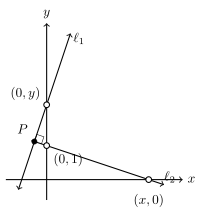
Turning a line through $90°$ swaps its rise and its run, and flips one of their signs. A gradient of $\dfrac{\text{rise}}{\text{run}}$ therefore becomes $-\dfrac{\text{run}}{\text{rise}}$ — precisely the negative reciprocal. Multiply the two together and the rise and run cancel: $\dfrac{\text{rise}}{\text{run}} \times \left(-\dfrac{\text{run}}{\text{rise}}\right) = -1$. That single fact is what lets you turn "these lines are perpendicular" into an equation you can actually use.
Negative reciprocal means do both steps: flip the fraction and change the sign. The perpendicular of $\tfrac34$ is $-\tfrac43$ — not $-\tfrac34$ (sign only), and not $\tfrac43$ (flip only). For a whole-number gradient like $2$, write it as $\tfrac21$ first so the flip is obvious: the perpendicular gradient is $-\tfrac12$. A quick check: if your two gradients don't multiply to exactly $-1$, they aren't perpendicular.
Worked example 1
"Parallel to" is the easiest relationship to use: it hands you the gradient directly, with no flipping or negating required. The intercept of the original line ($-1$) is irrelevant here — only its gradient carries over.
Worked example 2
Two lines are perpendicular exactly when their gradients multiply to $-1$. So the perpendicular gradient is the negative reciprocal: flip the fraction and change the sign.
The perpendicular gradient here is $-\tfrac12$, and a quick check confirms it: $2 \times -\tfrac12 = -1$ ✓. Notice the given equation $y = 2x + 1$ was only needed for its gradient — its intercept $+1$ plays no part, since $\ell_2$ is fixed by its own point $(4,3)$. Reading off just the gradient you need, and ignoring the rest, is what keeps these solutions short.
Worked example 3
A perpendicular bisector cuts a segment exactly in half, at a right angle. So it passes through the midpoint of $PQ$, with the perpendicular gradient to $PQ$. Two ideas, combined.
The perpendicular bisector is the set of all points equidistant from $P$ and $Q$ — which is why it turns up constantly in circle problems (the centre of a circle through two points lies on their perpendicular bisector — see the circle lessons later in this topic). Recognising "midpoint + perpendicular gradient" as a single move saves you every time this reappears.
Don't mix up the two rules: parallel lines have equal gradients ($m_1 = m_2$), while perpendicular lines have gradients multiplying to $-1$ ($m_1 m_2 = -1$). A frequent slip is to give a "perpendicular" line the same gradient, or to negate the gradient without also flipping it. When a question says perpendicular, always take the full negative reciprocal — flip and change sign — and sanity-check that your two gradients multiply to exactly $-1$.
Check yourself
Find the equation of the line through $(-1, 4)$ that is perpendicular to $y = \tfrac{1}{3}x + 2$, giving your answer in the form $ax + by + c = 0$ with integer coefficients.
(Hint: perpendicular gradient first, then point–gradient form, then clear fractions.)
The negative reciprocal of $\tfrac13$ is $-3$ (flip and sign). Moving everything to one side gives the tidy integer form $3x+y-1=0$.