Equation of a Straight Line
A line is fixed by just two things — its steepness and a point it passes through. Master gradient and point–gradient form, and every straight-line question falls open.
What the equation of a line captures
Every straight line is fixed by just two pieces of information: how steep it is and where it sits. The steepness is the gradient $m$; the position is pinned by any single point the line passes through. Get those two, and the line's equation is determined. That's the whole topic in one sentence — everything else is choosing the most convenient way to write it down.
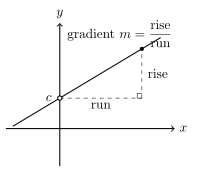
The familiar form $y = mx + c$ makes both facts visible at a glance: $m$ is the gradient, and $c$ is the $y$-intercept (the value of $y$ when $x=0$). But in exam problems you're usually handed a point and a gradient, or two points — and for those, a second form is far quicker.
Gradient between two points: $m = \dfrac{y_2 - y_1}{x_2 - x_1}$ — the change in $y$ over the change in $x$.
Point–gradient form: $y - y_1 = m(x - x_1)$ — use this whenever you know a point and the gradient. It's the fastest route in almost every question.
General form: $ax + by + c = 0$ — the tidy form exams often ask for the final answer in, with integer coefficients.
Two ideas that build directly on gradient — how parallel and perpendicular lines relate, and how to measure length and area from coordinates — each get a lesson of their own next.
Worked example 1
Check with the other point: at $x=6$, $y = 2(6)-3 = 9$ ✓ — matches $B(6,9)$. It's a five-second guarantee your line passes through both. And be consistent labelling $(x_1,y_1)$ and $(x_2,y_2)$ — swapping them mid-calculation flips the sign of the gradient.
Check yourself
Find the equation of the line through $(2, -1)$ and $(-4, 11)$, giving your answer in the form $ax + by + c = 0$ with integer coefficients.
(Hint: gradient first, then point–gradient form, then clear fractions.)
Check with the other point: $2(-4)+11-3 = -8+11-3=0$ ✓ — confirming $(-4,11)$ also lies on the line.