Polynomials & the Factor Theorem
Cubics won't factorise by sight — but the factor theorem turns the hard problem of factorising into the easy one of substituting a number and checking for zero.
A polynomial is a sum of powers of $x$ with number coefficients — things like $x^3 - 2x^2 + 5x - 6$. Quadratics are just the degree-2 case; now we go higher. The central problem is factorising them: breaking a cubic into a product of simpler brackets, exactly as we broke quadratics into two. But cubics don't factorise by inspection, so we need a smarter tool.
That tool is the factor theorem, and it rests on one beautifully simple observation. If $(x-a)$ is a factor of a polynomial $f(x)$, then substituting $x=a$ must give zero — because that factor becomes $(a-a)=0$, and zero times anything is zero. Run that logic backwards and you get a factor-detector.
If $f(x) = (x-a)\times(\text{something})$, then $f(a) = (a-a)\times(\text{something}) = 0\times(\text{something}) = 0$. So $(x-a)$ is a factor exactly when $f(a)=0$. That's it. To test whether $(x-2)$ divides a polynomial, you don't do any division — you just plug in $x=2$ and see if you get zero. This turns the hard problem of factorising into the easy problem of substituting numbers.
The method for factorising a cubic
1. Find one root by trial. Test small values — $x=1, -1, 2, -2, 3\ldots$ — in $f(x)$ until one gives zero. That value $a$ means $(x-a)$ is a factor. (Only test factors of the constant term; roots hide there.)
2. Divide it out. Divide $f(x)$ by $(x-a)$ using algebraic (long) division, leaving a quadratic.
3. Factorise the quadratic by the usual methods. Now you have all three factors.
The integer roots of a polynomial are always factors of the constant term. For $x^3-2x^2-5x+6$, the constant is $6$, so only test $x=\pm1,\pm2,\pm3,\pm6$ — there's no point trying $x=4$. This narrows an infinite search to a short list, and $x=1$ is so often a root that it's always worth trying first.
Worked example 1
State the theorem you're using ("since $f(2)=0$, by the factor theorem $(x-2)$ is a factor") — the conclusion earns a mark, not just the arithmetic. And watch the signs on the substitution: $-5(2)=-10$, not $-5$. Sign slips in the substitution are the number-one error here.
Worked example 2
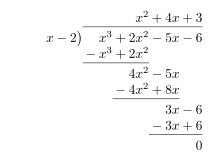
The factor theorem cracks the problem open — it finds the one factor you couldn't spot — and then ordinary quadratic factorising finishes it. This "find one, divide, factorise the rest" pattern is how every cubic in this course is factorised. A cubic has at most three linear factors, so once you have three brackets, you're done.
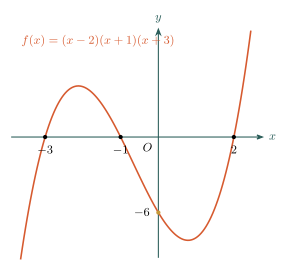
Worked example 3
A known factor is a zero waiting to be used: if $(x+1)$ is a factor, then $f(-1)=0$, and that single equation pins down $a$.
A single unknown needs a single equation, and the factor theorem hands you exactly one: "$f$ at the root equals zero." That's the elegance — a geometric fact (the curve passes through the $x$-axis at $x=-1$) becomes one clean algebraic equation in $a$. This "known factor $\Rightarrow$ known zero $\Rightarrow$ equation" chain solves a whole family of exam questions.
The factor $(x+1)$ corresponds to the root $x=-1$, not $x=+1$ — flip the sign. Setting $f(1)=0$ here would give the wrong equation and the wrong $a$. Always read $(x-a)$ carefully: $(x+1)$ is $(x-(-1))$, so substitute $x=-1$.
Check yourself
Fully factorise $f(x) = x^3 - 3x^2 - x + 3$.
(Hint: try $x=1$ first — the constant term is 3, so test factors of 3.)
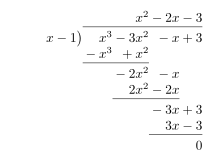
The pattern holds every time: one trial root unlocks the first bracket, algebraic division reduces the cubic to a quadratic, and the quadratic finishes the job.