Solving an inequality algebraically gives a range of x. Drawing it gives a whole region of the plane — and combining several inequalities carves out exactly the area they all agree on.
10 min read4 worked examples
From a line to a region
A linear equation like $y = 2x+1$ draws a single line. The inequality $y \leq 2x+1$ describes every point on or below that line — a whole half of the plane. Turning an inequality into a picture always follows the same two moves: draw the boundary curve (treating the inequality as if it were an equation), then decide which side to shade.
Solid or dashed — and which side
If the inequality is strict ($<$ or $>$), the boundary itself is not included, and is drawn dashed. If it's non-strict ($\leq$ or $\geq$), the boundary is included, and is drawn solid. To find which side satisfies the inequality, test a point not on the line — the origin $(0,0)$ is usually easiest, provided the line doesn't pass through it. If the point satisfies the inequality, shade the side containing it; if not, shade the other side.
Combining several inequalities
A system of two or more inequalities defines a region — usually labelled $R$ — consisting of every point that satisfies all of them simultaneously. Draw each boundary, decide each side, and the region $R$ is wherever the shaded sides overlap.
Strategy — build up one inequality at a time
Don't try to picture every constraint at once. Draw and shade each boundary line separately, then find the overlap. In an exam, it's common to shade the unwanted region for each inequality (leaving the answer region blank and clearly labelled $R$) — always check which convention a question is using before you start.
Regions bounded by curves
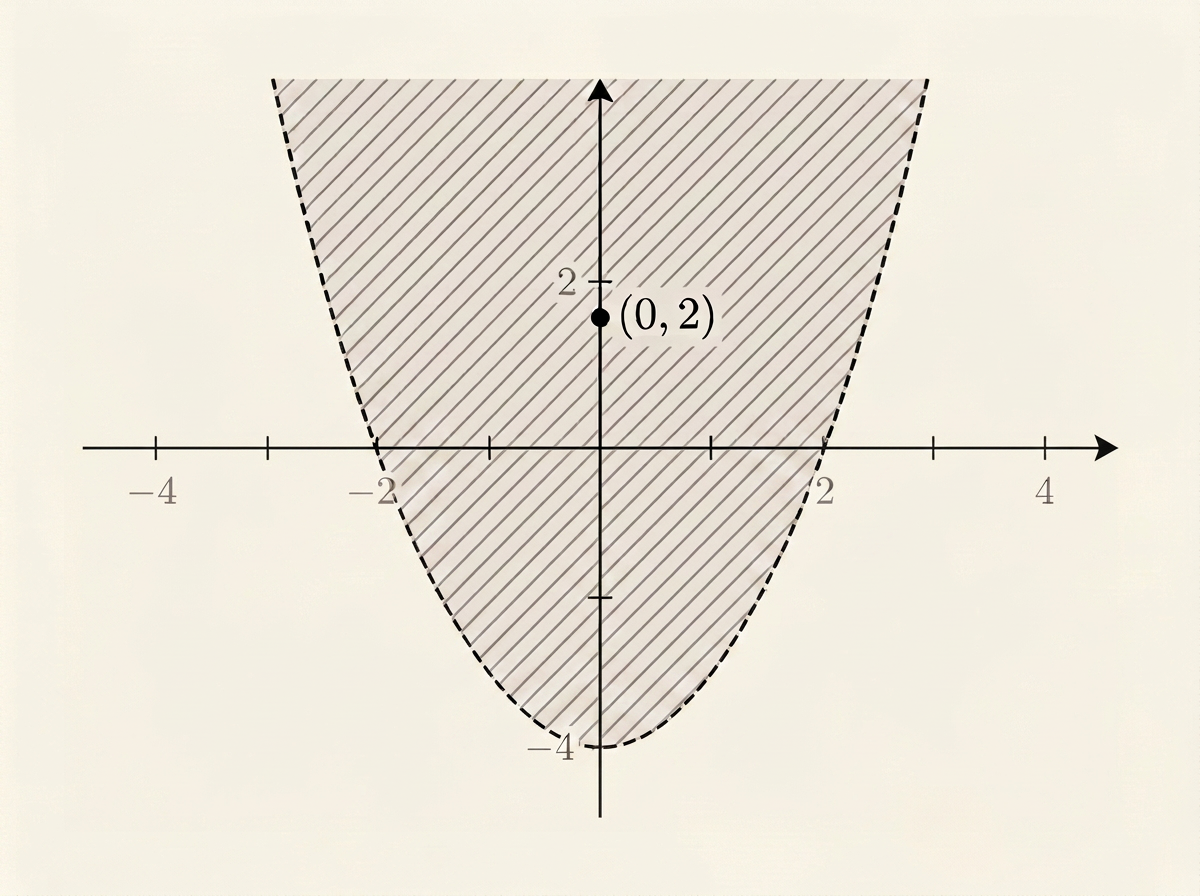
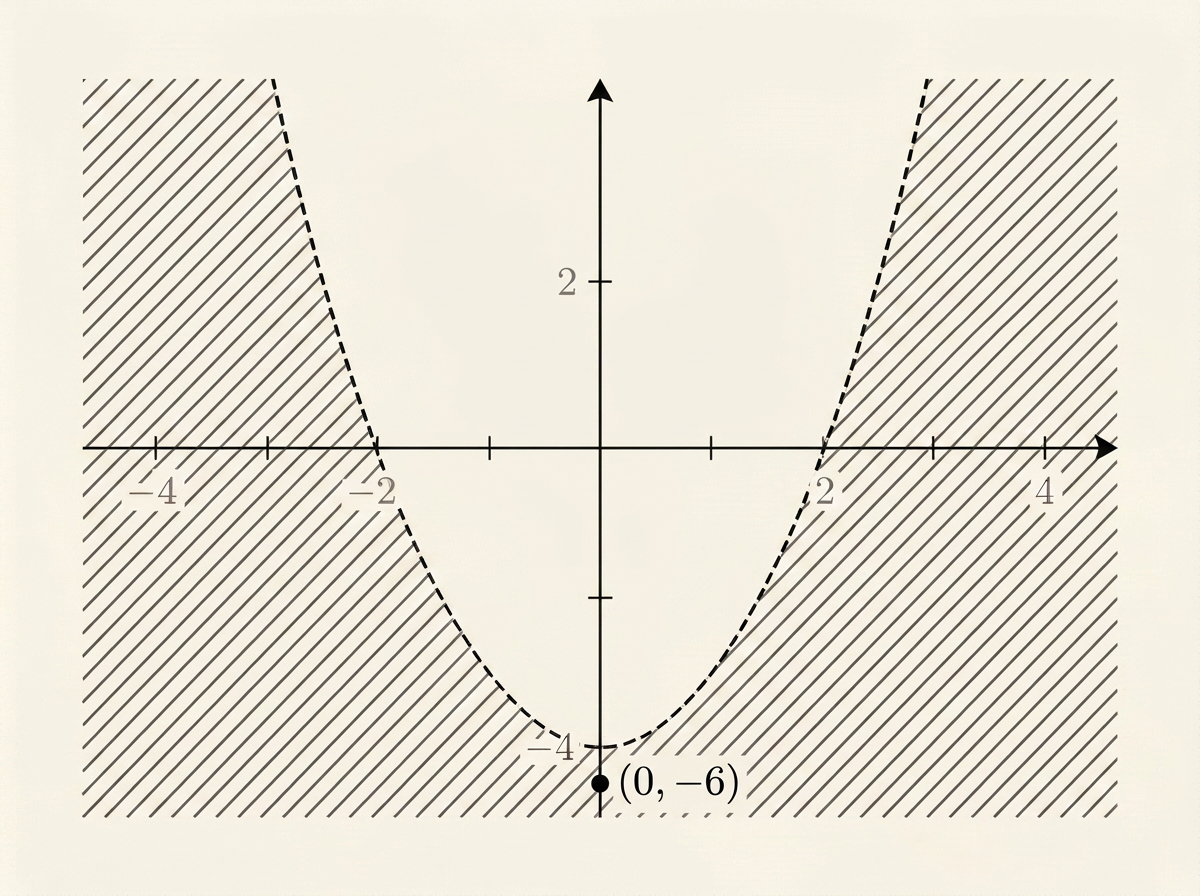
Boundaries aren't always straight lines. An inequality like $y > x^2 - 4$ describes the region above the parabola $y=x^2-4$; $y < x^2-4$ describes below it. The same solid/dashed and test-point rules apply — only the boundary shape changes.
y > x² − 4: dashed boundary, the region between the arms (above the parabola) shaded.y < x² − 4: dashed boundary, the region outside the parabola (below/around it) shaded.
Worked example 1
Shading a single linear inequality
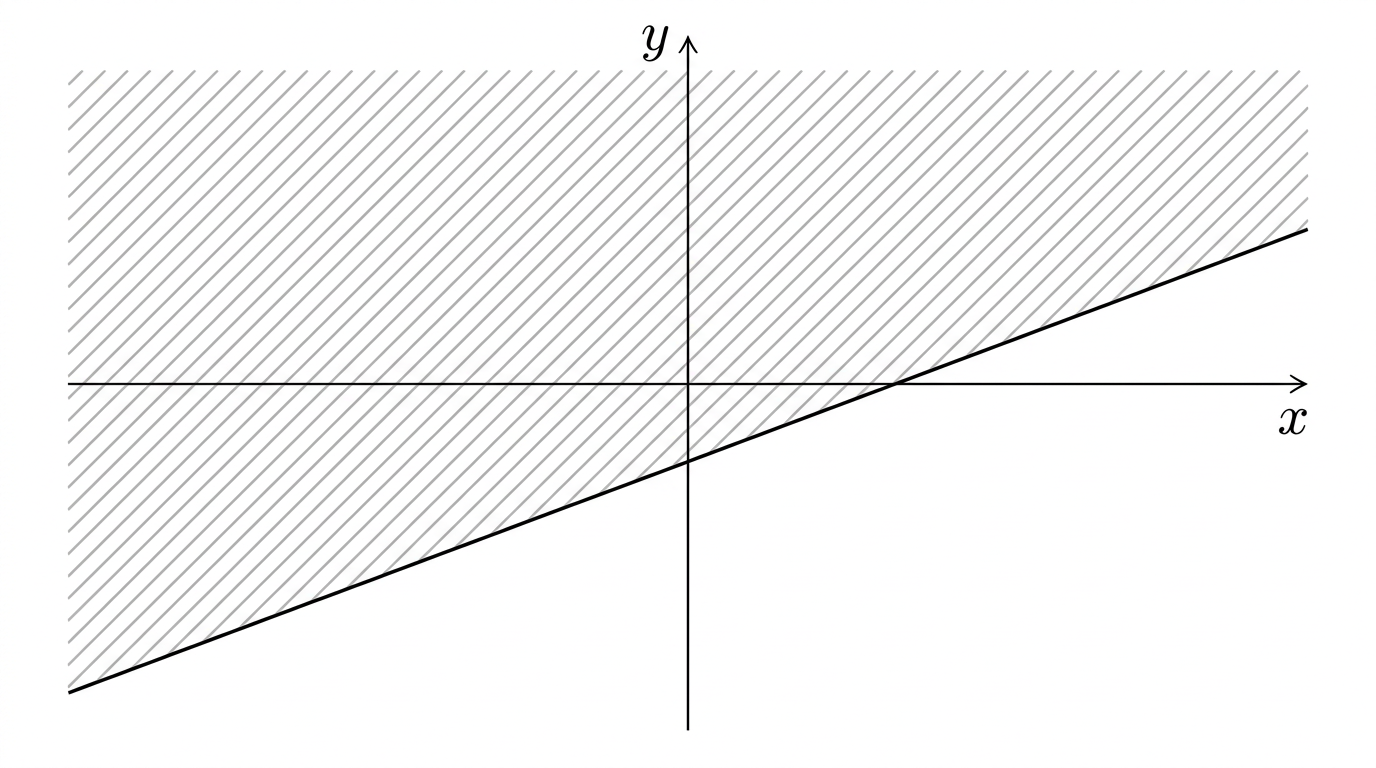
Describe the region satisfying $y \geq 2x - 3$, stating whether the boundary is included.
y ≥ 2x − 3: a solid boundary line, with the region above it shaded.
MethodDraw the boundary, then test a point
1
Boundary line: $y = 2x-3$, a straight line with gradient $2$ and $y$-intercept $-3$.
Treat the inequality as an equation to find the boundary.
2
The inequality is $\geq$ (non-strict), so the boundary is included and drawn solid.
$\geq$ and $\leq$ always give solid boundaries.
3
Test $(0,0)$: is $0 \geq 2(0)-3 = -3$? Yes, $0 \geq -3$ is true.
The origin doesn't lie on the line, so it's a valid test point.
4
So the region is the side of the line containing $(0,0)$ — above the line — including the boundary itself.
Shade the side that made the test true.
▪ described
Examiner's eye
"Above the line" is a shorthand check for $y \geq (\text{expression in }x)$ inequalities: whenever the inequality is written with $y$ isolated on the left, $y >$ or $y \geq$ shades above the boundary, and $y <$ or $y \leq$ shades below it. It's a useful sanity check, but always confirm with a test point if the inequality isn't in that form.
Worked example 2
A region defined by three inequalities
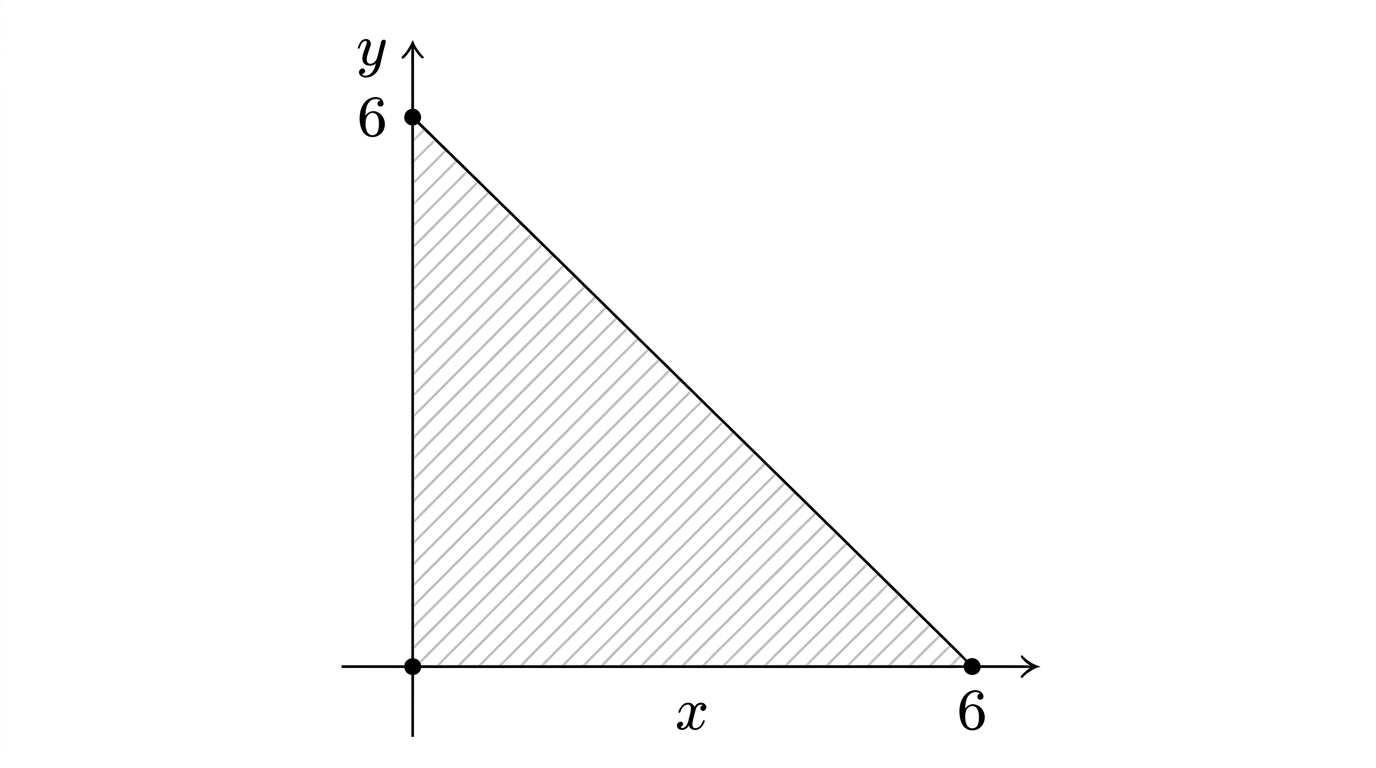
Describe the region $R$ satisfying all three inequalities: $x \geq 0$, $y \geq 0$, and $x + y \leq 6$.
The region R: bounded by the x-axis, the y-axis, and the line x + y = 6.
MethodHandle each boundary in turn, then find the overlap
1
$x \geq 0$: the vertical line $x=0$ (the $y$-axis), solid, shading everything to the right.
Non-strict, so solid; test (1,0) satisfies it.
2
$y \geq 0$: the horizontal line $y=0$ (the $x$-axis), solid, shading everything above.
Same reasoning, the other axis.
3
$x+y \leq 6$: the line through $(6,0)$ and $(0,6)$, solid, shading the side containing $(0,0)$ since $0+0=0\leq6$ is true — the side below-left of the line.
Test point confirms the correct side.
4
$R$ is the triangular region bounded by the $x$-axis, the $y$-axis, and the line $x+y=6$ — all three boundaries included.
The overlap of all three shaded half-planes.
▪ described
The key insight
Three linear inequalities here produce a closed, bounded triangle with vertices $(0,0)$, $(6,0)$ and $(0,6)$ — every point inside or on this triangle satisfies all three conditions at once. Sketching the boundaries first, roughly and quickly, makes the final region obvious without needing to test every point.
Worked example 3
A region between a line and a curve
Find the points of intersection of $y = x^2 - 4$ and $y = 2x - 1$, and describe the finite region satisfying both $y \leq 2x - 1$ and $y \geq x^2 - 4$.
MethodFind where the boundaries cross, then describe the enclosed region
1
Set the boundaries equal: $x^2-4 = 2x-1$.
Intersection points satisfy both equations.
2
Rearrange: $x^2-2x-3=0$, which factorises to $(x-3)(x+1)=0$, so $x=3$ or $x=-1$.
Standard quadratic solving.
3
Corresponding $y$-values from $y=2x-1$: at $x=3$, $y=5$; at $x=-1$, $y=-3$. Intersection points: $(3,5)$ and $(-1,-3)$.
Substitute into the simpler (linear) equation.
4
$y \geq x^2-4$ means above (or on) the parabola; $y \leq 2x-1$ means below (or on) the line — both solid, since both inequalities are non-strict.
Standard above/below reading.
5
The region satisfying both is the finite, lens-shaped area enclosed between the line and the parabola, from $x=-1$ to $x=3$.
Bounded exactly where the line sits above the curve.
▪ described
Common mistake
Don't assume the line is above the curve everywhere just because it is at the intersection points — check a value strictly between them, e.g. $x=1$: line gives $y=1$, curve gives $y=-3$, and indeed $1 > -3$, confirming the line stays above the parabola throughout that interval.
Worked example 4
Reading inequalities from a described region · Challenge
A region $R$ is bounded by the following: the vertical line $x=1$ on its left, the line $y=6-x$ on its upper-right, and the horizontal line $y=1$ underneath. $R$ is the finite triangular region enclosed by these three boundaries, with all boundaries included. Write down the three inequalities that define $R$.
This runs the whole process in reverse — starting from a description of the shape, and recovering the inequalities that would produce it.
MethodFind the triangle's vertices, then test each side
1
Find the vertices: $x=1$ meets $y=1$ at $(1,1)$; $x=1$ meets $y=6-x$ at $(1,5)$; $y=1$ meets $y=6-x$ at $(5,1)$.
Solve each pair of boundary equations.
2
The triangle has vertices $(1,1)$, $(1,5)$, $(5,1)$ — a right-angled triangle. Its interior contains, e.g., the point $(2,2)$.
A convenient test point strictly inside R.
3
"Left" boundary at $x=1$, with the region to its right: since $2 \geq 1$ at the test point, the inequality is $x \geq 1$.
Test point satisfies x ≥ 1.
4
"Underneath" boundary at $y=1$, with the region above: since $2 \geq 1$, the inequality is $y \geq 1$.
Test point satisfies y ≥ 1.
5
"Upper-right" boundary $y=6-x$, with the region below-left: at $(2,2)$, is $2 \leq 6-2=4$? Yes, so the inequality is $y \leq 6-x$, i.e. $x+y \leq 6$.
Test point confirms the correct side.
6
All boundaries are included, so all three inequalities are non-strict: $x \geq 1$, $y \geq 1$, $x+y \leq 6$.
Matches "all boundaries included" from the question.
▪ solved
Look deeper — a single interior test point settles every boundary at once
Rather than reasoning about each side of the triangle in isolation, picking one point known to be inside $R$ and testing it against every boundary equation in one pass is faster and less error-prone — each test simply tells you which direction that boundary's inequality must point.
Common mistake
Forgetting to state whether boundaries are included (solid) or excluded (dashed) loses marks even when the shading itself is correct — always match strict inequalities ($<,>$) to dashed lines and non-strict ($\leq,\geq$) to solid ones, and say so explicitly.
Check yourself
Describe the region satisfying both $y < x + 2$ and $y \geq -1$, stating which boundaries are included. (Hint: handle each inequality separately, then combine — test the origin where possible.)
Method
1
$y<x+2$: strict, dashed line through $(0,2)$ with gradient 1; test $(0,0)$: $0<2$ true, so shade below the line.
2
$y\geq-1$: non-strict, solid horizontal line at $y=-1$; shade above it (test (0,0): 0≥-1 true).
3
Region: the strip below the dashed line $y=x+2$ and on or above the solid line $y=-1$ — the line $y=x+2$ excluded, the line $y=-1$ included.