Inequalities
An inequality's answer is a region, not a point. Master the one sign-flip rule and let the parabola's sketch reveal exactly which range you want.
An inequality asks a richer question than an equation. An equation says "where is this exactly equal?"; an inequality says "where is this bigger (or smaller)?" The answer is rarely a single value — it's a whole range of values. Solving $2x+1=7$ gives the one point $x=3$; solving $2x+1>7$ gives every point beyond it, $x>3$. We're no longer finding a spot on the number line, we're finding a region of it.
For linear inequalities, you solve almost exactly as you would an equation — with one crucial exception that comes straight from what "bigger" means. For quadratic inequalities, the sketch of the parabola becomes your most powerful tool.
Here's the one rule everyone half-remembers — now here's why. Start with a true statement: $3 < 5$. Multiply both sides by $-1$: is $-3 < -5$? No! $-3$ is the bigger number. The correct statement is $-3 > -5$. Multiplying (or dividing) by a negative reverses the order of the number line — what was smaller is now larger. That's not a rule to memorise; it's a fact about how negatives flip the line. Whenever you multiply or divide an inequality by a negative, the sign must flip.
Quadratic inequalities: let the parabola decide
To solve something like $x^2 - x - 6 > 0$, the reliable method is always the same three moves:
1. Rearrange so one side is zero, then find the roots of the corresponding equation (where the curve crosses the $x$-axis).
2. Sketch the parabola — just a rough U (or $\cap$) through those roots.
3. Read off the region: for $>0$ you want where the curve is above the axis; for $<0$, below it.
Never try to solve a quadratic inequality in your head from the roots alone — that's how the two most common errors creep in. A ten-second sketch showing the parabola and its two roots makes the answer unambiguous: you can literally see which region is above or below the axis. Mark the roots, note whether the U opens up or down, and shade.
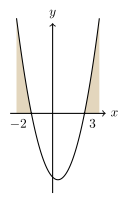
Worked example 1
The single most-checked point in the whole topic is that flip in step 2. If you dislike dividing by a negative, there's a neat dodge: add $3x$ to both sides first to get $4 \geq 19 + 3x$, then $-15 \geq 3x$, so $x \leq -5$ — same answer, no flip needed, because you never divided by a negative.
Worked example 2
The shape of the answer follows the shape of the parabola. For a U-shape (positive $x^2$): "$>0$" gives the outside region ($x<-2$ or $x>3$), while "$<0$" would give the inside ($-2<x<3$, a single joined-up range). The words "and"/"or" aren't arbitrary — they mirror whether the region is one connected piece or two separated ones. Always let the sketch, not memory, decide.
Worked example 3
A "$<0$" quadratic with an upward parabola gives the region between the roots — a single connected range.
Because the inequality was strict ($<$, not $\leq$), the roots themselves are excluded — at $x=-3$ and $x=\tfrac12$ the expression equals $0$, not less than it. That's why we use $<$ (open) rather than $\leq$ (closed) in the answer, and why set notation uses strict inequalities here. Getting the boundary type right is a genuine mark.
Writing a quadratic answer as $3 < x < -2$ is meaningless — the left number must be smaller than the right. And never glue two outside regions with "and": $x<-2$ and $x>3$ describes no numbers at all. Use "or" for two separated regions, and always put the smaller bound on the left.
Check yourself
Solve the inequality $x^2 + 2x - 8 \leq 0$, giving your answer as a single range.
(Hint: factorise, sketch the U, and decide whether you want inside or outside.)
Because the inequality is inclusive ($\leq$), the roots are part of the solution, so we use closed bounds $-4 \leq x \leq 2$ — the single connected range where the U sits on or below the axis.