Simultaneous Equations
Two equations, two unknowns — and one point where the graphs cross. Solving them is really the art of reducing two unknowns down to one.
A single equation in two unknowns, like $x+y=5$, has infinitely many solutions — $(1,4)$, $(2,3)$, $(0,5)$ and endlessly more. Each is a point on a line. To pin down one answer, you need a second equation: a second line. Where the two lines cross is the single pair $(x,y)$ that satisfies both at once. That crossing point is the solution, and it's why we call them simultaneous — both conditions must hold simultaneously.
So solving simultaneous equations is really a geometry question in disguise: where do these two graphs intersect? Algebra is just the tool that finds the meeting point without having to draw anything.
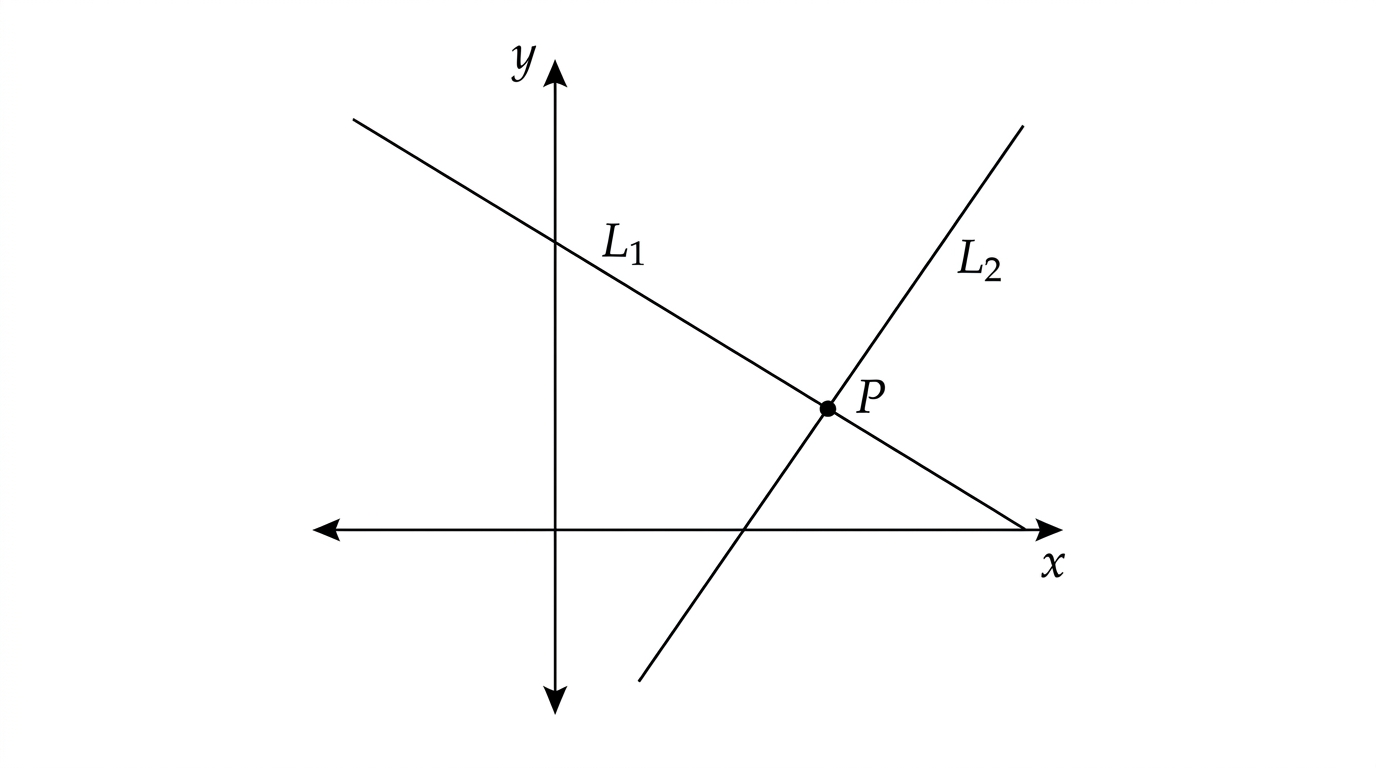
The winning idea behind every method is elimination: reduce two unknowns to one, because one equation in one unknown is something we can always solve. Substitution does this by rearranging one equation and slotting it into the other, so a variable disappears. Once you understand that the goal is simply "get down to one unknown," you'll never be unsure which move to make — you make whichever move removes a variable.
The two situations you'll meet
Linear–linear (two straight lines): they cross at most once, so expect a single solution. You can eliminate by adding/subtracting the equations, or by substitution.
Linear–quadratic (a line and a curve): a line can cut a parabola twice, touch it once, or miss it. So expect up to two solution pairs. Here substitution is essential — rearrange the linear equation and substitute into the quadratic.
Rearrange the linear equation to make one variable the subject (it's linear, so this is easy), then substitute into the quadratic. This collapses everything to a single quadratic in one variable, which you already know how to solve. Never try to substitute the quadratic into the line.
Worked example 1
Always check your pair in the other equation: $5(3)-2(3.5)=15-7=8$ ✓. It costs five seconds and catches almost every arithmetic slip. And give the answer as a pair $(x,y)$ — the solution is a single point, not two loose numbers.
Worked example 2
Notice the two $x$-values appeared the moment we formed a quadratic — that's the algebra telling us the line crosses the parabola in two places. The number of solutions to a linear–quadratic pair is exactly the number of roots of that quadratic, which the discriminant predicts. Substitute the $y$'s back into the linear equation, never the quadratic: it's far less work and impossible to get a spurious extra answer.
Worked example 3
"Does not intersect" means the resulting quadratic has no real roots — so this is a discriminant problem hiding inside a simultaneous-equations one.
This is the discriminant earning its keep. For a line and a curve: $b^2-4ac>0$ means they cross twice, $=0$ means the line is a tangent (touches once), and $<0$ means they never meet. We didn't need to find the points to know how many there are — the sign alone tells the geometric story. (Here the arithmetic revealed the line is actually tangent, a good reminder to trust the maths over the wording.)
When you find two $x$-values in a linear–quadratic problem, you must pair each with its own $y$. Don't mix them up — $(1,8)$ and $(4,2)$ would be wrong here. Substitute each $x$ back separately, and keep each pair together as a coordinate.
Check yourself
Solve simultaneously: $y = x^2 + x - 2$ and $y = 2x + 4$.
(Hint: set the two right-hand sides equal and form a quadratic $=0$.)
Because a quadratic appeared with two distinct roots, the line cuts the parabola in two places — exactly what the two coordinate pairs represent.