Length & Area
Two points give a distance; three points give an area. Both formulas are Pythagoras wearing a different outfit — once you see the triangle hiding inside each one, neither needs memorising.
The length of a line segment
Given two points $A(x_1, y_1)$ and $B(x_2, y_2)$, how far apart are they? Drop a horizontal and a vertical line between them and a right-angled triangle appears, with legs $(x_2-x_1)$ and $(y_2-y_1)$ and the segment $AB$ itself as the hypotenuse. Pythagoras finishes the job immediately.
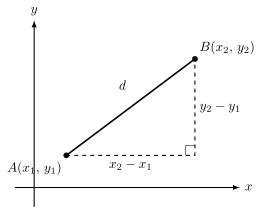
$$d = \sqrt{(x_2-x_1)^2 + (y_2-y_1)^2}$$ This is nothing but "square the legs, add them, square-root the total" — the same move behind the circle equation later in this topic. There's no separate formula to memorise: sketch the horizontal and vertical gap between any two points, and the distance is whatever Pythagoras says the hypotenuse must be.
The area of a triangle from its vertices
Sometimes you're given three vertices with no picture at all, and asked for the area they enclose. Splitting the triangle into right-angled pieces works but is slow — there's a single formula that takes the coordinates straight in.
For a triangle with vertices $(x_1,y_1)$, $(x_2,y_2)$, $(x_3,y_3)$:
$$\text{Area} = \frac{1}{2}\left| x_1(y_2-y_3) + x_2(y_3-y_1) + x_3(y_1-y_2) \right|$$
Substitute the three vertices in order, simplify inside the modulus, then halve.
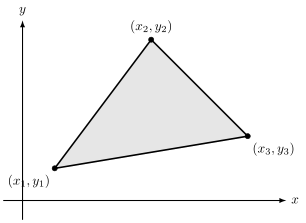
The expression inside the bars actually tracks a signed area — positive if you list the vertices anticlockwise, negative if clockwise. Area itself is never negative, so the modulus simply discards that direction and keeps the size. Practically: don't worry about which way round you list the vertices, just take the absolute value at the end and you'll always get the right answer.
Worked example 1
Don't forget the final square root — the most common slip in this topic is stopping at $d^2=100$ and writing that down as the distance. The formula gives a squared length under the root sign for a reason: it's Pythagoras, and Pythagoras always needs that last step.
Worked example 2
If the square of one side equals the sum of the squares of the other two, the triangle is right-angled — at the vertex between the two shorter sides. This is Pythagoras's theorem used in reverse.
The right angle is always opposite the longest side — here that's $AB$, so the angle to test is the one at $P$. Once you know a triangle is right-angled, its area is simply $\tfrac12 \times$ the two legs: here $\tfrac12 \times 5 \times 5 = 12.5$, no formula needed at all.
Worked example 3
This triangle isn't right-angled, so there's no quick "half base times height" shortcut — this is exactly where the coordinate area formula earns its keep.
Forgetting the modulus, or the $\tfrac12$, are the two ways this goes wrong. Without the modulus you'd report an area of $-10.5$, which is meaningless — areas are never negative. Always take the absolute value before halving, not the other way round (though here it makes no difference, it avoids confusion when the running total is negative partway through).
Check yourself
Find the area of the triangle with vertices $(0, 0)$, $(6, 0)$ and $(2, 5)$.
(Hint: substitute into the coordinate area formula — then check your answer against $\tfrac12 \times \text{base} \times \text{height}$, since one side lies conveniently on the $x$-axis.)
Cross-check: the base from $(0,0)$ to $(6,0)$ has length $6$ and lies on the $x$-axis, and $(2,5)$ sits $5$ units above it — so $\tfrac12 \times 6 \times 5 = 15$ ✓, matching exactly.