Mutually Exclusive & Independent Events
Two special relationships between events — never happening together, and never affecting each other — each collapse the general rules into something much simpler.
Mutually exclusive events
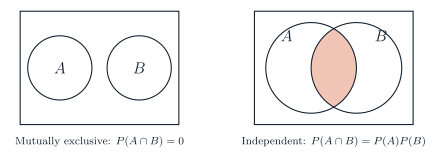
Two events are mutually exclusive if they can never happen at the same time — on a Venn diagram, their circles don't overlap at all, so $P(A\cap B)=0$. The addition rule then simplifies:
This is just the general addition rule with the overlap term removed, since there's nothing to subtract.
A set of mutually exclusive events is called exhaustive if, together, they cover the entire sample space — every outcome belongs to exactly one of them. Their probabilities then sum to exactly $1$: $P(A)+P(B)+\cdots=1$. Rolling a die and defining events "even" and "odd" gives a simple exhaustive, mutually exclusive pair.
Independent events
Two events are independent if one occurring has no effect on the probability of the other. This gives the multiplication rule:
This formula also serves as a test: if $P(A\cap B) = P(A)\times P(B)$ holds for given data, the events are independent; if it doesn't, they aren't.
These terms are easy to confuse but describe very different (in fact, almost opposite) relationships. Mutually exclusive events with nonzero probabilities can never be independent — if $A$ happening rules $B$ out completely, $A$ occurring is about as much "effect" on $B$ as possible. Genuinely independent events, by contrast, will generally overlap somewhat, since neither restricts the other.
Worked example 1
Always state why events are mutually exclusive in context ("a card can't be both a King and a Queen"), not just assert it — this is usually a method mark in its own right, separate from the probability calculation.
Worked example 2
Independence here comes from the physical setup, not from a calculation — two unconnected devices simply can't influence each other. Once independence is justified, "and" translates directly into multiplication, exactly as "or" (for mutually exclusive events) translates into addition.
Worked example 3
The independence test only checks whether the multiplication rule happens to hold for the given numbers — it doesn't require any physical reason for independence. Even seemingly unrelated events must be checked numerically; the test can't be assumed just because a scenario "seems" unconnected.
Worked example 4
Once $A\cap B$ is found as a number, it can be treated exactly like any single event for the remaining calculation — its internal structure (that it's itself an intersection) stops mattering once its probability is known. Breaking a compound question into "find this piece, then combine" is the standard strategy whenever multiple rules apply in sequence.
Applying $P(A\cap B)=P(A)\times P(B)$ to events that aren't independent gives a wrong answer with no warning — the formula doesn't know whether it's valid. Always confirm independence (from context or a stated test) before multiplying; otherwise the general rules, or a tree diagram, are needed instead.
Check yourself
A spinner has three mutually exclusive, exhaustive outcomes: red, blue, green, with $P(\text{red})=0.35$ and $P(\text{blue})=0.4$. Find $P(\text{green})$, and find $P(\text{red or blue})$.
(Hint: exhaustive probabilities sum to 1; mutually exclusive events just add.)