A Venn diagram keeps overlapping possibilities from being counted twice — the single most useful picture in probability.
9 min read4 worked examples
Set notation and Venn diagrams
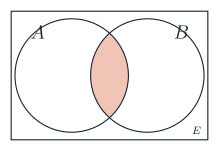
A Venn diagram draws the sample space as a rectangle, with events as circles inside it. Three combinations come up constantly:
Union, $A \cup B$: outcomes in $A$ or $B$ (or both) — everywhere the two circles cover.
Intersection, $A \cap B$: outcomes in $A$ and $B$ — only the overlap.
Complement, $A'$: outcomes not in $A$ — everywhere outside the circle, but still inside the rectangle.
A Venn diagram: the rectangle is the sample space, and the overlap of the two circles is the intersection A ∩ B.
The addition rule
Adding $P(A)+P(B)$ double-counts any outcome in both events — it's counted once inside $A$ and again inside $B$. The addition rule corrects for this by subtracting the overlap once:
$P(A\cup B) = P(A) + P(B) - P(A\cap B).$
Why the overlap is subtracted, not added
Picture the Venn diagram: adding the areas of circle $A$ and circle $B$ counts the overlapping region twice. Subtracting $P(A\cap B)$ once removes exactly that double-count, leaving the true area of the union. This is the same idea behind the inclusion-exclusion principle used throughout combinatorics and probability.
Worked example 1
Reading probabilities from a Venn diagram
In a class of 30 students, 18 study French ($F$), 14 study Spanish ($S$), and 7 study both. Find $P(F\cap S)$, $P(F\cup S)$, and $P(\text{neither})$.
MethodFill in the Venn diagram region by region
1
$P(F\cap S) = \dfrac{7}{30}$, directly from the "both" figure.
"Neither" is the complement of the union, not the complement of either individual event — a common slip is computing $1-P(F)$ instead. Always translate "neither $A$ nor $B$" into $(A\cup B)'$ before calculating.
Worked example 2
Finding a missing probability
For two events, $P(A)=0.4$, $P(B)=0.5$, and $P(A\cup B)=0.7$. Find $P(A\cap B)$.
MethodRearrange the addition rule
1
$P(A\cup B) = P(A)+P(B)-P(A\cap B) \Rightarrow 0.7 = 0.4+0.5-P(A\cap B)$.
Substitute the given values.
2
$0.7 = 0.9 - P(A\cap B) \Rightarrow P(A\cap B) = 0.2$.
Rearrange for the unknown.
▪ solved
The key insight
The addition rule links four quantities — $P(A)$, $P(B)$, $P(A\cap B)$, $P(A\cup B)$ — and any one can be found once the other three are known. This single rearrangeable formula does the work of what might otherwise need a full Venn diagram.
Worked example 3
Building a three-set Venn diagram
A survey of 50 people asks whether they own a cat ($C$), a dog ($D$), or neither. 22 own a cat, 19 own a dog, and 8 own both. Find the number of people who own neither.
MethodFind the union, then subtract from the total
1
Number owning cat or dog (or both): $22+19-8=33$.
Addition rule, using raw counts instead of probabilities.
2
Number owning neither: $50-33=17$.
Total minus the union.
▪ solved
Common mistake
The addition rule works identically with raw frequencies or with probabilities — don't feel you need to convert to probabilities first if the question is phrased in counts. Just be consistent about which one you're using throughout.
Worked example 4
Working backwards to a full Venn diagram · Challenge
In a group of 40 people, $P(A)=0.55$, $P(B)=0.375$, and $P(A\cap B')=0.375$ (in $A$ but not $B$). Find $P(A\cap B)$ and the number of people in neither $A$ nor $B$.
MethodSplit A into its two pieces, then apply the addition rule
1
Event $A$ splits into "$A$ and $B$" and "$A$ but not $B$": $P(A) = P(A\cap B) + P(A\cap B')$.
A is the disjoint union of these two pieces.
2
$0.55 = P(A\cap B) + 0.375 \Rightarrow P(A\cap B) = 0.175$.
Rearrange for the intersection.
3
$P(A\cup B) = P(A)+P(B)-P(A\cap B) = 0.55+0.375-0.175 = 0.75$.
Addition rule.
4
$P(\text{neither}) = 1-0.75=0.25$, so the number of people is $0.25\times40=10$.
Complement, then scale up to the group size.
▪ solved
Look deeper — splitting an event by another event
Any event $A$ can always be split into the two disjoint pieces $A\cap B$ and $A\cap B'$, since every outcome in $A$ either is or isn't also in $B$. This decomposition — used here to unlock the missing intersection — is one of the most useful moves in Venn diagram problems, well beyond just the addition rule itself.
Common mistake
$A\cap B'$ means "in $A$ but not in $B$" — not "not in $A$ and not in $B$" (that's $(A\cup B)'$, or equivalently $A'\cap B'$). Complements attach to a single named event unless the notation says otherwise; mixing these up is one of the most common set-notation errors.
Check yourself
For two events, $P(A)=0.3$, $P(B)=0.45$, $P(A\cap B)=0.12$. Find $P(A\cup B)$ and $P((A\cup B)')$. (Hint: apply the addition rule, then take the complement.)