When an experiment happens in stages, a tree diagram tracks every possible path through it — and turns even a multi-stage problem into two simple rules.
10 min read4 worked examples
Reading a tree diagram
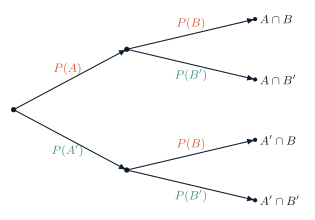
A tree diagram shows a multi-stage experiment as a set of branches: each stage is a new set of branches leading out from every branch of the previous stage, and each branch is labelled with its probability. Reading one relies on exactly two rules.
A two-stage tree diagram. Following the top path from left to right gives outcome A ∩ B; its probability is found by multiplying the two branch probabilities along that path.
Multiply along a path. The probability of following one complete path through the tree (one branch from each stage) is the product of the probabilities on that path.
Add across paths. If more than one path leads to the outcome you want, add together the probabilities of each of those paths.
A built-in check
The branches leaving any single point always have probabilities that sum to $1$ (they cover every possibility at that stage), and — since the tree covers the whole sample space — the probabilities of every complete path, added together, also sum to $1$. Both are quick ways to catch an arithmetic slip.
Sampling without replacement
When items are drawn from a group without replacement, removing one item changes what's left for the next draw — both the total and, if it matches, the count of that type. The branch probabilities at the second stage must be updated to reflect this before multiplying, rather than reused from the first stage.
Worked example 1
A tree diagram with replacement
A bag contains $3$ red and $2$ blue counters. A counter is drawn and replaced, then a second counter is drawn. Find the probability that both counters are the same colour.
MethodMultiply along each same-colour path, then add
1
Since the counter is replaced, $P(\text{red})=\dfrac35$ and $P(\text{blue})=\dfrac25$ at both stages.
Replacing the counter restores the bag to its original state.
Add the two paths, since either gives "same colour".
▪ solved
Worked example 2
Without replacement
A bag contains $7$ green and $5$ blue beads. Two beads are drawn at random, one after another, without replacement. Find the probability that both beads are green.
MethodUpdate the bag's contents before the second branch
1
$P(\text{1st green}) = \dfrac{7}{12}$.
7 green beads out of 12 total.
2
If the first bead drawn was green, $11$ beads remain, of which $6$ are green: $P(\text{2nd green}) = \dfrac{6}{11}$.
One green bead has been removed from the bag, so both the total and the green count drop by one.
The second-stage probability is never simply "carried over" from the first draw without replacement — always re-count what's left in the bag before writing the second branch's fraction.
Worked example 3
Combining two different-outcome paths
Using the same bag of $7$ green and $5$ blue beads, two beads are drawn without replacement. Find the probability that the two beads are different colours.
MethodThere are two orders that give "different colours" — find both, then add
1
Green then blue: $P(\text{GB}) = \dfrac{7}{12}\times\dfrac{5}{11}=\dfrac{35}{132}$.
7 green out of 12, then 5 blue out of the remaining 11.
2
Blue then green: $P(\text{BG}) = \dfrac{5}{12}\times\dfrac{7}{11}=\dfrac{35}{132}$.
5 blue out of 12, then 7 green out of the remaining 11.
Add the two paths that both give "different colours".
▪ solved
Why GB and BG give the same probability
It isn't a coincidence that both orders give $\tfrac{35}{132}$ here — with no replacement, $\dfrac{7}{12}\times\dfrac{5}{11}$ and $\dfrac{5}{12}\times\dfrac{7}{11}$ multiply the same three numbers ($7$, $5$, and $\dfrac1{12\times11}$) in a different order, which never changes the product.
Worked example 4
Using the complement to avoid extra branches · Challenge
A bag contains $4$ red, $3$ blue and $3$ yellow counters. Two counters are drawn without replacement. Find the probability that at least one is red.
MethodFind P(no red) along a single path, then take the complement
1
"At least one red" has several paths (red-then-anything, or non-red-then-red) — but its complement, "no red at all", is just a single path: not-red, then not-red again.
Recognising the simpler complementary event avoids drawing every branch.
2
$P(\text{1st not red}) = \dfrac{6}{10}$, since $6$ of the $10$ counters aren't red.
3 blue + 3 yellow = 6 non-red counters.
3
If the first counter wasn't red, $9$ remain, of which $5$ aren't red: $P(\text{2nd not red}) = \dfrac{5}{9}$.
One non-red counter has been removed, so 5 of the remaining 9 are non-red.
$P(\text{at least one red}) = 1-\dfrac13=\dfrac23$.
Complement of "no red".
▪ solved
Look deeper — "at least one" almost always means "use the complement"
Directly computing "at least one red" would mean finding and adding three separate paths (RR, R-not-R, not-R-R). Its complement, "no red", is always exactly one path, however many stages or categories are involved. Whenever a question asks for "at least one" of something, checking whether the complement is a single, simpler path is usually the fastest way in.
Check yourself
A bag contains $5$ orange and $3$ purple sweets. Two sweets are taken at random, without replacement. Find $P(\text{both purple})$. (Hint: update the count of purple sweets, and the total, before the second branch.)
Method
1
$P(\text{1st purple}) = \dfrac38$.
2
$P(\text{2nd purple}) = \dfrac27$, since $2$ of the remaining $7$ sweets are purple.