Points of Intersection
Do two lines meet, or pass each other by in different planes entirely? Setting parametric equations equal — and always checking the leftover equation — gives the answer.
Intersection of two lines
Set the two line equations equal, componentwise, giving three equations in two parameters $\lambda,\mu$. Solve two of the equations simultaneously, then check the solution in the third. If it's consistent, the lines meet at that point; if not, the lines are skew (they miss each other without being parallel).
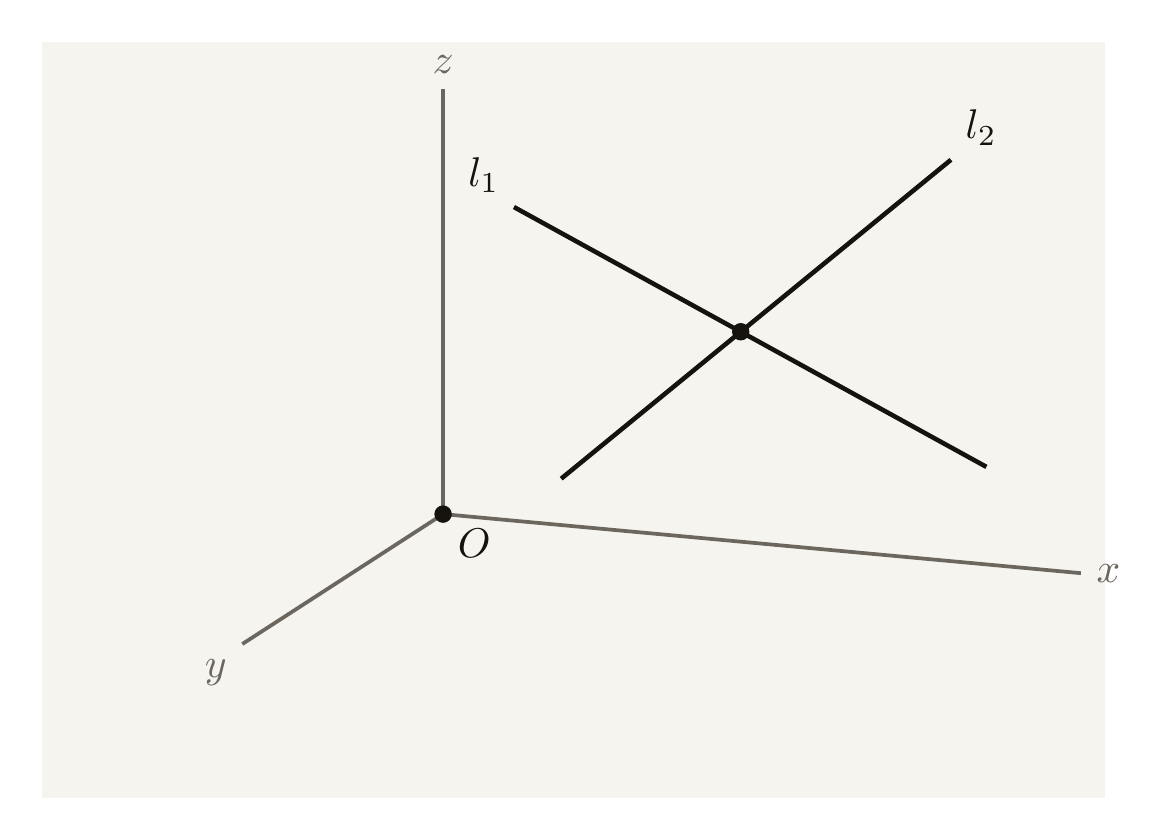
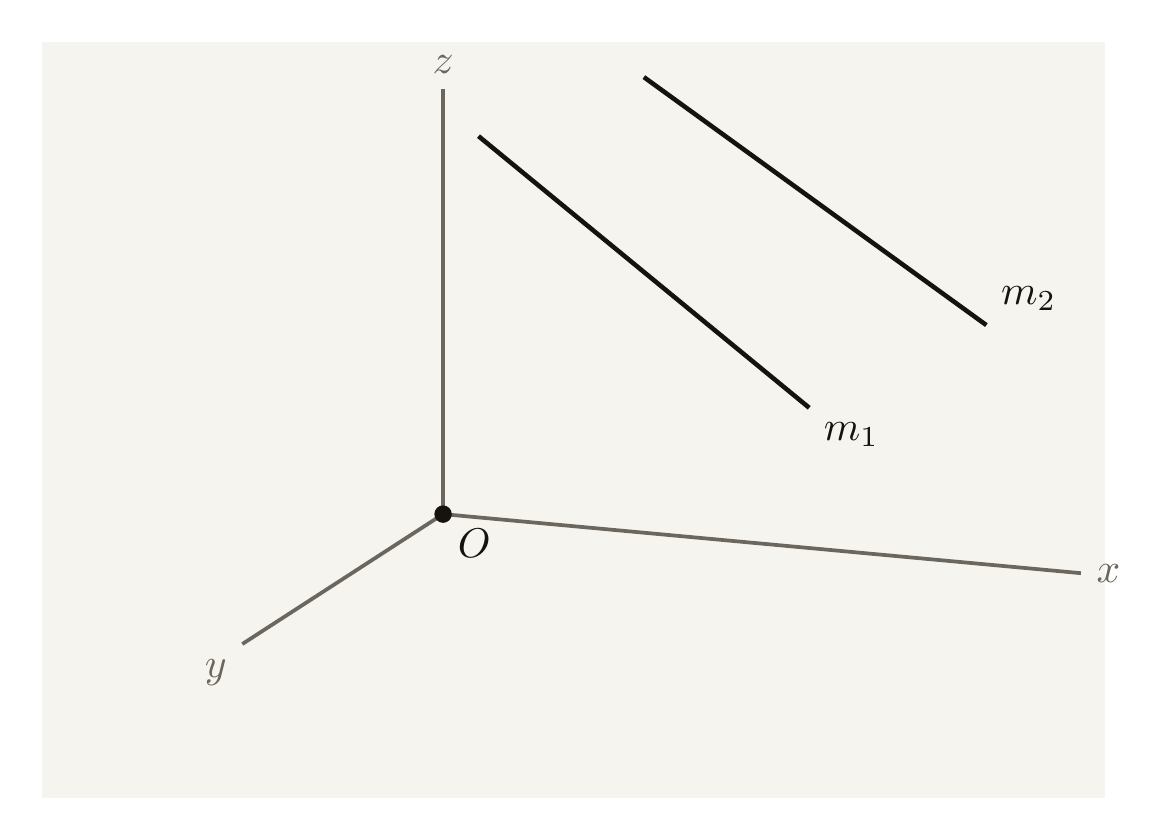
Equate components: $x$: $1+\lambda=2\mu$. $y$: $2-\lambda=3+\mu$. $z$: $2\lambda=1-\mu$.
From the $y$-equation: $\lambda=-1-\mu$. Substitute into the $x$-equation: $1+(-1-\mu)=2\mu \Rightarrow -\mu=2\mu \Rightarrow \mu=0$, so $\lambda=-1$.
Check in the $z$-equation: LHS $=2(-1)=-2$; RHS $=1-0=1$. These don't match, so the lines are skew — they do not intersect.
Equate components: $x$: $\lambda=4-\mu$. $y$: $\lambda=\mu$. $z$: $\lambda=\mu$.
From $y$: $\lambda=\mu$. Substituting into the $x$-equation: $\mu=4-\mu \Rightarrow 2\mu=4 \Rightarrow \mu=2$, so $\lambda=2$.
Check in the $z$-equation: LHS $=\lambda=2$; RHS $=\mu=2$. These match, confirming the lines intersect.
Substituting $\lambda=2$ into $\mathbf{r}_1$: the point of intersection is $(2,2,2)$.
Intersection of a line and a plane
Substitute the parametric coordinates of the line ($x=x_0+\lambda l$, etc.) into the Cartesian equation of the plane, and solve for $\lambda$. Substituting this value of $\lambda$ back into the line's equation gives the point of intersection. If the resulting equation in $\lambda$ has no solution, the line is parallel to the plane and doesn't meet it (or, if the equation is true for all $\lambda$, the line lies entirely within the plane).
Substitute $x=1+2\lambda$, $y=2-\lambda$, $z=-1+3\lambda$ into the plane equation:
$(1+2\lambda)+2(2-\lambda)-(-1+3\lambda)=9$
$1+2\lambda+4-2\lambda+1-3\lambda=9 \Rightarrow 6-3\lambda=9 \Rightarrow -3\lambda=3 \Rightarrow \lambda=-1$.
Substituting back: $x=1-2=-1$, $y=2+1=3$, $z=-1-3=-4$.
The line meets the plane at $(-1,3,-4)$.
Substitute: $(2+\lambda)+(1+\lambda)-2(\lambda)=1$
$2+\lambda+1+\lambda-2\lambda=1 \Rightarrow 3+0\lambda=1 \Rightarrow 3=1$, which is never true.
Since this equation has no solution for $\lambda$, the line never meets the plane — it is parallel to it (and, checking the direction vector $(1,1,1)$ against the normal $(1,1,-2)$: their dot product is $1+1-2=0$, confirming the line's direction is indeed perpendicular to the normal, i.e. parallel to the plane).
Using the same parameter letter for two different lines when checking for intersection is a common error — always use a different letter ($\lambda$ and $\mu$) for each line, since they are independent variables that generally take different values at the point of intersection.
Exam-style questions
Question 1 6 marks
Show that the lines $\mathbf{r}_1=(1,0,2)+\lambda(1,1,-1)$ and $\mathbf{r}_2=(3,2,0)+\mu(-1,1,1)$ intersect, and find the coordinates of the point of intersection.
$x$: $1+\lambda=3-\mu \Rightarrow \lambda+\mu=2$. $y$: $\lambda=2+\mu \Rightarrow \lambda-\mu=2$. (M1, A1)
Adding the two equations: $2\lambda=4 \Rightarrow \lambda=2$, so $\mu=0$. (M1, A1)
Check $z$: LHS $=2-\lambda=2-2=0$; RHS $=0+\mu=0$. These match, confirming the lines intersect. (M1)
Substituting $\lambda=2$ into $\mathbf{r}_1$: point of intersection is $(1+2,0+2,2-2)=(3,2,0)$. (A1)
Question 2 6 marks
Find the point where the line $\mathbf{r}=(0,-1,2)+\lambda(1,2,-1)$ meets the plane $2x-y+z=7$.
Substitute: $2(\lambda)-(-1+2\lambda)+(2-\lambda)=7$ (M1, A1)
$2\lambda+1-2\lambda+2-\lambda=7 \Rightarrow 3-\lambda=7 \Rightarrow \lambda=-4$ (M1, A1)
$x=-4$, $y=-1-8=-9$, $z=2+4=6$; point is $(-4,-9,6)$ (M1, A1)
Question 3 6 marks
Show that the lines $\mathbf{r}_1=(1,0,0)+\lambda(0,1,0)$ and $\mathbf{r}_2=(0,0,1)+\mu(1,0,0)$ are skew.
$x$: $1=\mu$. $y$: $\lambda=0$. $z$: $0=1$. (M1, A1)
The $x$- and $y$-equations give $\mu=1$, $\lambda=0$ directly, but the $z$-equation reads $0=1$, which is never true regardless of $\lambda$ or $\mu$. (M1, A1)
The direction vectors $(0,1,0)$ and $(1,0,0)$ are not parallel (not scalar multiples of one another), so the lines are not parallel; combined with the inconsistent $z$-equation, the lines never meet. (A1)
Since the lines are neither parallel nor intersecting, they are skew. (A1)