Finding Perpendiculars
The shortest distance from a point to a line or plane always runs along a perpendicular — find the foot of that perpendicular, and the distance follows immediately.
Shortest distance from a point to a line
To find the shortest distance from point $P$ to line $\mathbf{r}=\mathbf{a}+\lambda\mathbf{d}$: let $F=\mathbf{a}+\lambda\mathbf{d}$ be a general point on the line. The vector $\vec{PF}$ is perpendicular to the line exactly when $\vec{PF}\cdot\mathbf{d}=0$. Solve this equation for $\lambda$ to find $F$, the foot of the perpendicular, then the distance is $|\vec{PF}|$.
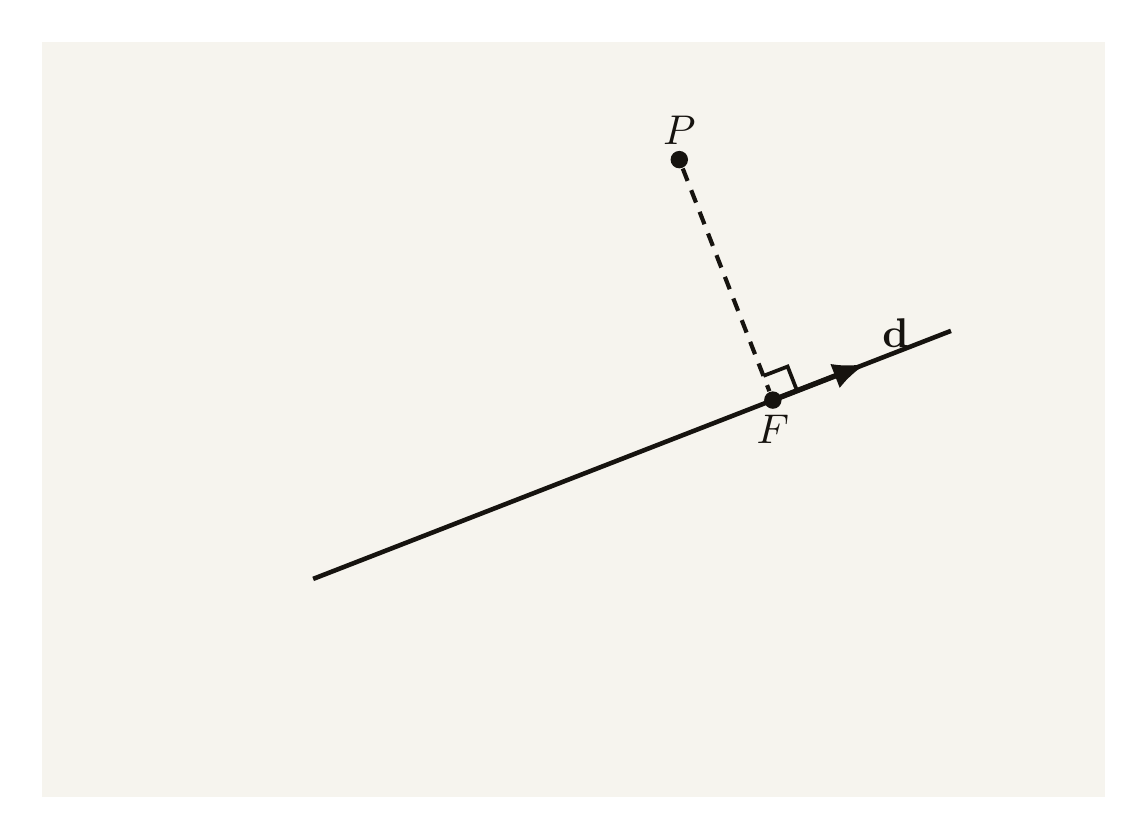
General point on line: $F=(2+\lambda,1+\lambda,-\lambda)$. Then $\vec{PF}=F-P=(1+\lambda,1+\lambda,-\lambda-2)$.
$\vec{PF}\cdot(1,1,-1)=0$: $(1+\lambda)+(1+\lambda)-(-\lambda-2)=0 \Rightarrow 1+\lambda+1+\lambda+\lambda+2=0 \Rightarrow 3\lambda+4=0 \Rightarrow \lambda=-\tfrac43$.
$F=(2-\tfrac43,1-\tfrac43,\tfrac43)=(\tfrac23,-\tfrac13,\tfrac43)$. $\vec{PF}=(\tfrac23-1,-\tfrac13,\tfrac43-2)=(-\tfrac13,-\tfrac13,-\tfrac23)$.
Shortest distance between two skew lines
For two skew lines with general points $F_1=\mathbf{a}_1+s\mathbf{d}_1$ and $F_2=\mathbf{a}_2+t\mathbf{d}_2$, the connecting vector $\vec{F_1F_2}$ is shortest exactly when it is perpendicular to both direction vectors at once. This gives two equations — $\vec{F_1F_2}\cdot\mathbf{d}_1=0$ and $\vec{F_1F_2}\cdot\mathbf{d}_2=0$ — which can be solved simultaneously for $s$ and $t$, and then $|\vec{F_1F_2}|$ is the shortest distance.
General points: $F_1=(1+s,s,0)$, $F_2=(0,2+t,1+t)$.
$\vec{F_1F_2}=F_2-F_1=(-1-s,\,2+t-s,\,1+t)$.
Perpendicular to $\mathbf{d}_1=(1,1,0)$: $(-1-s)+(2+t-s)=0 \Rightarrow 1+t-2s=0$.
Perpendicular to $\mathbf{d}_2=(0,1,1)$: $(2+t-s)+(1+t)=0 \Rightarrow 3+2t-s=0$.
From the first equation, $t=2s-1$. Substituting into the second: $3+2(2s-1)-s=0 \Rightarrow 3s+1=0 \Rightarrow s=-\tfrac13$, so $t=-\tfrac53$.
$\vec{F_1F_2}=(-1+\tfrac13,\,2-\tfrac53+\tfrac13,\,1-\tfrac53)=(-\tfrac23,\,\tfrac23,\,-\tfrac23)$.
This method only gives the shortest distance for lines that are not parallel. If the two lines are parallel, the connecting segment between corresponding general points is never uniquely perpendicular to both (infinitely many perpendicular segments exist, all of equal length) — in that case, pick any point on one line and use the point-to-line method above against the other line instead.
Shortest distance from a point to a plane
For a plane $n_1x+n_2y+n_3z=d$ and a point $P=(p_1,p_2,p_3)$, the shortest distance is $$\text{distance}=\frac{|n_1p_1+n_2p_2+n_3p_3-d|}{|\mathbf{n}|}$$ where $\mathbf{n}=(n_1,n_2,n_3)$ is the normal vector. This follows from projecting the vector from any point on the plane to $P$ onto the (unit) normal direction.
$\mathbf{n}=(2,-1,2)$, $|\mathbf{n}|=\sqrt{4+1+4}=3$.
$n_1p_1+n_2p_2+n_3p_3=2(3)-1(-1)+2(2)=6+1+4=11$.
Distance $=\dfrac{|11-5|}{3}=\dfrac63=2$.
Finding the foot of the perpendicular to a plane
The perpendicular from $P$ has direction equal to the normal $\mathbf{n}=(1,2,-2)$, so its equation is $\mathbf{r}=(1,2,-3)+\lambda(1,2,-2)$.
Substitute into the plane: $(1+\lambda)+2(2+2\lambda)-2(-3-2\lambda)=3$
$1+\lambda+4+4\lambda+6+4\lambda=3 \Rightarrow 11+9\lambda=3 \Rightarrow \lambda=-\dfrac89$.
Foot: $x=1-\tfrac89=\tfrac19$, $y=2-\tfrac{16}{9}=\tfrac29$, $z=-3+\tfrac{16}{9}=-\tfrac{11}{9}$.
Foot of perpendicular: $\left(\tfrac19,\tfrac29,-\tfrac{11}{9}\right)$.
Perpendicular line: $\mathbf{r}=(3,-1,2)+\lambda(2,-1,2)$.
Substitute: $2(3+2\lambda)-(-1-\lambda)+2(2+2\lambda)=5$
$6+4\lambda+1+\lambda+4+4\lambda=5 \Rightarrow 11+9\lambda=5 \Rightarrow \lambda=-\dfrac23$.
Foot: $x=3-\tfrac43=\tfrac53$, $y=-1+\tfrac23=-\tfrac13$, $z=2-\tfrac43=\tfrac23$.
$\vec{PF}=\left(\tfrac53-3,-\tfrac13+1,\tfrac23-2\right)=\left(-\tfrac43,\tfrac23,-\tfrac43\right)$.
$|\vec{PF}|=\sqrt{\tfrac{16}{9}+\tfrac49+\tfrac{16}{9}}=\sqrt{\tfrac{36}{9}}=\sqrt4=2$ ✓ (matches Example 2).
When finding the foot of a perpendicular to a plane, the direction of the perpendicular line must be the plane's normal vector, not an arbitrary direction lying in the plane — using the wrong direction gives a line that doesn't meet the plane at a right angle.
Exam-style questions
Question 1 6 marks
Find the shortest distance from the point $Q(0,0,0)$ to the line $\mathbf{r}=(1,2,1)+\lambda(1,-1,1)$.
General point: $F=(1+\lambda,2-\lambda,1+\lambda)$. $\vec{QF}=F-Q=(1+\lambda,2-\lambda,1+\lambda)$. (M1)
$\vec{QF}\cdot(1,-1,1)=0$: $(1+\lambda)-(2-\lambda)+(1+\lambda)=0 \Rightarrow 3\lambda=0 \Rightarrow \lambda=0$ (M1, A1)
$F=(1,2,1)$, so $\vec{QF}=(1,2,1)$, and $|\vec{QF}|=\sqrt{1+4+1}=\sqrt6$ (M1, A1, A1)
Question 1b 7 marks
Find the shortest distance between the skew lines $\mathbf{r}_1=(2,0,1)+s(1,0,1)$ and $\mathbf{r}_2=(0,1,-1)+t(1,1,0)$.
General points: $F_1=(2+s,0,1+s)$, $F_2=(t,1+t,-1)$. $\vec{F_1F_2}=(t-2-s,\,1+t,\,-2-s)$ (M1, A1)
Perpendicular to $\mathbf{d}_1=(1,0,1)$: $(t-2-s)+(-2-s)=0 \Rightarrow t-2s-4=0$ (M1)
Perpendicular to $\mathbf{d}_2=(1,1,0)$: $(t-2-s)+(1+t)=0 \Rightarrow 2t-s-1=0$ (M1)
Solving simultaneously: $s=-\tfrac73$, $t=-\tfrac23$ (A1)
$\vec{F_1F_2}=\left(-\tfrac13,\tfrac13,\tfrac13\right)$, so distance $=\sqrt{\tfrac19+\tfrac19+\tfrac19}=\dfrac{1}{\sqrt3}=\dfrac{\sqrt3}{3}$ (M1, A1)
Question 2 5 marks
Find the shortest distance from $P(2,1,-1)$ to the plane $3x-4y+5z=10$, giving your answer to 3 significant figures.
$\mathbf{n}=(3,-4,5)$, $|\mathbf{n}|=\sqrt{9+16+25}=\sqrt{50}$ (M1, A1)
$n_1p_1+n_2p_2+n_3p_3=3(2)-4(1)+5(-1)=6-4-5=-3$ (M1)
Distance $=\dfrac{|-3-10|}{\sqrt{50}}=\dfrac{13}{\sqrt{50}}=1.84$ (3 s.f.) (A1, A1)
Question 3 6 marks
Find the foot of the perpendicular from $P(0,1,4)$ to the plane $x-y+z=2$, and hence find the shortest distance from $P$ to the plane.
Perpendicular line: $\mathbf{r}=(0,1,4)+\lambda(1,-1,1)$ (M1)
Substitute: $(\lambda)-(1-\lambda)+(4+\lambda)=2 \Rightarrow 3\lambda+3=2 \Rightarrow \lambda=-\tfrac13$ (M1, A1)
Foot: $\left(-\tfrac13,\tfrac43,\tfrac{11}{3}\right)$ (A1)
$\vec{PF}=\left(-\tfrac13,\tfrac13,-\tfrac13\right)$, $|\vec{PF}|=\sqrt{\tfrac19+\tfrac19+\tfrac19}=\sqrt{\tfrac13}=\dfrac{1}{\sqrt3}$ (M1, A1)