Calculating Angles Between Lines and Planes
Line-line, line-plane, plane-plane — three variations on a theme, distinguished by a single question: is it sine or cosine you need?
Angle between two lines
The angle between two lines is found from the angle between their direction vectors $\mathbf{d}_1,\mathbf{d}_2$, using $\cos\theta=\dfrac{\mathbf{d}_1\cdot\mathbf{d}_2}{|\mathbf{d}_1||\mathbf{d}_2|}$. Since a line has no inherent "direction" (it extends both ways), the angle between two lines is always taken as the acute angle, so use $|\cos\theta|$ if the raw calculation gives an obtuse value.
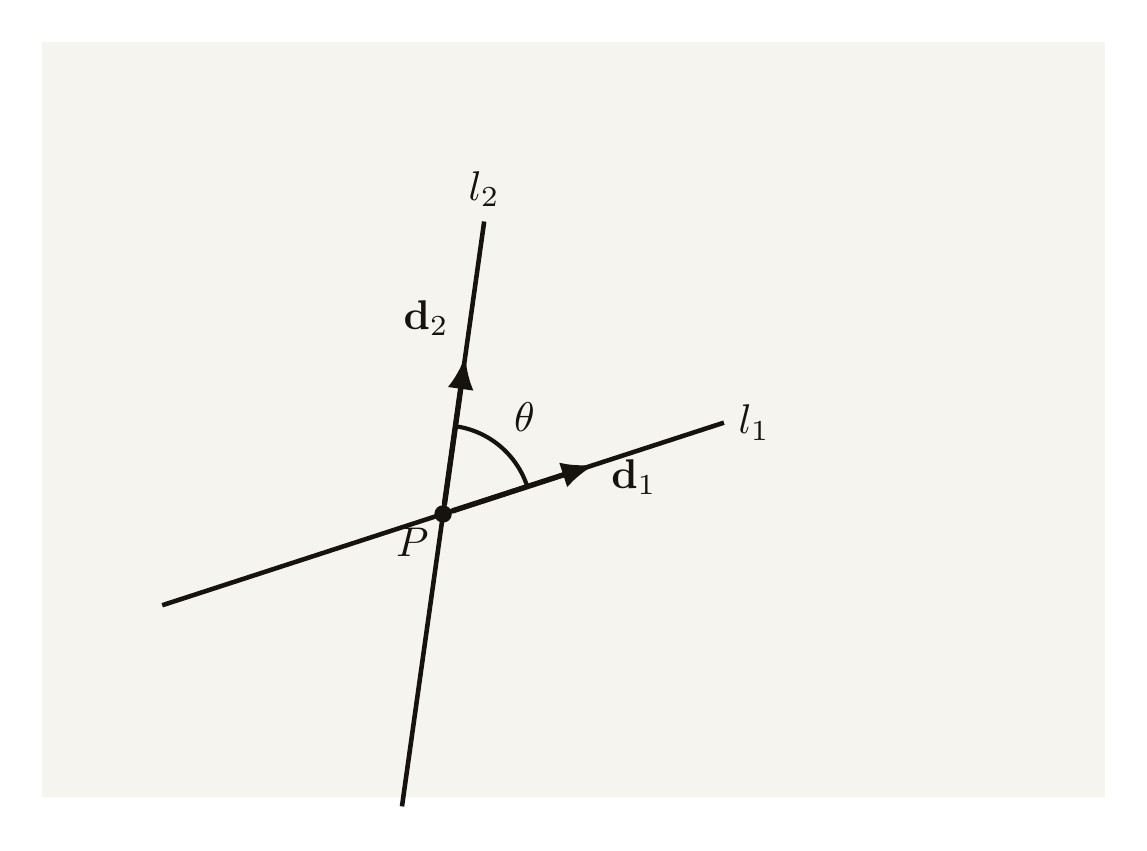
Dot product: $2(1)+1(-2)+(-2)(2)=2-2-4=-4$.
$|\mathbf{d}_1|=3$, $|\mathbf{d}_2|=3$.
$\cos\theta=\dfrac{-4}{9}$; taking the acute angle, $\cos\theta=\dfrac{4}{9} \Rightarrow \theta=63.6°$ (3 s.f.).
Angle between a line and a plane
Let $\phi$ be the angle between a line (direction $\mathbf{d}$) and a plane (normal $\mathbf{n}$). Since the normal is perpendicular to the plane, the angle between $\mathbf{d}$ and $\mathbf{n}$ is the complement of $\phi$: $$\sin\phi=\frac{|\mathbf{d}\cdot\mathbf{n}|}{|\mathbf{d}||\mathbf{n}|}$$ (Using $\sin$, not $\cos$, and using the modulus to ensure $\phi$ is taken between $0°$ and $90°$.)
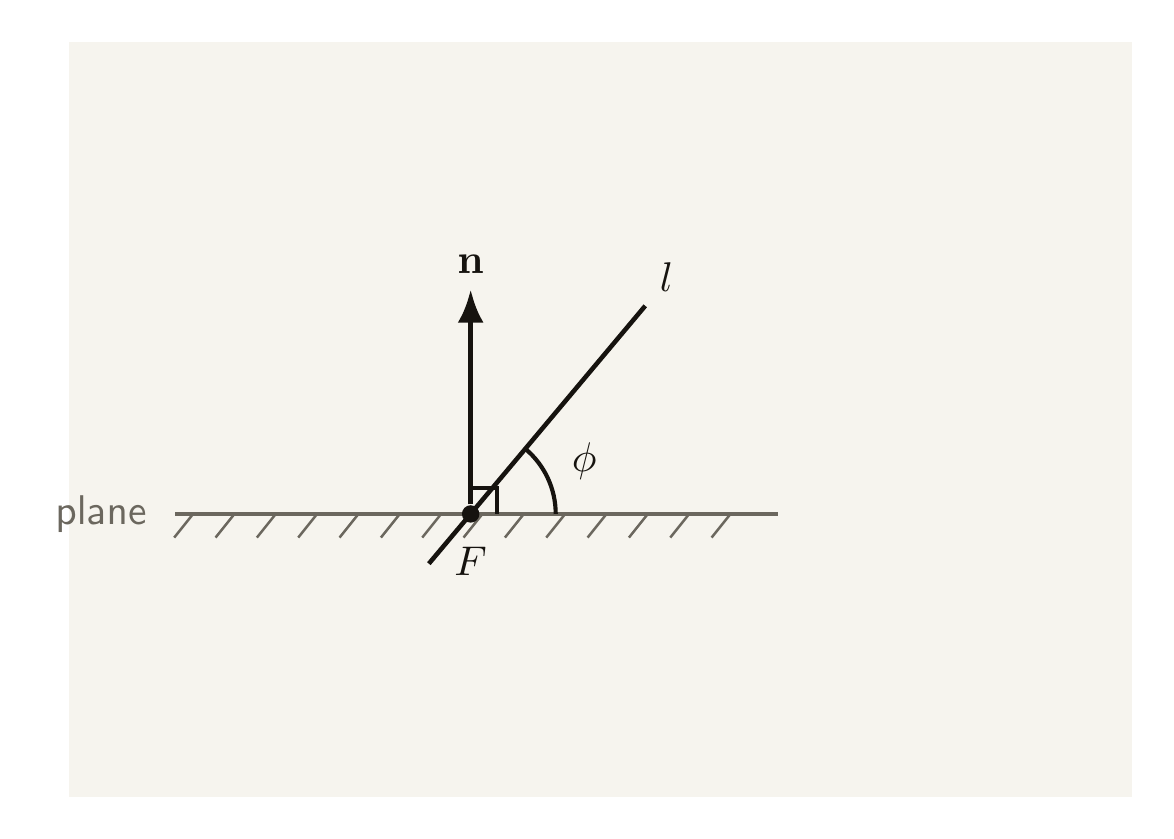
Direction $\mathbf{d}=(2,1,-2)$; normal $\mathbf{n}=(1,-2,2)$.
$\mathbf{d}\cdot\mathbf{n}=2(1)+1(-2)+(-2)(2)=2-2-4=-4$.
$|\mathbf{d}|=3$, $|\mathbf{n}|=3$.
$\sin\phi=\dfrac{|-4|}{9}=\dfrac49 \Rightarrow \phi=26.4°$ (3 s.f.).
Angle between two planes
The angle between two planes equals the angle between their normal vectors $\mathbf{n}_1,\mathbf{n}_2$: $$\cos\theta=\frac{|\mathbf{n}_1\cdot\mathbf{n}_2|}{|\mathbf{n}_1||\mathbf{n}_2|}$$ (Using cosine here, like the line-line case, since we're comparing two normals directly — and the modulus again ensures the acute angle.)
$\mathbf{n}_1=(2,1,-2)$, $\mathbf{n}_2=(1,-2,2)$.
$\mathbf{n}_1\cdot\mathbf{n}_2=2(1)+1(-2)+(-2)(2)=2-2-4=-4$.
$|\mathbf{n}_1|=3$, $|\mathbf{n}_2|=3$.
$\cos\theta=\dfrac{|-4|}{9}=\dfrac49 \Rightarrow \theta=63.6°$ (3 s.f.).
Direction $\mathbf{d}=(3,1,1)$; normal $\mathbf{n}=(1,-2,-1)$.
$\mathbf{d}\cdot\mathbf{n}=3(1)+1(-2)+1(-1)=3-2-1=0$.
Since $\mathbf{d}\cdot\mathbf{n}=0$, the direction of the line is perpendicular to the normal, meaning the line runs parallel to the plane (or lies within it).
Using $\cos$ instead of $\sin$ for a line-plane angle (or vice versa) is the most common error in this topic — remember: line vs line, and plane vs plane, both use cosine directly on the given vectors (direction or normal); line vs plane uses sine, because a direction vector and a normal vector are being compared, not two vectors that lie in the same kind of geometric object.
Exam-style questions
Question 1 2 marks
Find the angle between the line $\mathbf{r}=(0,1,2)+\lambda(1,2,-2)$ and the plane $2x-y+2z=7$.
$\mathbf{d}=(1,2,-2)$, $\mathbf{n}=(2,-1,2)$ (B1)
$\mathbf{d}\cdot\mathbf{n}=2-2-4=-4$; $|\mathbf{d}|=3$, $|\mathbf{n}|=3$ (M1, A1)
$\sin\phi=\dfrac{4}{9} \Rightarrow \phi=26.4°$ (3 s.f.) (M1, A1, A1)
Question 2 2 marks
Find the angle between the planes $x+2y-z=6$ and $3x-y+z=2$.
$\mathbf{n}_1=(1,2,-1)$, $\mathbf{n}_2=(3,-1,1)$ (B1)
$\mathbf{n}_1\cdot\mathbf{n}_2=3-2-1=0$ (M1, A1)
Since the dot product is $0$, the planes are perpendicular: $\theta=90°$. (A1, B1, B1)
Question 3 2 marks
Find the acute angle between the lines with direction vectors $(1,1,1)$ and $(2,-1,1)$, to 1 decimal place.
Dot product: $2-1+1=2$ (M1, A1)
$|\mathbf{d}_1|=\sqrt3$, $|\mathbf{d}_2|=\sqrt6$ (A1)
$\cos\theta=\dfrac{2}{\sqrt{18}}=\dfrac{2}{3\sqrt2}=0.4714\ldots \Rightarrow \theta=61.9°$ (3 s.f.) (M1, A1, A1)