Tangents to Polar Curves
Using the Cartesian parametric form of a polar curve to find where its tangent is horizontal or vertical.
Tangents to polar curves
Convert to Cartesian parametric form using $\theta$ as the parameter: $x=r\cos\theta=f(\theta)\cos\theta$, $y=r\sin\theta=f(\theta)\sin\theta$.
· The tangent is parallel to the initial line (horizontal) where $\dfrac{dy}{d\theta}=0$.
· The tangent is perpendicular to the initial line (vertical) where $\dfrac{dx}{d\theta}=0$.
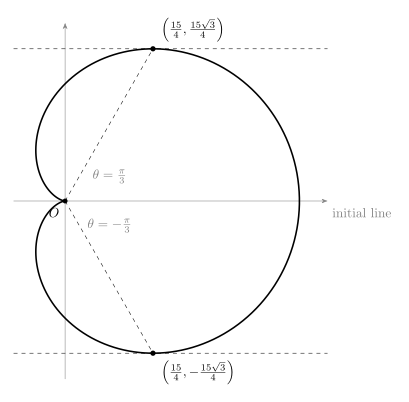
$y=r\sin\theta=5(1+\cos\theta)\sin\theta=5\sin\theta+5\sin\theta\cos\theta=5\sin\theta+\dfrac52\sin2\theta$.
$$\frac{dy}{d\theta}=5\cos\theta+5\cos2\theta=5\cos\theta+5(2\cos^2\theta-1)=10\cos^2\theta+5\cos\theta-5$$
Set to zero: $2\cos^2\theta+\cos\theta-1=0$, so $(2\cos\theta-1)(\cos\theta+1)=0$, giving $\cos\theta=\dfrac12$ or $\cos\theta=-1$.
Since $0<\theta<\dfrac\pi2$, we need $\cos\theta=\dfrac12$, so $\theta=\dfrac\pi3$.
Then $r=5\left(1+\dfrac12\right)=\dfrac{15}2$.
Exam-style questions
Question 1 7 marks
The curve $C$ has polar equation $r=2+\cos\theta$. Find the value of $\theta$, with $0<\theta<\pi$, at which the tangent to $C$ is perpendicular to the initial line, giving your answer to 3 significant figures if it is not exact.
$x=r\cos\theta=(2+\cos\theta)\cos\theta=2\cos\theta+\cos^2\theta$. (M1, A1)
$$\frac{dx}{d\theta}=-2\sin\theta-2\cos\theta\sin\theta=-2\sin\theta(1+\cos\theta)$$ (M1, A1)
Set to zero: $\sin\theta=0$ or $\cos\theta=-1$. For $0<\theta<\pi$, $\sin\theta\neq0$, and $\cos\theta=-1$ gives $\theta=\pi$, which is outside the open interval. (M1)
So there is no solution with $0<\theta<\pi$ — the tangent is never perpendicular to the initial line on this open interval (the curve is convex throughout, consistent with $p=2\geq2q=2$ in the dimple condition). (A1, A1)
Question 2 7 marks
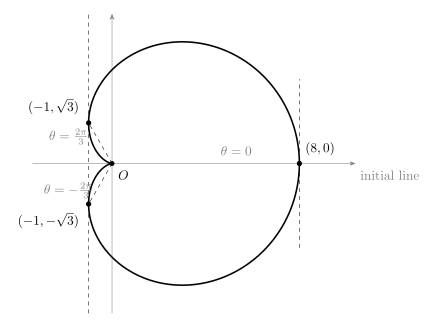
The curve $C$ has polar equation $r=4(1+\cos\theta)$. Find the value of $\theta$, with $0<\theta<\pi$, at which the tangent to $C$ is perpendicular to the initial line, and find the corresponding value of $r$.
$x=r\cos\theta=4(1+\cos\theta)\cos\theta=4\cos\theta+4\cos^2\theta$. (M1, A1)
$$\frac{dx}{d\theta}=-4\sin\theta-8\cos\theta\sin\theta=-4\sin\theta(1+2\cos\theta)$$ (M1, A1)
Set to zero: $\sin\theta=0$ or $\cos\theta=-\dfrac12$. For $0<\theta<\pi$, $\sin\theta\neq0$, so $\cos\theta=-\dfrac12$, giving $\theta=\dfrac{2\pi}3$. (M1)
Then $r=4\left(1-\dfrac12\right)=2$. (A1, A1)