Introduction to Hyperbolic Functions
sinh, cosh and tanh built from eˣ, their odd/even behaviour, and the shape of each graph.
Defining the hyperbolic functions
The hyperbolic functions are built directly from $e^x$:
$$\sinh x\equiv\frac{e^x-e^{-x}}2$$
$$\cosh x\equiv\frac{e^x+e^{-x}}2$$
$$\tanh x\equiv\frac{\sinh x}{\cosh x}=\frac{e^x-e^{-x}}{e^x+e^{-x}}$$
They are called hyperbolic because the point $(\cosh t,\sinh t)$ traces the right-hand branch of the hyperbola $x^2-y^2=1$, in the same way $(\cos t,\sin t)$ traces the unit circle. Three further reciprocal functions are defined analogously to $\sec,\csc,\cot$: $\operatorname{sech}x=\dfrac1{\cosh x}$, $\operatorname{cosech}x=\dfrac1{\sinh x}$, $\coth x=\dfrac1{\tanh x}$.
Since $e^{-x}$ swaps with $e^x$ under $x\to-x$: $\sinh(-x)=-\sinh x$ (odd), $\cosh(-x)=\cosh x$ (even), $\tanh(-x)=-\tanh x$ (odd) — matching the parity of their trigonometric namesakes.
$$\frac{e^x+e^{-x}}2=4 \;\Rightarrow\; e^x+e^{-x}=8$$
Multiply through by $e^x$: $e^{2x}+1=8e^x$, i.e. $e^{2x}-8e^x+1=0$.
Let $u=e^x$: $u^2-8u+1=0 \Rightarrow u=4\pm\sqrt{15}$.
Since $e^x>0$ and we want $x>0$, take the larger root: $e^x=4+\sqrt{15}$, so $x=\ln(4+\sqrt{15})=2.06$ (2 d.p.).
Graphs of the hyperbolic functions
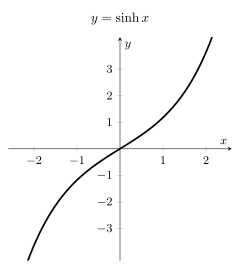
$y=\sinh x$: odd, passes through the origin, increases monotonically for all $x\in\mathbb R$, range $\mathbb R$.
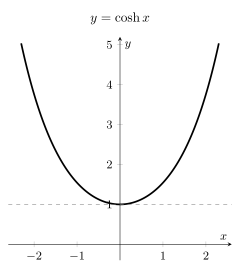
$y=\cosh x$: even, minimum value $1$ at $x=0$ (a "catenary" curve, the shape of a hanging chain), range $[1,\infty)$.
$y=\tanh x$: odd, passes through the origin, bounded between horizontal asymptotes $y=\pm1$ since $\tanh x\to1$ as $x\to\infty$ and $\tanh x\to-1$ as $x\to-\infty$, range $(-1,1)$.
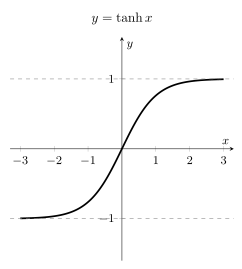
As $x\to\infty$, $e^{-x}\to0$, so $\tanh x=\dfrac{e^x-e^{-x}}{e^x+e^{-x}}\to\dfrac{e^x}{e^x}=1$.
As $x\to-\infty$, $e^{x}\to0$, so $\tanh x\to\dfrac{-e^{-x}}{e^{-x}}=-1$.
So $y=1$ and $y=-1$ are horizontal asymptotes, never actually reached.
Exam-style questions
Question 1 5 marks
Use the definition of $\sinh x$ in terms of exponentials to find, to 2 decimal places, the value of $x$ for which $\sinh x=-3$.
$\dfrac{e^x-e^{-x}}2=-3 \Rightarrow e^x-e^{-x}=-6$. (M1)
Multiply by $e^x$: $e^{2x}+6e^x-1=0$. (M1, A1)
$e^x=\dfrac{-6\pm\sqrt{40}}2=-3\pm\sqrt{10}$. Since $e^x>0$, take $e^x=-3+\sqrt{10}$. (M1)
$x=\ln(\sqrt{10}-3)=-1.82$ (2 d.p.). (A1)
Question 2 6 marks
On the same diagram, sketch $y=4\tanh x-1$, stating the equations of any asymptotes and the coordinates of any intercepts with the axes.
As $x\to\infty$, $\tanh x\to1$, so $y\to3$; as $x\to-\infty$, $\tanh x\to-1$, so $y\to-5$. Asymptotes: $y=3$ and $y=-5$. (M1, A1, A1)
At $x=0$: $y=4(0)-1=-1$, so $y$-intercept $(0,-1)$. (M1)
$x$-intercept: $4\tanh x=1\Rightarrow\tanh x=\dfrac14\Rightarrow x=\operatorname{artanh}\dfrac14=\dfrac12\ln\dfrac53$. (A1, A1)