Core Pure · Hyperbolic Functions · Year 2

Inverse Hyperbolic Functions

Deriving arsinh, arcosh and artanh as natural logarithms, and using them to solve equations.

8 min read 1 worked example

Inverse hyperbolic functions

Definition 6.2 — arsinh, arcosh, artanh

Since $\sinh$ and $\tanh$ are one-to-one on $\mathbb R$, they have inverses $\operatorname{arsinh}x$ and $\operatorname{artanh}x$ (domain $|x|<1$ for the latter). $\cosh x$ is only one-to-one for $x\geq0$, so $\operatorname{arcosh}x$ is defined with range restricted to $y\geq0$, domain $x\geq1$.
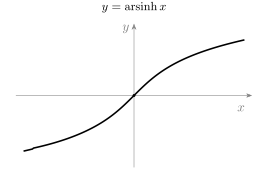
Graph of y = arsinh x, an increasing S-shaped curve through the origin, defined for all real x with range all real y
$y=\operatorname{arsinh}x$ — domain $x\in\mathbb R$, range $y\in\mathbb R$. Odd, one-to-one, and defined everywhere since $\sinh x$ itself takes every real value exactly once.
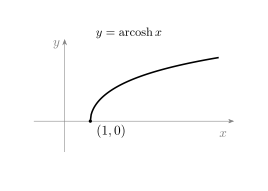
Graph of y = arcosh x, an increasing curve starting at the point (1,0), defined only for x greater than or equal to 1 with range y greater than or equal to 0
$y=\operatorname{arcosh}x$ — domain $x\geq1$, range $y\geq0$. Restricted to this branch because $\cosh x$ is only one-to-one for $x\geq0$; starts at $(1,0)$ where $\cosh0=1$.
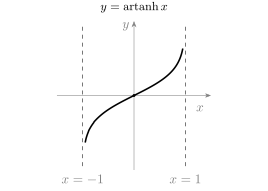
Graph of y = artanh x, an S-shaped curve through the origin with vertical asymptotes at x = -1 and x = 1, defined only for -1 less than x less than 1 with range all real y
$y=\operatorname{artanh}x$ — domain $-1\lt x\lt1$, range $y\in\mathbb R$. Vertical asymptotes at $x=\pm1$, matching the fact that $\tanh x\to\pm1$ only as $x\to\pm\infty$.
ProofArsinh x = ln(x + √(x² + 1))
1
Let $y=\operatorname{arsinh}x$, so $x=\sinh y=\dfrac{e^y-e^{-y}}2$.
2
Multiply by $2e^y$: $2xe^y=e^{2y}-1$, i.e. $e^{2y}-2xe^y-1=0$.
3
This is a quadratic in $e^y$: $e^y=\dfrac{2x\pm\sqrt{4x^2+4}}2=x\pm\sqrt{x^2+1}$.
4
Since $\sqrt{x^2+1}>|x|\geq x$, the root $x-\sqrt{x^2+1}$ is always negative, which is impossible since $e^y>0$. So $e^y=x+\sqrt{x^2+1}$, giving $y=\ln\left(x+\sqrt{x^2+1}\right)$.
∎
The other two logarithmic forms

By similar derivations: $\operatorname{arcosh}x=\ln\left(x+\sqrt{x^2-1}\right)$ for $x\geq1$, and $\operatorname{artanh}x=\dfrac12\ln\left(\dfrac{1+x}{1-x}\right)$ for $-1\lt x\lt1$.

ProofArcosh x = ln(x + √(x² − 1))
1
Let $y=\operatorname{arcosh}x$ (so $y\geq0$), giving $x=\cosh y=\dfrac{e^y+e^{-y}}2$.
2
Multiply by $2e^y$: $2xe^y=e^{2y}+1$, i.e. $e^{2y}-2xe^y+1=0$.
3
This is a quadratic in $e^y$: $e^y=\dfrac{2x\pm\sqrt{4x^2-4}}2=x\pm\sqrt{x^2-1}$.
4
Since $x\geq1$, both roots are positive, so both give a valid value of $e^y$ — but we also need $y\geq0$, i.e. $e^y\geq1$.
Note $\left(x-\sqrt{x^2-1}\right)\left(x+\sqrt{x^2-1}\right)=x^2-(x^2-1)=1$, so the two roots are reciprocals of each other. Since $x+\sqrt{x^2-1}\geq1$ (as $x\geq1$), its reciprocal $x-\sqrt{x^2-1}\leq1$.
5
So the root satisfying $e^y\geq1$ is $e^y=x+\sqrt{x^2-1}$, giving $y=\ln\left(x+\sqrt{x^2-1}\right)$, as required.
∎
ProofArtanh x = ½ln((1 + x)/(1 − x))
1
Let $y=\operatorname{artanh}x$, so $x=\tanh y=\dfrac{e^y-e^{-y}}{e^y+e^{-y}}$.
2
Multiply top and bottom by $e^y$: $x=\dfrac{e^{2y}-1}{e^{2y}+1}$.
3
Cross-multiply: $x\left(e^{2y}+1\right)=e^{2y}-1$, so $xe^{2y}+x=e^{2y}-1$.
4
Collect the $e^{2y}$ terms: $x+1=e^{2y}-xe^{2y}=e^{2y}(1-x)$, so $e^{2y}=\dfrac{1+x}{1-x}$.
5
Take $\ln$ of both sides and divide by 2: $y=\dfrac12\ln\left(\dfrac{1+x}{1-x}\right)$, as required.
The right-hand side is only defined (and positive inside the log) for $-1\lt x\lt1$, matching the domain of $\operatorname{artanh}$.
∎
Example 1 · Evaluating inverse hyperbolic functions
Express as natural logarithms: (a) $\operatorname{arsinh}2$, (b) $\operatorname{artanh}\dfrac15$.

(a) $\operatorname{arsinh}2=\ln\left(2+\sqrt{2^2+1}\right)=\ln\left(2+\sqrt5\right)$.

(b) $\operatorname{artanh}\dfrac15=\dfrac12\ln\left(\dfrac{1+\frac15}{1-\frac15}\right)=\dfrac12\ln\left(\dfrac{6/5}{4/5}\right)=\dfrac12\ln\dfrac32$.

Exam-style questions

Question 1 4 marks

Show that $\operatorname{arcosh}3=\ln\left(3+2\sqrt2\right)$.

$\operatorname{arcosh}3=\ln\left(3+\sqrt{3^2-1}\right)=\ln\left(3+\sqrt8\right)$. (M1, A1)

$\sqrt8=2\sqrt2$, so $\operatorname{arcosh}3=\ln\left(3+2\sqrt2\right)$, as required. (M1, A1)

Question 2 4 marks

Solve $\operatorname{arsinh}(2x)=\ln3$, giving your answer as an exact fraction.

$\operatorname{arsinh}(2x)=\ln3 \Rightarrow 2x=\sinh(\ln3)$. (M1)

$\sinh(\ln3)=\dfrac{e^{\ln3}-e^{-\ln3}}2=\dfrac{3-\frac13}2=\dfrac{8/3}2=\dfrac43$. (M1, A1)

So $2x=\dfrac43$, giving $x=\dfrac23$. (A1)

Question 3 5 marks

Sketch the graph of $y=\operatorname{arsinh}(x+3)$, stating its domain and range, and the exact coordinates of the points where the curve crosses the coordinate axes.

Since $\operatorname{arsinh}$ has domain $x\in\mathbb R$ and range $y\in\mathbb R$, replacing $x$ with $x+3$ is a horizontal translation only, so the domain remains $x\in\mathbb R$ and the range remains $y\in\mathbb R$. (B1, B1)

$x$-intercept: set $y=0$, so $\operatorname{arsinh}(x+3)=0\Rightarrow x+3=0\Rightarrow x=-3$, giving $(-3,0)$. (M1, A1)

$y$-intercept: set $x=0$, so $y=\operatorname{arsinh}3=\ln\left(3+\sqrt{3^2+1}\right)=\ln\left(3+\sqrt{10}\right)$, giving $\left(0,\ln(3+\sqrt{10})\right)$. (A1)
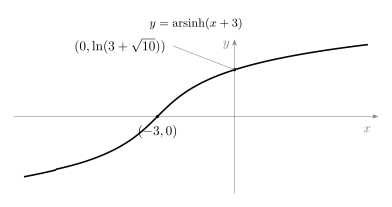
Graph of y = arsinh(x+3), the standard arsinh S-curve translated 3 units left, crossing the x-axis at (-3,0) and the y-axis at (0, ln(3+root 10))
$y=\operatorname{arsinh}(x+3)$ — the arsinh curve shifted 3 units left, so its point of inflection moves from the origin to $(-3,0)$.

Question 4 5 marks

Sketch the graph of $y=\operatorname{arcosh}(x-2)+1$, stating its domain and range, and the exact coordinates of its starting point.

$\operatorname{arcosh}$ has domain $x\geq1$, so $\operatorname{arcosh}(x-2)$ needs $x-2\geq1$, i.e. $x\geq3$. (M1, A1)

$\operatorname{arcosh}$ has range $y\geq0$, and adding $1$ shifts this to $y\geq1$. (A1)

The starting point of $\operatorname{arcosh}$ is $(1,0)$; the transformation $x\mapsto x-2$ shifts this to $x=3$, and $y\mapsto y+1$ shifts the $y$-value to $0+1=1$, giving the starting point $(3,1)$. (M1, A1)
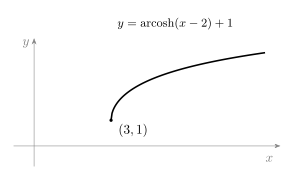
Graph of y = arcosh(x-2)+1, the standard arcosh curve translated 2 units right and 1 unit up, starting at the point (3,1)
$y=\operatorname{arcosh}(x-2)+1$ — the arcosh curve translated $2$ right and $1$ up, so its starting point moves from $(1,0)$ to $(3,1)$.

Question 5 5 marks

Sketch the graph of $y=\operatorname{artanh}\left(\dfrac x2\right)$, stating its domain and range, and the equations of its asymptotes.

$\operatorname{artanh}$ has domain $-1\lt x\lt1$, so $\operatorname{artanh}\left(\dfrac x2\right)$ needs $-1\lt\dfrac x2\lt1$, i.e. $-2\lt x\lt2$. (M1, A1)

Since a horizontal stretch does not affect the $y$-values taken, the range is still $y\in\mathbb R$. (B1)

The asymptotes of $\operatorname{artanh}x$ are at $x=\pm1$; the stretch $x\mapsto\dfrac x2$ (i.e. a stretch of scale factor $2$ parallel to the $x$-axis) moves these to $x=\pm2$. (M1, A1)
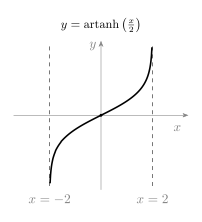
Graph of y = artanh(x/2), the standard artanh S-curve stretched horizontally by scale factor 2, with vertical asymptotes at x = -2 and x = 2
$y=\operatorname{artanh}\left(\dfrac x2\right)$ — the artanh curve stretched by scale factor $2$ parallel to the $x$-axis, moving the asymptotes from $x=\pm1$ to $x=\pm2$.