Area Enclosed by a Polar Curve
The sector-area formula for polar regions, built from summing infinitely many thin circular sectors.
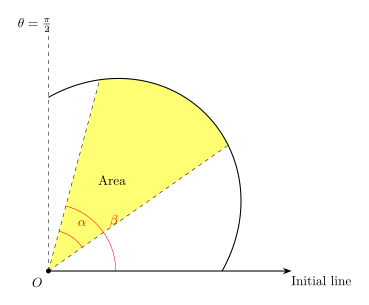
Area enclosed by a polar curve
The area enclosed by the curve $r=f(\theta)$ between the half-lines $\theta=\alpha$ and $\theta=\beta$ (measured from the pole) is
$$A=\frac12\int_\alpha^\beta r^2\,d\theta$$
The full curve is traced as $\theta$ runs from $-\pi$ to $\pi$, so
$$A=\frac12\int_{-\pi}^\pi 16(1+\cos\theta)^2\,d\theta=8\int_{-\pi}^\pi(1+2\cos\theta+\cos^2\theta)\,d\theta$$
Using $\cos^2\theta=\dfrac12(1+\cos2\theta)$:
$$A=8\int_{-\pi}^\pi\left(\frac32+2\cos\theta+\frac12\cos2\theta\right)d\theta=8\left[\frac32\theta+2\sin\theta+\frac14\sin2\theta\right]_{-\pi}^\pi$$
$$A=8\left(\frac{3\pi}2-\left(-\frac{3\pi}2\right)\right)=8\times3\pi=24\pi$$
By symmetry about the initial line, consider $0\leq\theta\leq\dfrac\pi2$ and double.
For $0\leq\theta\leq\dfrac\pi2$, $C_2$ is the inner boundary (check at $\theta=0$: $C_2$ gives $r=0$, well inside $C_1$'s $r=6$), so the region inside both is bounded by $C_2$ here.
For $\dfrac\pi2\leq\theta\leq\pi$, $C_1$ becomes the inner boundary (at $\theta=\pi$, $C_2$ gives $r=12>6=C_1$).
By the symmetry of the whole figure about the initial line:
$$A=2\left[\frac12\int_0^{\pi/2}36(1-\cos\theta)^2\,d\theta+\frac12\int_{\pi/2}^\pi 36\,d\theta\right]$$
The second integral: $\dfrac12\times36\times\dfrac\pi2=9\pi$.
The first: $18\displaystyle\int_0^{\pi/2}(1-2\cos\theta+\cos^2\theta)\,d\theta=18\int_0^{\pi/2}\left(\frac32-2\cos\theta+\frac12\cos2\theta\right)d\theta$
$$=18\left[\frac32\theta-2\sin\theta+\frac14\sin2\theta\right]_0^{\pi/2}=18\left(\frac{3\pi}4-2\right)=\frac{27\pi}2-36$$
So $A=2\left(\dfrac{27\pi}2-36+9\pi\right)=2\left(\dfrac{45\pi}2-36\right)=45\pi-72$.
Exam-style questions
Question 1 6 marks
Find the area enclosed by the curve $r=3\sin2\theta$, for $0\leq\theta\leq\dfrac\pi2$ (one petal).
$$A=\frac12\int_0^{\pi/2}9\sin^22\theta\,d\theta=\frac92\int_0^{\pi/2}\frac{1-\cos4\theta}2\,d\theta$$ (M1, A1, M1)
$$=\frac94\left[\theta-\frac14\sin4\theta\right]_0^{\pi/2}=\frac94\times\frac\pi2=\frac{9\pi}8$$ (A1, A1, A1)
Question 2 5 marks
Find the area of the region enclosed by one petal of the curve $r=6\cos3\theta$.
One petal runs from $\theta=-\dfrac\pi6$ to $\theta=\dfrac\pi6$. (B1)
$$A=\frac12\int_{-\pi/6}^{\pi/6}36\cos^23\theta\,d\theta=18\int_{-\pi/6}^{\pi/6}\frac{1+\cos6\theta}2\,d\theta$$ (M1, A1)
$$=9\left[\theta+\frac16\sin6\theta\right]_{-\pi/6}^{\pi/6}=9\left(\frac\pi6+\frac\pi6\right)=3\pi$$ (A1, A1)