Sketching Polar Curves
Circles, cardioids and petal curves — how the shape of r = f(θ) reveals itself point by point.
Sketching curves point by point
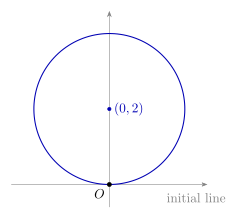
To sketch $r=f(\theta)$: build a table of $r$ against $\theta$ at convenient angles (typically multiples of $\dfrac\pi6$ or $\dfrac\pi4$), plot the resulting points, and join them smoothly. Pay close attention to values of $\theta$ where $r=0$ (the curve passes through the pole) and where $r$ is at a maximum or minimum. Remember $r\geq0$ — if $f(\theta)<0$ for some interval, that interval is simply excluded from the curve.
At $\theta=0$, $r=0$. At $\theta=\dfrac\pi2$, $r=4$ (maximum distance). At $\theta=\pi$, $r=0$ again. Between these, $r$ rises smoothly to $4$ and falls back to $0$, tracing a single loop from the pole, up and around, back to the pole — this is in fact a circle of radius $2$ passing through the pole, centred at $\left(0,2\right)$ in Cartesian terms (which can be checked by converting: $r=4\sin\theta\Rightarrow r^2=4r\sin\theta\Rightarrow x^2+y^2=4y$, i.e. $x^2+(y-2)^2=4$).
Cardioids
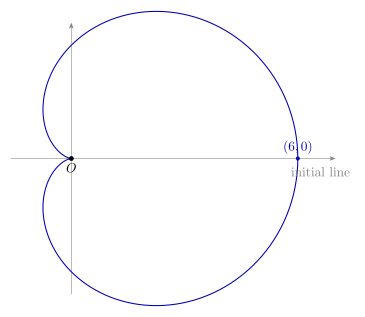
Curves of the form $r=a(1+\cos\theta)$ (or with $\sin$) are called cardioids because of their heart-like shape. At $\theta=0$, $r=2a$ (furthest point); at $\theta=\pi$, $r=0$, so the curve returns to the pole and forms a single cusp there rather than crossing itself.
$\theta=0$: $r=3(1+1)=6$. $\quad\theta=\dfrac\pi2$: $r=3(1+0)=3$. $\quad\theta=\pi$: $r=3(1+(-1))=0$.
By symmetry (since $\cos$ is even), the curve is symmetric about the initial line. It bulges out to $r=6$ along $\theta=0$, narrows to $r=3$ at $\theta=\pm\dfrac\pi2$, and pinches to a single point (a cusp) at the pole when $\theta=\pi$.
Petal (rose) curves
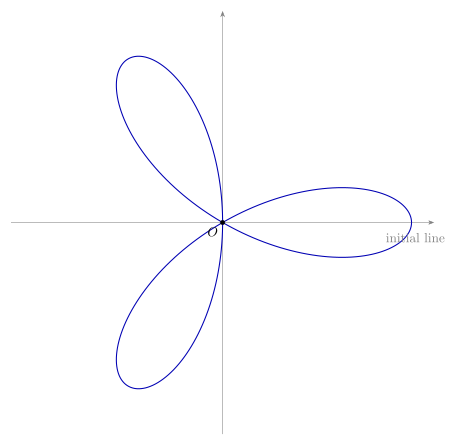
These trace out a "flower" of loops (petals). If $n$ is odd, the curve has $n$ petals; if $n$ is even, it has $2n$ petals (because $\sin(n\theta)$ becomes negative — and therefore excluded — over exactly half of each period when $n$ is even, effectively doubling the number of separate visible loops compared to what you might first expect). Each petal has maximum length $a$, reached when $n\theta=\dfrac\pi2+k\pi$.
Here $n=3$ is odd, so there are $3$ petals, each of maximum length $5$.
$r=0$ when $\cos3\theta=0$, i.e. $3\theta=\dfrac\pi2+k\pi$, so $\theta=\dfrac\pi6,\dfrac\pi2,\dfrac{5\pi}6,\ldots$ — these are the angles at which the curve passes through the pole, between consecutive petals.
The first petal runs from $\theta=-\dfrac\pi6$ to $\theta=\dfrac\pi6$ (symmetric about the initial line, reaching $r=5$ at $\theta=0$); the other two petals are rotated by $\dfrac{2\pi}3$ and $\dfrac{4\pi}3$ from the first.
Classifying r = a(p + q cosθ)
For $r=a(p+q\cos\theta)$ with $p,q>0$, the shape depends on comparing $p$ with $2q$:
· If $p\geq2q$: a convex closed curve with no dimple (an "oval").
· If $q
· If $p\lt q$: the curve has an inner loop.
This classification is proved rigorously by examining $\dfrac{dx}{d\theta}$, covered in the next lesson.
Exam-style questions
Question 1 4 marks
State the number of petals of the curve $r=2\sin4\theta$, and state the maximum value of $r$.
$n=4$ is even, so the curve has $2n=8$ petals. (B1, B1)
Maximum value of $r$ is $2$ (the coefficient $a$). (B2)
Question 2 6 marks
The curve $C$ has polar equation $r=7\cos\theta$, for $-\dfrac\pi2\leq\theta\leq\dfrac\pi2$. Show that $C$ is a circle, stating its radius and Cartesian centre.
Multiply by $r$: $r^2=7r\cos\theta$. (M1)
Substitute $r^2=x^2+y^2$, $r\cos\theta=x$: $x^2+y^2=7x$. (M1, A1)
Complete the square: $\left(x-\dfrac72\right)^2+y^2=\dfrac{49}4$. (M1, A1)
This is a circle, centre $\left(\dfrac72,0\right)$, radius $\dfrac72$. (A1)
Question 3 5 marks
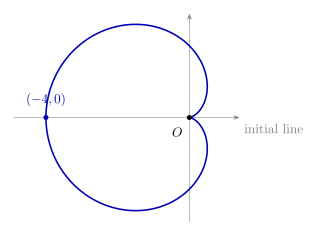
Sketch $r=2(1-\cos\theta)$ for $-\pi<\theta\leq\pi$, marking the value of $r$ at $\theta=0,\dfrac{\pi}2,\pi$, and state the name given to this shape.
$\theta=0$: $r=2(1-1)=0$. $\quad\theta=\dfrac\pi2$: $r=2(1-0)=2$. $\quad\theta=\pi$: $r=2(1-(-1))=4$. (M1, A1, A1)
The curve starts at the pole, bulges out to $r=4$ along $\theta=\pi$ (i.e. in the negative-$x$ direction), symmetric about the initial line. This is a cardioid. (A1, B1)