Polar Coordinates & Equations
Describe a point by distance and angle instead of x and y — and translate freely between the two systems.
A new coordinate system
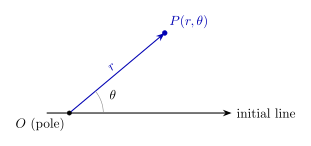
Instead of describing a point by its horizontal and vertical distances $(x,y)$, polar coordinates describe a point by its distance from a fixed point $O$ (the pole), and the angle turned from a fixed ray (the initial line, corresponding to the positive $x$-axis). A point is written $(r,\theta)$, where $r\geq0$ is the distance from the pole and $\theta$ is measured anticlockwise from the initial line, usually in radians with $-\pi<\theta\leq\pi$ (though other ranges are sometimes used for a specific curve).
Placing the pole at the Cartesian origin and the initial line along the positive $x$-axis, basic right-angled trigonometry in the triangle formed by $O$, the point, and its foot on the $x$-axis gives:
$$x=r\cos\theta$$
$$y=r\sin\theta$$
$$r^2=x^2+y^2$$
$$\tan\theta=\frac yx \; (x\neq0)$$
$r=\sqrt{(-4)^2+(4\sqrt3)^2}=\sqrt{16+48}=\sqrt{64}=8$.
The point is in the second quadrant. The reference angle is $\arctan\left(\dfrac{4\sqrt3}4\right)=\arctan(\sqrt3)=\dfrac\pi3$, so $\theta=\pi-\dfrac\pi3=\dfrac{2\pi}3$.
Polar coordinates: $\left(8,\dfrac{2\pi}3\right)$.
$x=6\cos\dfrac{5\pi}6=6\times\left(-\dfrac{\sqrt3}2\right)=-3\sqrt3$.
$y=6\sin\dfrac{5\pi}6=6\times\dfrac12=3$.
Cartesian coordinates: $(-3\sqrt3,3)$.
Polar equations of curves
A curve's polar equation is usually written $r=f(\theta)$, giving the distance from the pole as a function of the angle. Simple examples include $r=a$ (a circle of radius $a$ centred at the pole) and $r=a\theta$ (a spiral, since $r$ grows steadily as $\theta$ increases).
Use the substitutions $x=r\cos\theta$, $y=r\sin\theta$ and $r^2=x^2+y^2$. Often it helps to first multiply both sides of the polar equation by a suitable power of $r$ so that every term becomes expressible using these substitutions.
Multiply both sides by $r$: $r^2=3r+2r\cos\theta$.
Substitute $r^2=x^2+y^2$ and $r\cos\theta=x$: $x^2+y^2=3r+2x$.
The remaining $r$ needs eliminating too: $r=\sqrt{x^2+y^2}$, so $x^2+y^2-2x=3\sqrt{x^2+y^2}$.
This is an acceptable final Cartesian equation — polar equations often don't simplify to a "nice" $y=\ldots$ form.
Substitute $x=r\cos\theta$ and $y=r\sin\theta$ directly into the Cartesian equation, then simplify (often dividing through by a common power of $r$) to isolate $r$ as a function of $\theta$.
Substitute: $r\cos\theta+r\sin\theta\sqrt3=6$.
Factor out $r$: $r(\cos\theta+\sqrt3\sin\theta)=6$, so $r=\dfrac6{\cos\theta+\sqrt3\sin\theta}$.
By convention $r\geq0$ always. If an equation you derive would give a negative value of $r$ for some $\theta$, that particular $\theta$ simply isn't part of the curve for this branch — you don't flip the sign of $r$ to "fix" it (some textbooks allow negative $r$ with a separate convention, but this course restricts to $r\geq0$ throughout).
Exam-style questions
Question 1 5 marks
Find the polar coordinates of the point with Cartesian coordinates $(-5,-5)$, giving $r$ exactly and $\theta$ in radians with $-\pi<\theta\leq\pi$.
$r=\sqrt{(-5)^2+(-5)^2}=\sqrt{50}=5\sqrt2$. (M1, A1)
The point is in the third quadrant; reference angle $\arctan\left(\dfrac55\right)=\dfrac\pi4$, so $\theta=-\left(\pi-\dfrac\pi4\right)=-\dfrac{3\pi}4$. (M1, A1)
Polar coordinates: $\left(5\sqrt2,-\dfrac{3\pi}4\right)$. (A1)
Question 2 6 marks
Find a Cartesian equation of the curve with polar equation $r^2=\cos2\theta$, for $0\leq\theta<\dfrac\pi2$.
$r^2=\cos2\theta=\cos^2\theta-\sin^2\theta$. (M1, A1)
Multiply both sides by $r^2$: $r^4=r^2\cos^2\theta-r^2\sin^2\theta=(r\cos\theta)^2-(r\sin\theta)^2=x^2-y^2$. (M1, A1)
Since $r^2=x^2+y^2$, $r^4=(x^2+y^2)^2$, so the Cartesian equation is $(x^2+y^2)^2=x^2-y^2$. (A1, A1)
Question 3 5 marks
Find a polar equation of the circle with Cartesian equation $x^2+y^2=6x$, giving your answer in the form $r=f(\theta)$.
$x^2+y^2=r^2$ and $x=r\cos\theta$, so $r^2=6r\cos\theta$. (M1, A1)
Dividing by $r$ (valid since $r=0$, the pole, trivially satisfies both forms): $r=6\cos\theta$. (M1, A1, A1)