Reflections & Rotations
Two of the most familiar transformations, both captured perfectly by a matrix — and a neat trigonometric derivation shows exactly where the rotation matrix comes from.
Reflections
Reflection in the $x$-axis is represented by the matrix:
Reflection in the $y$-axis is represented by the matrix:
Reflection in the line $y=x$ is represented by the matrix:
Reflection in the line $y=-x$ is represented by the matrix:
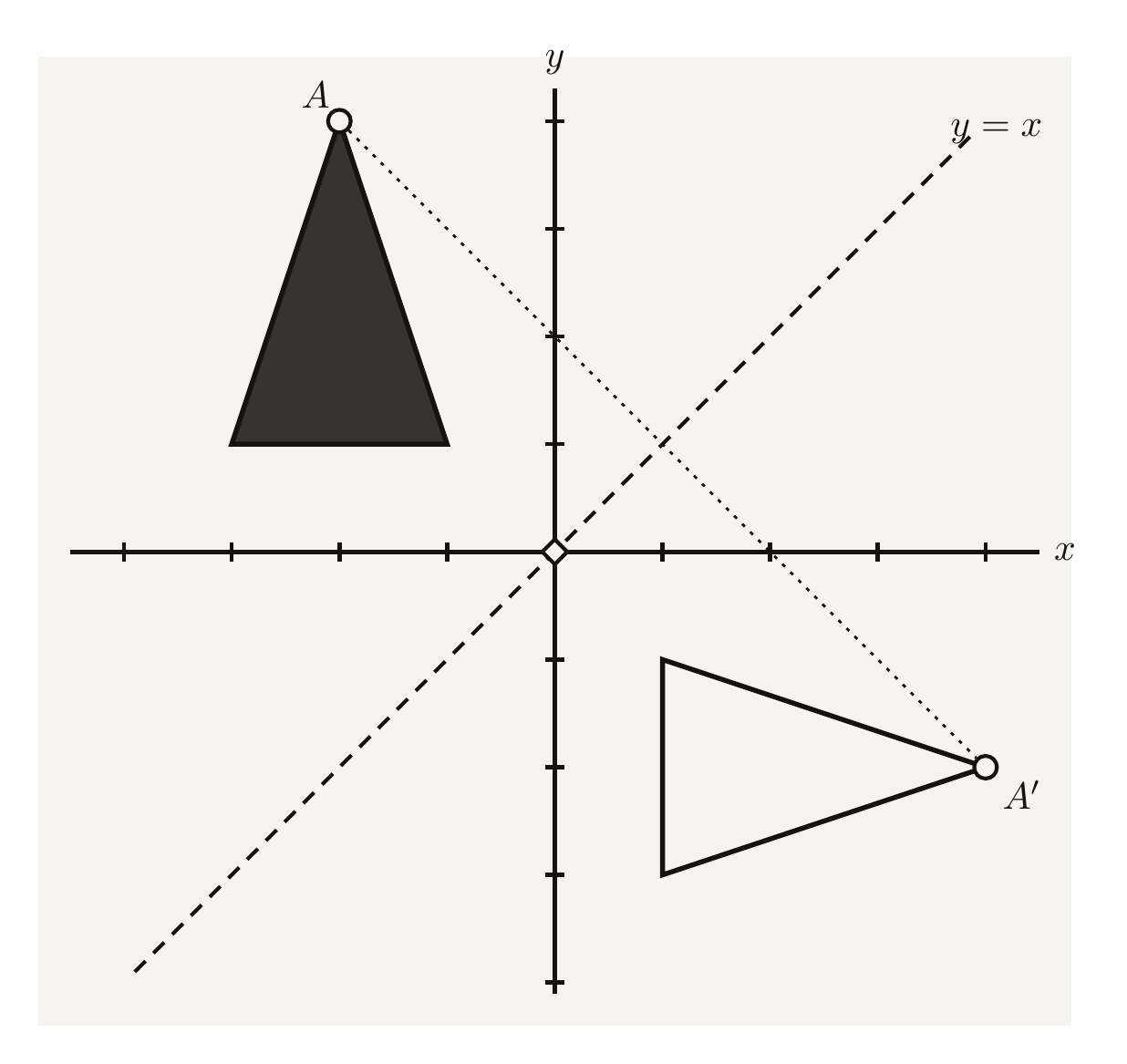
Reflecting $(1,0)$ in $y=x$ swaps its coordinates: image is $(0,1)$. Reflecting $(0,1)$ gives $(1,0)$.
These images become the columns: $M=\begin{pmatrix}0&1\\1&0\end{pmatrix}$.
For reflection in the mirror line $\ell$, every point on $\ell$ is invariant (mapped to itself). Any line perpendicular to $\ell$ is also an invariant line as a whole, even though the individual points on it move — they simply swap to the mirrored position on the same perpendicular line. For example, reflecting in the $x$-axis fixes every point on $y=0$, and maps each vertical line $x=k$ onto itself.
Rotations
Rotation about the origin by angle $\theta$ anticlockwise is given by $$R_\theta=\begin{pmatrix}\cos\theta&-\sin\theta\\\sin\theta&\cos\theta\end{pmatrix}$$
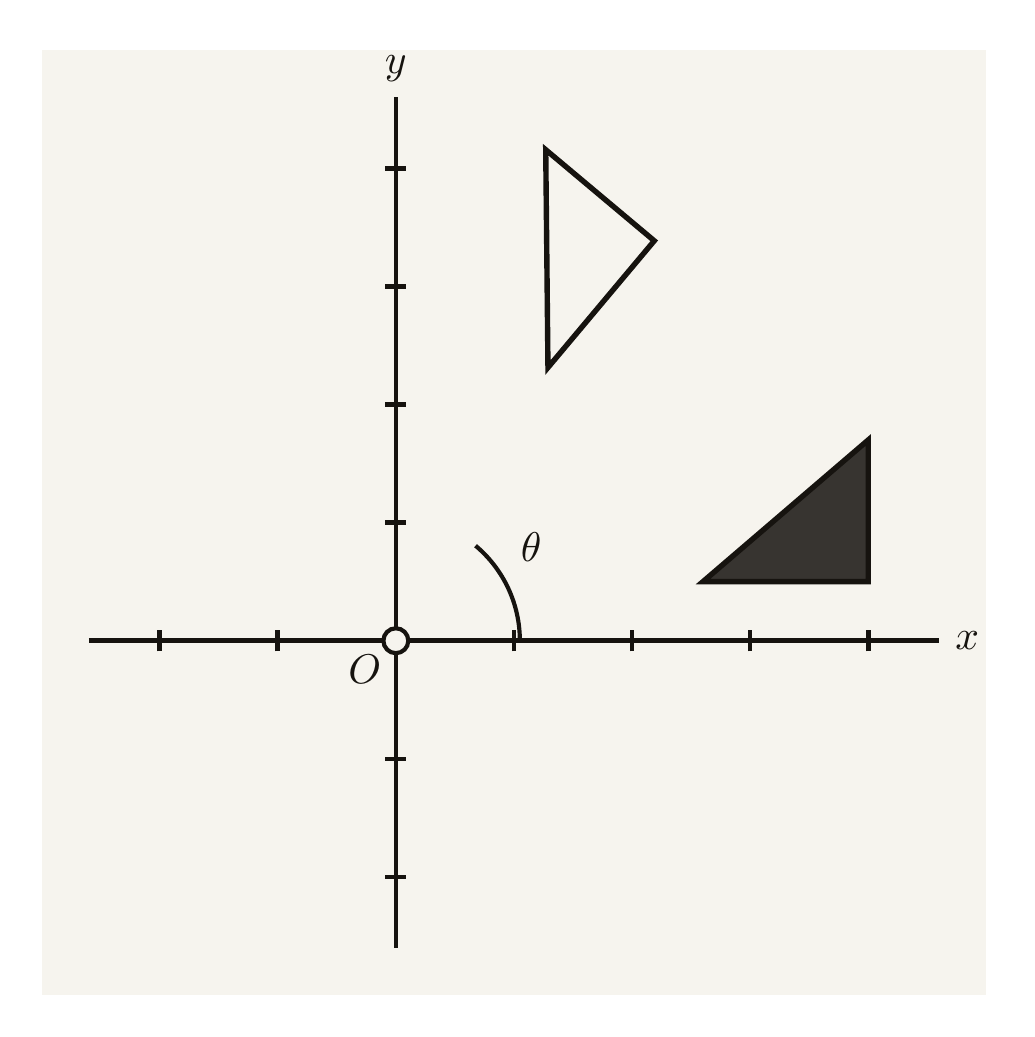
Substituting the common angles into $R_\theta$ gives matrices you should recognise on sight:
$R_{90°}=\begin{pmatrix}0&-1\\1&0\end{pmatrix}$, $\quad R_{180°}=\begin{pmatrix}-1&0\\0&-1\end{pmatrix}$, $\quad R_{270°}=\begin{pmatrix}0&1\\-1&0\end{pmatrix}$.
The only invariant point for any rotation (other than $0°$ or $360°$) is the origin. The single exception is $\theta=180°$: because this sends every point to its negative, every line through the origin is invariant as a whole (though no point on it besides the origin is individually fixed) — for any other angle, there are no invariant lines at all.
Comparing with $R_\theta$: $\cos\theta=0$, $\sin\theta=1$, so $\theta=90°$.
$M$ represents a rotation of $90°$ anticlockwise about the origin.
$\cos150°=-\dfrac{\sqrt3}{2}$, $\sin150°=\dfrac12$.
$\cos\theta=-\dfrac{1}{\sqrt2}$ and $\sin\theta=\dfrac{1}{\sqrt2}$: both conditions match $\theta=135°$ (second quadrant, since cosine negative and sine positive).
Confusing the reflection matrix for $y=x$ (swap coordinates) with a $90°$ rotation — although both matrices involve $0$s and $1$s in similar positions, $\begin{pmatrix}0&1\\1&0\end{pmatrix}$ (reflection, $\det=-1$) and $\begin{pmatrix}0&-1\\1&0\end{pmatrix}$ (rotation, $\det=1$) are very different transformations. Checking the determinant is a quick way to distinguish: reflections always have $\det=-1$, rotations always have $\det=1$.
Exam-style questions
Question 1 5 marks
Find the matrix representing a rotation of $180°$ about the origin, and describe an alternative single transformation that has the same effect.
$R_{180°}=\begin{pmatrix}\cos180°&-\sin180°\\\sin180°&\cos180°\end{pmatrix}=\begin{pmatrix}-1&0\\0&-1\end{pmatrix}$ (M1, A1)
This is the same as an enlargement with scale factor $-1$ centred at the origin (a point reflection through the origin). (B1, B1, B1)
Question 2 5 marks
Describe fully the transformation represented by $M=\begin{pmatrix}-1&0\\0&1\end{pmatrix}$, and find the image of the point $(3,-4)$ under this transformation.
Reflection in the $y$-axis. (B1, B1)
$M\begin{pmatrix}3\\-4\end{pmatrix}=\begin{pmatrix}-3\\-4\end{pmatrix}$ (M1, A1, A1)
Question 3 6 marks
Find the exact matrix representing rotation by $210°$ about the origin, and use it to find the image of $(2,0)$.
$\cos210°=-\dfrac{\sqrt3}{2}$, $\sin210°=-\dfrac12$ (M1, A1)
$R_{210°}=\begin{pmatrix}-\frac{\sqrt3}{2}&\frac12\\-\frac12&-\frac{\sqrt3}{2}\end{pmatrix}$ (A1, A1)
$R_{210°}\begin{pmatrix}2\\0\end{pmatrix}=\begin{pmatrix}-\sqrt3\\-1\end{pmatrix}$ (M1, A1)