Enlargements & Stretches
Diagonal matrices scale space uniformly or unevenly, and the determinant tells you precisely how much bigger — or how oriented — the result becomes.
Enlargements
Enlargement, scale factor $k$, centred at the origin (both directions scaled equally): $$\begin{pmatrix}k&0\\0&k\end{pmatrix}$$ Negative $k$ combines the enlargement with a $180°$ rotation (point reflection through the origin).
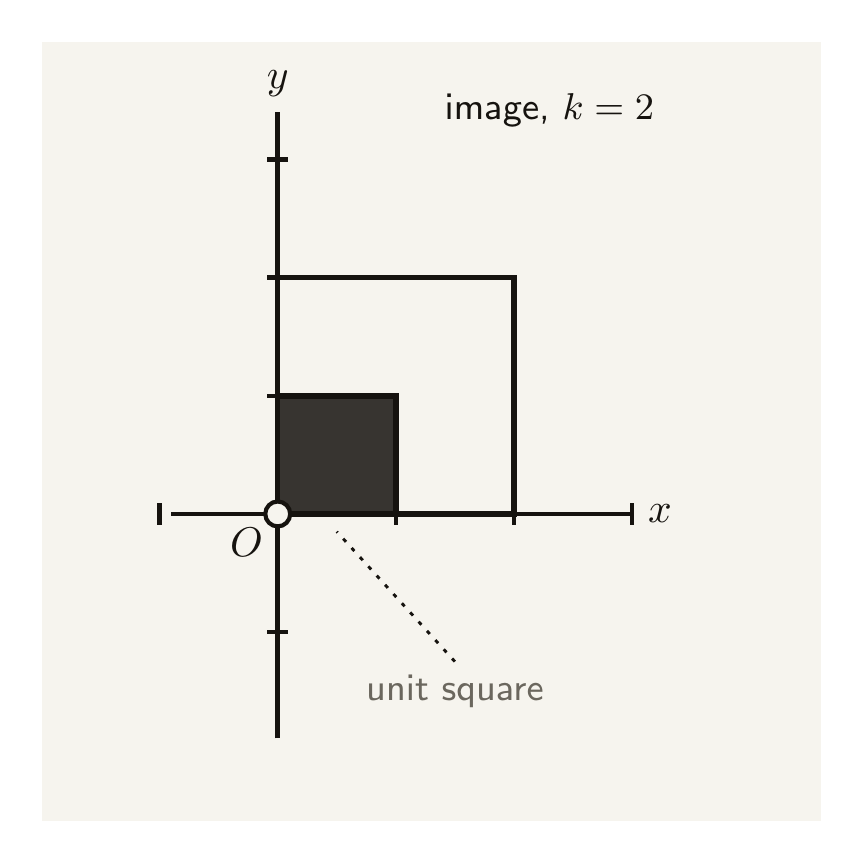
Stretches
Stretch scale factor $a$ parallel to the $x$-axis (the $y$-coordinate is unchanged): $\begin{pmatrix}a&0\\0&1\end{pmatrix}$. Stretch scale factor $b$ parallel to the $y$-axis: $\begin{pmatrix}1&0\\0&b\end{pmatrix}$. A combination of both gives a general non-uniform scaling $\begin{pmatrix}a&0\\0&b\end{pmatrix}$. When $a=b$, this non-uniform scaling becomes an ordinary enlargement.
For any transformation of the form $\begin{pmatrix}a&0\\0&b\end{pmatrix}$, the origin is always invariant, and the $x$-axis and $y$-axis are always invariant lines as a whole — but the individual points on them are only invariant if the corresponding scale factor is $1$. Specifically:
- Stretch parallel to the $x$-axis only ($\begin{pmatrix}a&0\\0&1\end{pmatrix}$): points on the $y$-axis are individually invariant (since $x=0$ stays fixed), and every line parallel to the $x$-axis maps onto itself.
- Stretch parallel to the $y$-axis only ($\begin{pmatrix}1&0\\0&b\end{pmatrix}$): points on the $x$-axis are individually invariant, and every line parallel to the $y$-axis maps onto itself.
- A stretch acting in both directions ($a\neq1$ and $b\neq1$) still leaves the two axes invariant as lines, but no point on either axis (other than the origin) is individually fixed — each non-zero point on an axis simply slides to a different point on the same axis.
$\begin{pmatrix}4&0\\0&4\end{pmatrix}\begin{pmatrix}3\\-2\end{pmatrix}=\begin{pmatrix}12\\-8\end{pmatrix}$.
Matrix: $\begin{pmatrix}3&0\\0&1\end{pmatrix}$. Applying it to $(0,5)$: $\begin{pmatrix}3&0\\0&1\end{pmatrix}\begin{pmatrix}0\\5\end{pmatrix}=\begin{pmatrix}0\\5\end{pmatrix}$ — unchanged, so invariant, as expected since it lies on the $y$-axis.
Applying it to $(4,0)$: $\begin{pmatrix}3&0\\0&1\end{pmatrix}\begin{pmatrix}4\\0\end{pmatrix}=\begin{pmatrix}12\\0\end{pmatrix}$ — this has moved, although it remains on the $x$-axis (which is an invariant line, just not a line of invariant points).
Area scale factor and the determinant
Under a transformation with matrix $M$, the area of any shape is multiplied by $|\det(M)|$. If $\det(M)<0$, the transformation also reverses orientation (e.g. clockwise becomes anticlockwise) as well as scaling area by $|\det(M)|$.
$\det(M)=3(4)-1(-2)=12+2=14$.
New area $=6\times14=84$.
Area scale factor $=|\det(M)|=|2k|$.
$3\times|2k|=30 \Rightarrow |2k|=10 \Rightarrow |k|=5 \Rightarrow k=5$ or $k=-5$.
$\det(M)=2(-3)-0=-6$.
Since $\det(M)<0$, the transformation reverses orientation. Area scale factor $=|-6|=6$.
Area scale factor is $|\det(M)|$, always non-negative — students sometimes forget the modulus and quote a negative "scale factor," which doesn't make sense for an actual area.
Exam-style questions
Question 1 5 marks
A shape of area $12$ is transformed by $M=\begin{pmatrix}5&2\\1&3\end{pmatrix}$. Find the area of the image.
$\det(M)=5(3)-2(1)=13$ (M1, A1)
New area $=12\times13=156$ (M1, A1, A1)
Question 2 6 marks
The transformation $M=\begin{pmatrix}3&0\\0&k\end{pmatrix}$ maps a shape of area $5$ to an image of area $45$, and reverses orientation. Find $k$.
$5|3k|=45 \Rightarrow |3k|=9 \Rightarrow |k|=3 \Rightarrow k=\pm3$ (M1, A1, A1)
Since orientation is reversed, $\det(M)<0 \Rightarrow 3k<0 \Rightarrow k<0$, so $k=-3$ (M1, A1, A1)
Question 3 5 marks
Find the image of the point $(-2,5)$ under a stretch of scale factor $3$ parallel to the $x$-axis, combined with a stretch of scale factor $\dfrac12$ parallel to the $y$-axis (applied as a single combined transformation).
Combined matrix: $\begin{pmatrix}3&0\\0&\frac12\end{pmatrix}$ (M1, A1)
$\begin{pmatrix}3&0\\0&\frac12\end{pmatrix}\begin{pmatrix}-2\\5\end{pmatrix}=\begin{pmatrix}-6\\\frac52\end{pmatrix}$ (M1, A1, A1)