Linear Transformations in Two Dimensions
Every 2×2 matrix defines a transformation of the plane — where the standard basis vectors land tells you the whole matrix.
What makes a transformation linear
A transformation of the plane is called linear if it can be written entirely using terms of the form (constant)$\times x$ and (constant)$\times y$ — no constants added on their own, no powers, no products like $xy$. Equivalently, a transformation $T$ is linear exactly when both of the following hold for all points and all scalars $k$:
$$T(k\mathbf{x})=kT(\mathbf{x})$$ $$\text{and}$$ $$T(\mathbf{x}_1+\mathbf{x}_2)=T(\mathbf{x}_1)+T(\mathbf{x}_2)$$
A direct consequence: every linear transformation fixes the origin, since $T(\mathbf{0})=T(0\cdot\mathbf{0})=0\cdot T(\mathbf{0})=\mathbf{0}$. Any rule with a "$+c$" term shifting position (a translation) is therefore never linear.
$P$ only involves the terms $3x$, $-y$, $x$, $2y$ — each is a constant times $x$ or $y$, with no terms added on their own. So $P$ is linear, and can be written as a matrix: $\begin{pmatrix}3&-1\\1&2\end{pmatrix}$.
$Q$ has a "$+5$" in its second coordinate that isn't a multiple of $x$ or $y$. Checking the origin confirms this: $Q(0,0)=(0,5)\neq(0,0)$, so $Q$ cannot be linear — it is a translation combined with a stretch, not a linear transformation, and has no matrix representation.
Matrices as transformations
A $2\times2$ matrix $M$ transforms a point $(x,y)$ (as a column vector) to $M\begin{pmatrix}x\\y\end{pmatrix}$. Because $M\begin{pmatrix}1\\0\end{pmatrix}$ is the first column of $M$ and $M\begin{pmatrix}0\\1\end{pmatrix}$ is the second column, the columns of $M$ are the images of the unit vectors $\mathbf{i}=(1,0)$ and $\mathbf{j}=(0,1)$. This is the fastest way to build or read off a transformation matrix.
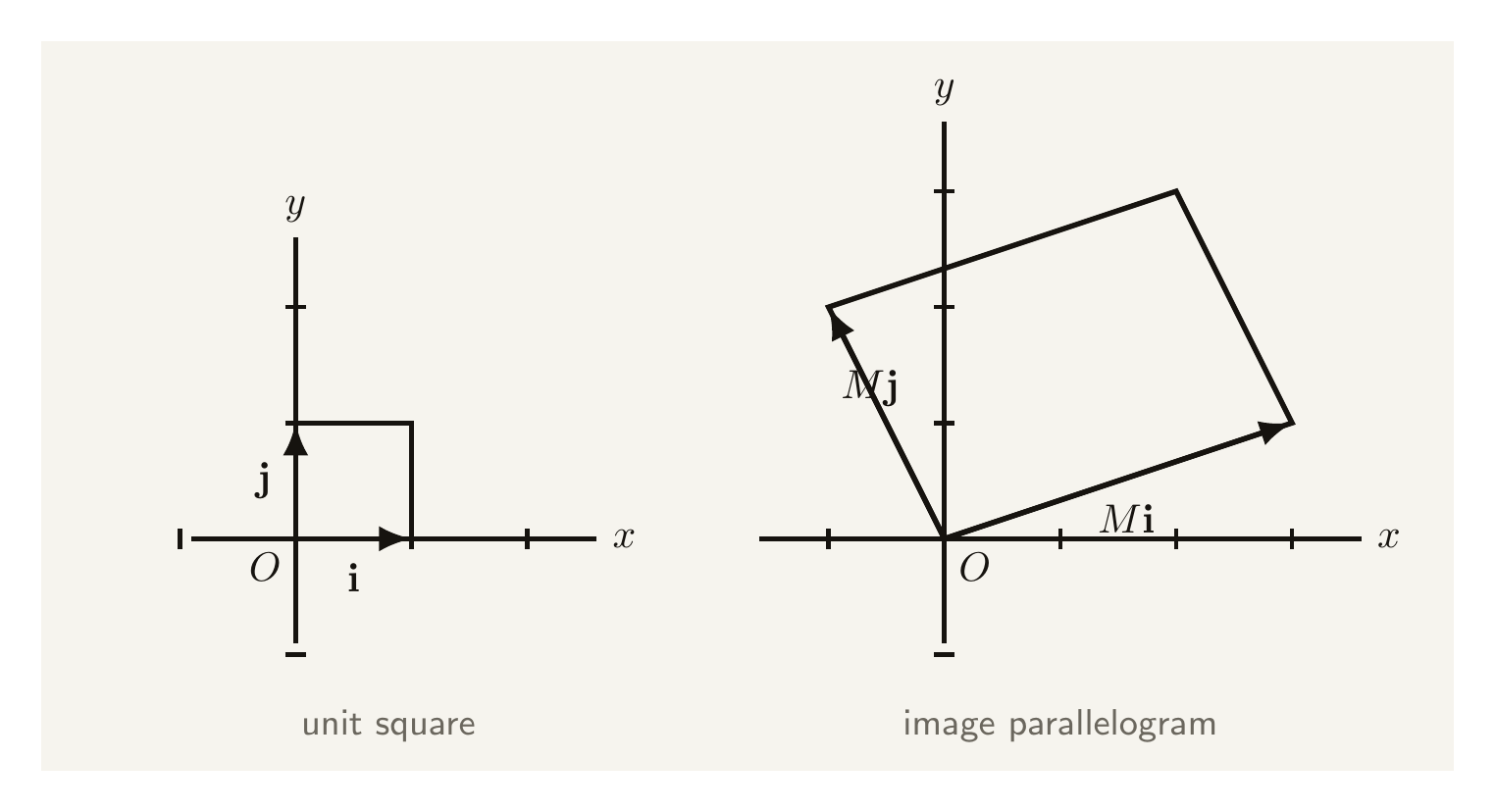
The image is $(4,-6)$.
By Definition 24.1, these images become the columns directly: $M=\begin{pmatrix}2&-1\\1&3\end{pmatrix}$.
$M\begin{pmatrix}4\\2\end{pmatrix}=\begin{pmatrix}2(4)-1(2)\\1(4)+3(2)\end{pmatrix}=\begin{pmatrix}6\\10\end{pmatrix}$.
Finding invariant points and lines
A point is invariant under a transformation $M$ if it maps to itself: $M\mathbf{x}=\mathbf{x}$. The origin is always invariant for any linear transformation, since $M\mathbf{0}=\mathbf{0}$.
Require $M\begin{pmatrix}x\\y\end{pmatrix}=\begin{pmatrix}x\\y\end{pmatrix}$: $3x-2y=x$ and $x=y$.
From the first equation: $2x=2y \Rightarrow x=y$, which matches the second equation exactly — so every point on the line $y=x$ is invariant, not just a single point.
When the equations $M\mathbf{x}=\mathbf{x}$ reduce to a single relationship between $x$ and $y$ (rather than forcing $x=y=0$), every point on that line is invariant — this is called a line of invariant points, and is a stronger condition than an invariant line (where points on the line move, but stay on the same line).
Take a general point on the line: $(t,2t)$. Its image is $M\begin{pmatrix}t\\2t\end{pmatrix}=\begin{pmatrix}t+2t\\2t+6t\end{pmatrix}=\begin{pmatrix}3t\\8t\end{pmatrix}$.
Check if the image also satisfies $y=2x$: is $8t=2(3t)=6t$? Only if $t=0$ — so this line is not invariant under $M$ (only the origin, which lies on the line, maps to itself).
Confusing the columns of $M$ with its rows when reading off images of $\mathbf{i}$ and $\mathbf{j}$ is the single most frequent error in this topic — always double check by direct multiplication $M\begin{pmatrix}1\\0\end{pmatrix}$ if unsure.
Exam-style questions
Question 1 5 marks
A transformation maps $(1,0)\to(0,-1)$ and $(0,1)\to(1,0)$. Write down the matrix $M$, and find the image of the point $(5,-3)$.
$M=\begin{pmatrix}0&1\\-1&0\end{pmatrix}$ (M1, A1)
$M\begin{pmatrix}5\\-3\end{pmatrix}=\begin{pmatrix}0(5)+1(-3)\\-1(5)+0(-3)\end{pmatrix}=\begin{pmatrix}-3\\-5\end{pmatrix}$ (M1, A1, A1)
Question 2 6 marks
Find the invariant points, other than the origin, of the transformation $M=\begin{pmatrix}4&-3\\2&-1\end{pmatrix}$.
$4x-3y=x \Rightarrow 3x=3y \Rightarrow x=y$ (M1, A1)
$2x-y=y \Rightarrow 2x=2y \Rightarrow x=y$ — same condition (M1, A1)
Every point on the line $y=x$ is invariant. (A1, A1)
Question 3 4 marks
A transformation matrix $M=\begin{pmatrix}a&2\\1&b\end{pmatrix}$ maps $(2,1)$ to $(8,5)$. Find $a$ and $b$.
$2a+2=8 \Rightarrow a=3$ (M1, A1)
$2+b=5 \Rightarrow b=3$ (M1, A1)