Modulus–Argument Form
Describe a complex number by its distance from the origin and the angle it makes with the positive real axis — the form that turns multiplication and division into simple geometry.
The modulus of a complex number
For $z=a+bi$, the modulus $|z|$ is $|z| = \sqrt{a^2+b^2}$: the distance from the origin to the point $(a,b)$ on the Argand diagram, by Pythagoras.
Recall from the previous lesson that $zz^{*}=a^2+b^2$. Combined with the definition above, this gives a compact and very useful identity: $zz^{*}=|z|^2$. It also follows directly that $|z^{*}|=|z|$ (conjugation reflects in the real axis, which does not change distance from the origin), and that $|z_1z_2|=|z_1||z_2|$ — a fact proved properly later in this lesson.
The argument of a complex number
The argument $\arg(z)$ of $z=a+bi$ (with $z\neq0$) is the angle $\theta$, measured anticlockwise from the positive real axis to the line segment $Oz$. The principal argument is the unique value of $\theta$ satisfying $-\pi < \theta \leq \pi$ (radians), and unless stated otherwise, "the argument" means this principal value.
Because $\tan\theta = \dfrac{b}{a}$, a first instinct is to compute $\theta=\arctan\!\left(\dfrac{b}{a}\right)$ — but a calculator's $\arctan$ only ever returns values in $\left(-\dfrac{\pi}{2},\dfrac{\pi}{2}\right)$, so this is only directly correct when $z$ lies in the first or fourth quadrant ($a>0$). For the second and third quadrants ($a<0$), the calculator's answer must be corrected by adding or subtracting $\pi$ so that the result lands in the correct quadrant and within $(-\pi,\pi]$.
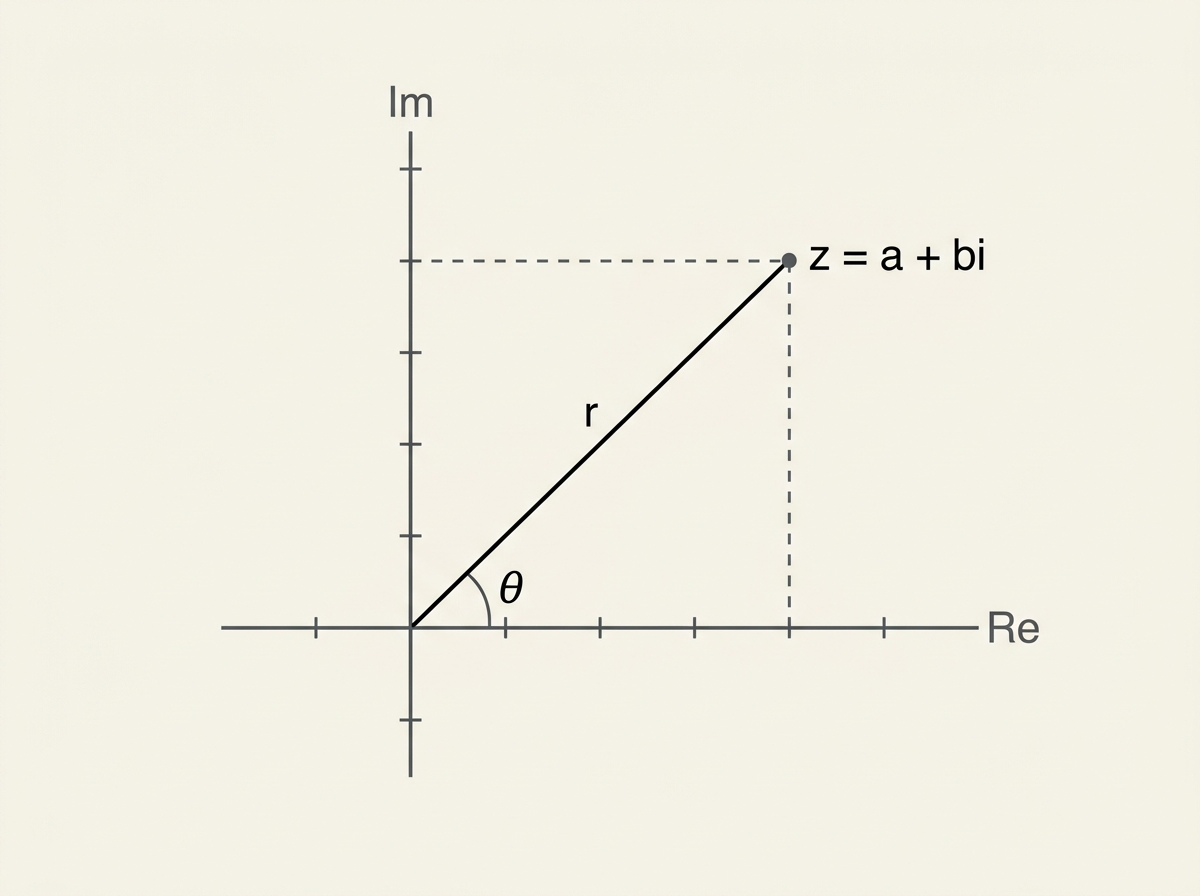
Before computing anything, plot roughly where $a+bi$ lies (which quadrant), then find the acute reference angle $\alpha=\arctan\left|\dfrac{b}{a}\right|$, and finally read off $\theta$ from a quick sketch: first quadrant $\theta=\alpha$; second quadrant $\theta=\pi-\alpha$; third quadrant $\theta=-(\pi-\alpha)$; fourth quadrant $\theta=-\alpha$. This sketch-first method avoids sign errors far more reliably than trusting a calculator blindly.
(a) $|z_1|=\sqrt{3^2+4^2}=\sqrt{25}=5$. First quadrant: $\arg(z_1)=\arctan\left(\dfrac43\right)\approx0.927$ rad.
(b) $|z_2|=\sqrt{(-1)^2+(\sqrt3)^2}=\sqrt{1+3}=2$. Reference angle $\alpha=\arctan\left(\dfrac{\sqrt3}{1}\right)=\dfrac{\pi}{3}$. Second quadrant, so $\arg(z_2)=\pi-\dfrac{\pi}{3}=\dfrac{2\pi}{3}$.
(c) $|z_3|=\sqrt{(-2)^2+(-2)^2}=\sqrt8=2\sqrt2$. Reference angle $\alpha=\arctan(1)=\dfrac{\pi}{4}$. Third quadrant, so $\arg(z_3)=-\left(\pi-\dfrac{\pi}{4}\right)=-\dfrac{3\pi}{4}$.
Modulus–argument (polar) form
Since $a=r\cos\theta$ and $b=r\sin\theta$ where $r=|z|$ and $\theta=\arg(z)$, every complex number can be written:
This is often abbreviated $z=r\operatorname{cis}\theta$. (Extension: writing $\operatorname{cis}\theta=e^{i\theta}$ gives the exponential form $z=re^{i\theta}$, which becomes central once you meet de Moivre's theorem in the next Complex Numbers lesson.)
(a) $|z|=\sqrt{1^2+1^2}=\sqrt2$; first quadrant, $\arg(z)=\arctan(1)=\dfrac{\pi}{4}$. So $z=\sqrt2\left(\cos\dfrac{\pi}{4}+i\sin\dfrac{\pi}{4}\right)$.
(b) $\cos\dfrac{5\pi}{6}=-\dfrac{\sqrt3}{2}$, $\sin\dfrac{5\pi}{6}=\dfrac12$, so $w=4\left(-\dfrac{\sqrt3}{2}+\dfrac12 i\right)=-2\sqrt3+2i$.
Multiplying and dividing in modulus–argument form
Modulus–argument form makes multiplication and division far cleaner than Cartesian form: moduli multiply (or divide) while arguments add (or subtract).
An identical argument (using the compound-angle formulae for a difference) gives the division rule:
Multiplying by $z_2=r_2(\cos\theta_2+i\sin\theta_2)$ geometrically scales a point by factor $r_2$ and rotates it anticlockwise by angle $\theta_2$ about the origin. This is why multiplying by $i$ (modulus $1$, argument $\dfrac{\pi}{2}$) rotates any point $90°$ anticlockwise with no change in size — a fact worth checking directly: $i(a+bi)=-b+ai$, which is indeed $(a,b)$ rotated a quarter-turn.
$|z_1z_2| = 2\times5=10$; $\arg(z_1z_2)=\dfrac{\pi}{3}+\dfrac{5\pi}{6}=\dfrac{2\pi}{6}+\dfrac{5\pi}{6}=\dfrac{7\pi}{6}$. Since $\dfrac{7\pi}{6} > \pi$, subtract $2\pi$: $\dfrac{7\pi}{6}-2\pi=-\dfrac{5\pi}{6}$. So $z_1z_2 = 10\left(\cos\left(-\dfrac{5\pi}{6}\right)+i\sin\left(-\dfrac{5\pi}{6}\right)\right)$.
$\left|\dfrac{z_1}{z_2}\right| = \dfrac{2}{5}$; $\arg\!\left(\dfrac{z_1}{z_2}\right)=\dfrac{\pi}{3}-\dfrac{5\pi}{6}=\dfrac{2\pi}{6}-\dfrac{5\pi}{6}=-\dfrac{3\pi}{6}=-\dfrac{\pi}{2}$. So $\dfrac{z_1}{z_2}=\dfrac25\left(\cos\left(-\dfrac{\pi}{2}\right)+i\sin\left(-\dfrac{\pi}{2}\right)\right)$.
Arguments must always be reduced back into the principal range $(-\pi,\pi]$ by adding or subtracting $2\pi$ — leaving an answer like $\dfrac{7\pi}{6}$ un-adjusted is a wrong final answer even though every step of working was correct. Also, $\arg(z_1z_2)\neq\arg(z_1)\times\arg(z_2)$: it is the moduli that multiply, and the arguments that add.
Exam-style questions
Question 1 5 marks
Express $z=-3+3i$ in the form $r(\cos\theta+i\sin\theta)$, where $r>0$ and $-\pi<\theta\leq\pi$, giving $\theta$ as an exact multiple of $\pi$.
$r=\sqrt{(-3)^2+3^2}=\sqrt{18}=3\sqrt2$ (M1)
Second quadrant. Reference angle $\alpha=\arctan\left(\dfrac{3}{3}\right)=\dfrac{\pi}{4}$ (M1)
$\theta = \pi-\dfrac{\pi}{4}=\dfrac{3\pi}{4}$ (M1)
$z = 3\sqrt2\left(\cos\dfrac{3\pi}{4}+i\sin\dfrac{3\pi}{4}\right)$ (A2)
Question 2 6 marks
Given that $z_1$ has modulus $4$ and argument $\dfrac{2\pi}{3}$, and $z_2=1-i$, find $|z_1z_2|$ and $\arg(z_1z_2)$, giving the argument in the range $(-\pi,\pi]$. Hence find $\arg\!\left(\dfrac{z_1}{z_2}\right)$.
(Hint: find $|z_2|$ and $\arg(z_2)$ first.)
$|z_2|=\sqrt{1^2+(-1)^2}=\sqrt2$; fourth quadrant, $\arg(z_2)=-\dfrac{\pi}{4}$ (M1, A1)
$|z_1z_2| = 4\times\sqrt2 = 4\sqrt2$ (M1)
$\arg(z_1z_2)=\dfrac{2\pi}{3}-\dfrac{\pi}{4}=\dfrac{8\pi}{12}-\dfrac{3\pi}{12}=\dfrac{5\pi}{12}$ (M1, A1 — already in range, no adjustment needed)
$\arg\!\left(\dfrac{z_1}{z_2}\right)=\dfrac{2\pi}{3}-\left(-\dfrac{\pi}{4}\right)=\dfrac{8\pi}{12}+\dfrac{3\pi}{12}=\dfrac{11\pi}{12}$ (A1)