Loci in the Complex Plane
Turn equations and inequalities in $z$ into circles, straight lines, half-lines and regions — the geometry hiding inside every $|z-a|$ and $\arg(z-a)$.
What is a locus?
A locus (plural: loci) is the set of all points satisfying a given condition. In the complex plane, the key building block is that $|z-a|$ measures the distance between the point $z$ and the fixed point $a$ — exactly as $|z_1-z_2|$ is the length of the vector from $z_2$ to $z_1$ on the Argand diagram. Once every locus is read as a distance or angle condition, the resulting shape becomes immediate.
Circles: $|z-a|=r$
The locus of points $z$ satisfying $|z-a|=r$ (where $a$ is a fixed complex number and $r>0$) is a circle, centre $a$, radius $r$. This follows immediately from the definition of $|z-a|$ as the distance from $z$ to $a$: fixing that distance at $r$ is precisely the definition of a circle.
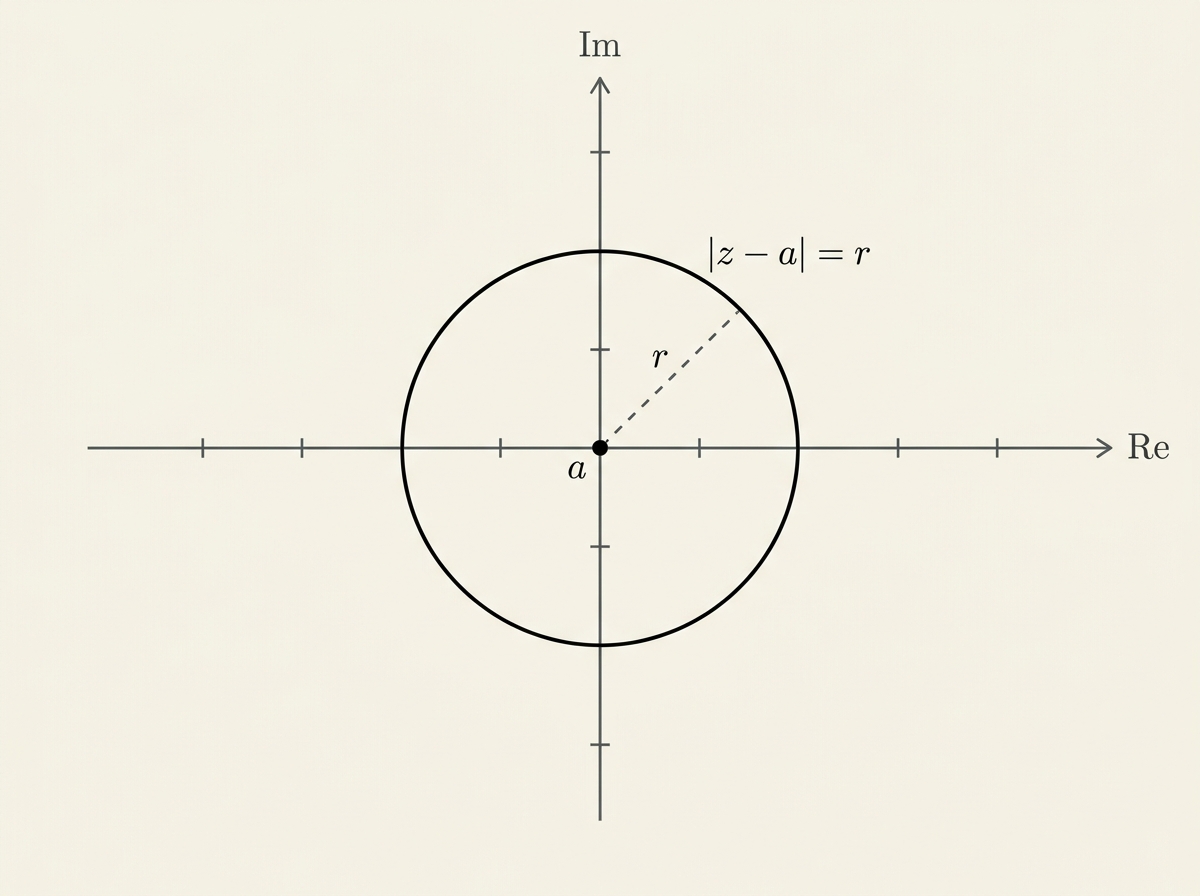
This is a circle, centre $(2,-1)$, radius $3$. The centre is at distance $\sqrt{2^2+(-1)^2}=\sqrt5$ from the origin. The greatest value of $|z|$ occurs at the point on the circle furthest from $O$, along the line through $O$ and the centre extended: $|z|_{\max}=\sqrt5+3$. The least value occurs at the nearest point on the circle to $O$: $|z|_{\min}=3-\sqrt5$ (positive since $3>\sqrt5\approx2.24$).
Perpendicular bisectors: $|z-a|=|z-b|$
The locus of points $z$ satisfying $|z-a|=|z-b|$ is the perpendicular bisector of the line segment joining $a$ and $b$: every point on it is equidistant from $a$ and $b$, which is exactly the defining property of a perpendicular bisector.
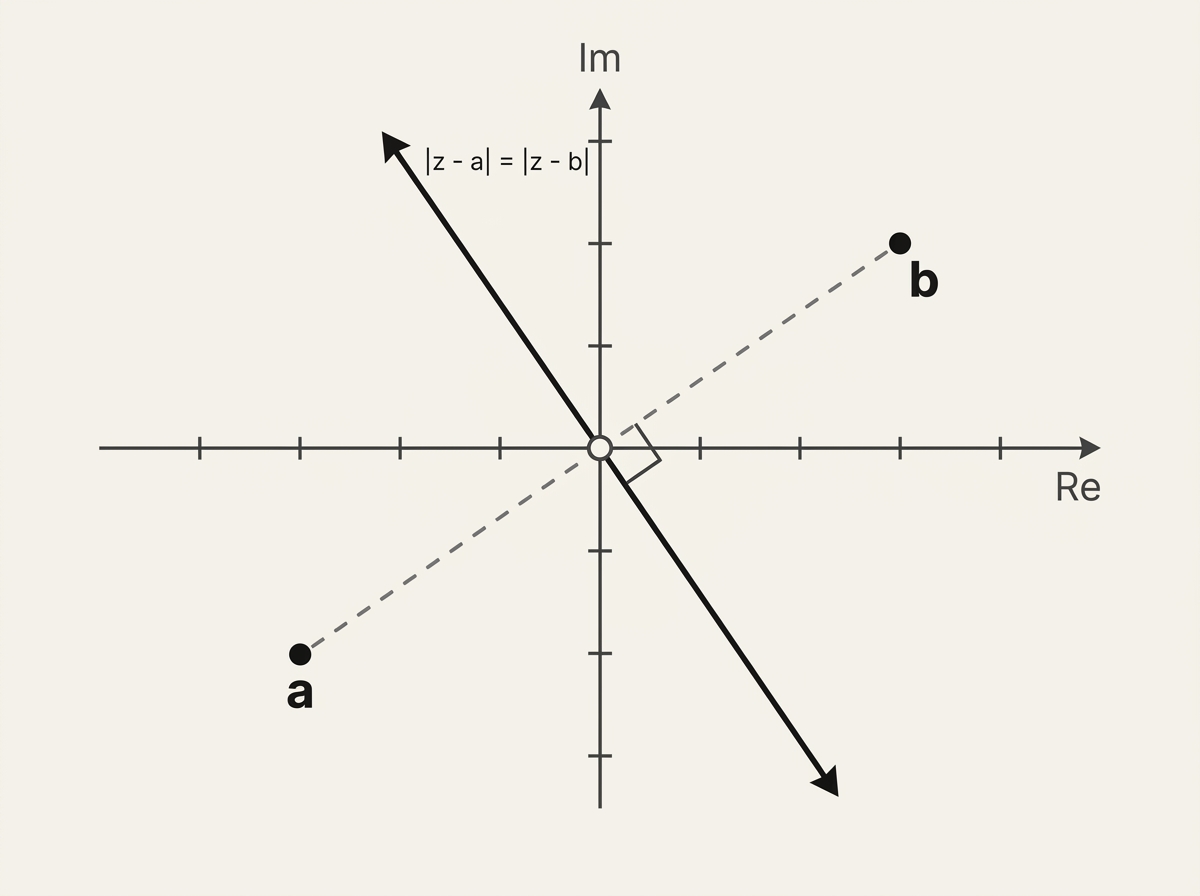
Substitute $z=x+iy$: $|(x-3)+iy| = |(x+1)+i(y-2)|$.
Squaring both sides: $(x-3)^2+y^2 = (x+1)^2+(y-2)^2$
$x^2-6x+9+y^2 = x^2+2x+1+y^2-4y+4$
$-6x+9 = 2x-4y+5 \;\Rightarrow\; -8x+4y+4=0 \;\Rightarrow\; y = 2x-1$
This is exactly what Theorem 3.2 predicts: the perpendicular bisector of the segment from $(3,0)$ to $(-1,2)$, which has midpoint $(1,1)$ and gradient $-\dfrac{1}{\left(\frac{2-0}{-1-3}\right)}=2$ — matching $y=2x-1$ (gradient $2$, passing through $(1,1)$: $1=2(1)-1$ ✓).
Half-lines: $\arg(z-a)=\theta$
The locus of points $z$ satisfying $\arg(z-a)=\theta$ is a half-line (ray) starting at, but not including, the point $a$, making angle $\theta$ with the positive real axis. The point $a$ is excluded because $\arg(0)$ is undefined.
$\arg(z-a)=\theta$ gives only one ray from $a$, not the full line through $a$. The opposite ray satisfies $\arg(z-a)=\theta+\pi$ (or $\theta-\pi$) instead — a different locus entirely. Always draw an open circle (a small hollow dot) at the excluded start point $a$ on any sketch.
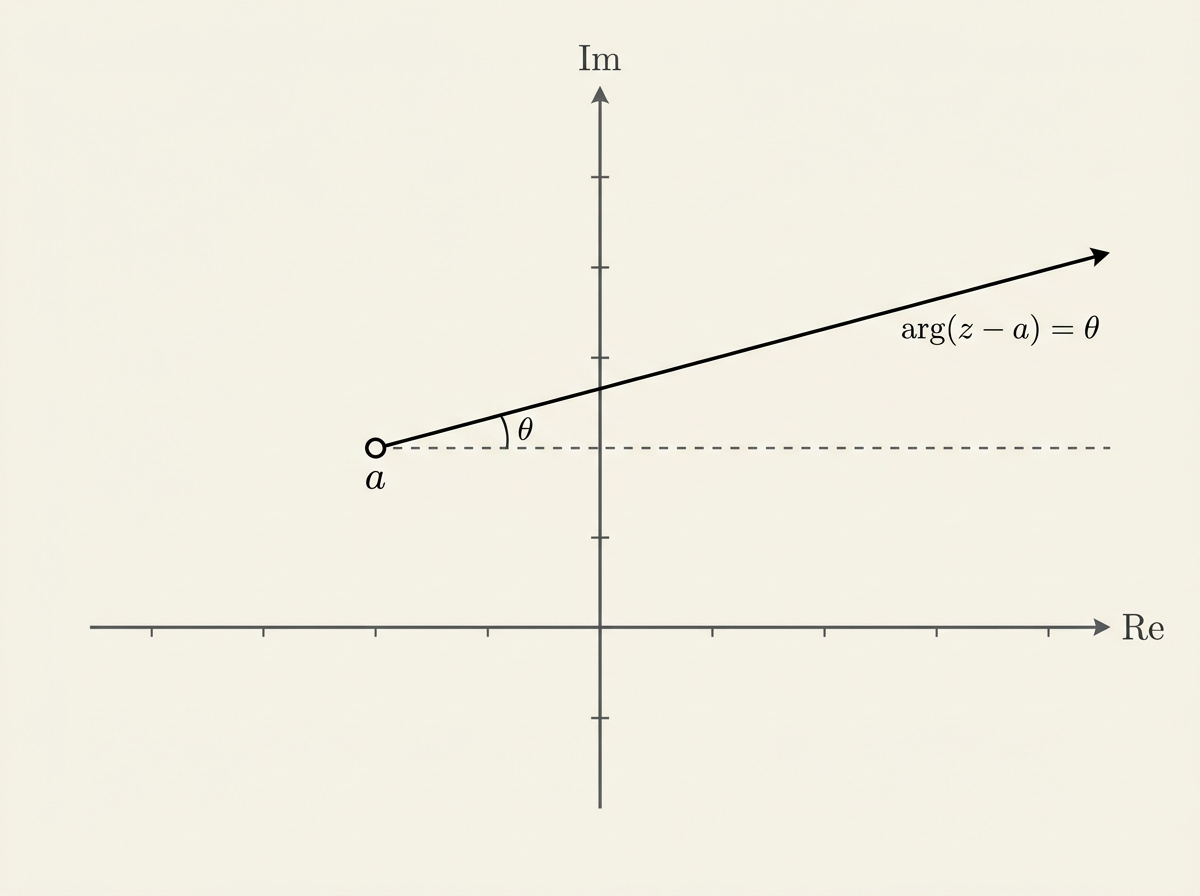
Write $z+1-i = z-(-1+i)$, so $a=-1+i=(-1,1)$. This is a ray starting (excluded) at $(-1,1)$ at angle $\dfrac{\pi}{4}$ to the positive real axis — i.e. heading up and to the right at $45°$.
With $z=x+iy$: $\arg\big((x+1)+i(y-1)\big)=\dfrac{\pi}{4}$ means $\dfrac{y-1}{x+1}=\tan\dfrac{\pi}{4}=1$, so $y=x+2$, restricted to $x>-1$ (the ray only continues in the direction of angle $\dfrac{\pi}{4}$, not the whole line).
Regions defined by inequalities
Replacing $=$ with an inequality turns a curve into a region. $|z-a|<r$ describes the open disc inside the circle (boundary excluded, drawn dashed); $|z-a|\leq r$ includes the boundary (drawn solid). $|z-a|<|z-b|$ describes the half-plane of points closer to $a$ than to $b$ — the side of the perpendicular bisector containing $a$.

$|z-2|\leq2$ is the closed disc, centre $(2,0)$, radius $2$ (solid boundary), which passes through the origin and touches $x=4$. $0\leq\arg(z)\leq\dfrac{\pi}{2}$ is the region between (and including) the positive real axis and the positive imaginary axis, i.e. the first quadrant including its boundary rays. The required region is the part of that quarter-plane that also lies within the closed disc — a quarter-circle-like "slice" bounded by the two solid axis segments and the arc of the circle, all in the first quadrant.
Many mark schemes require the exact coordinates (or exact complex numbers) where two loci cross, not just a sketch. Solve the two equations simultaneously — usually by substituting the Cartesian form of one locus into the other — and always state which of the two solutions found is relevant to the required region.
Exam-style questions
Question 1 6 marks
The locus $C$ is defined by $|z-4-3i|=5$. (a) Sketch $C$, stating its centre and radius. (b) Find the range of possible values of $\arg(z)$ for points on $C$, given that $C$ passes through the origin.
(a) Centre $(4,3)$, radius $5$ (B1, B1). Check it passes through $O$: distance from $(4,3)$ to $(0,0)$ is $\sqrt{16+9}=5$ ✓.
(b) Since $C$ passes through the origin, the two tangent lines from $O$ to the circle are the lines $OA$ and $OB$ where $A,B$ are the points of tangency — but because $O$ actually lies on the circle, every ray from $O$ into the circle sweeps between the two tangent directions at $O$ itself. The tangent to a circle at a point is perpendicular to the radius at that point; the radius $O$-to-centre has argument $\arctan\!\left(\dfrac34\right)$. The full range of $\arg(z)$ swept by points on $C$ (other than $O$ itself) is therefore the $180°$ arc on one side, giving $\arg(z)\in\left[\arctan\!\left(\dfrac34\right)-\dfrac{\pi}{2},\ \arctan\!\left(\dfrac34\right)+\dfrac{\pi}{2}\right]$ (M1 identify tangent property, A1 centre argument, A2 range).
Question 2 7 marks
(a) Find the Cartesian equation of the locus satisfying $|z-6i|=|z+4|$. (b) Hence, or otherwise, find the complex number satisfying both $|z-6i|=|z+4|$ and $|z|=|z-8|$.
(Hint: the second locus is also a perpendicular bisector.)
(a) $x^2+(y-6)^2 = (x+4)^2+y^2 \Rightarrow -12y+36 = 8x+16 \Rightarrow 8x+12y-20=0 \Rightarrow 2x+3y-5=0$ (M1, A1)
(b) $|z|=|z-8|$ is the perpendicular bisector of $0$ and $8$, i.e. the vertical line $x=4$ (B1). Substituting $x=4$ into $2x+3y-5=0$: $8+3y-5=0 \Rightarrow y=-1$ (M1). So $z = 4-i$ (A1).