Complex Arithmetic & Argand Diagrams
Extend the real number line into a plane. Define $i$, learn to add, multiply, conjugate and divide complex numbers, and see them as points and vectors on the Argand diagram.
Why we need a new number
The equation $x^2+1=0$ has no solution among the real numbers, since $x^2\geq0$ for every real $x$. Rather than declaring the equation unsolvable, mathematicians extended the number system by defining a new number that squares to $-1$.
The imaginary unit $i$ is defined by $i^2=-1$ (equivalently $i=\sqrt{-1}$). A complex number is any number of the form $z=a+bi$ where $a,b\in\mathbb{R}$. The set of all complex numbers is written $\mathbb{C}$.
For $z=a+bi$: the real part is $\operatorname{Re}(z)=a$ and the imaginary part is $\operatorname{Im}(z)=b$ — note that $\operatorname{Im}(z)$ is the real coefficient $b$, not $bi$. If $b=0$, $z$ is (purely) real; if $a=0$ and $b\neq0$, $z$ is said to be purely imaginary. Two complex numbers are equal exactly when both their real parts and their imaginary parts match: $a+bi=c+di \iff a=c \text{ and } b=d$. This "compare real and imaginary parts separately" idea is used constantly throughout the topic to turn one complex equation into two real ones.
Adding, subtracting and multiplying
Complex numbers are added and subtracted by combining real parts together and imaginary parts together, exactly as you would collect like terms:
Multiplication uses the distributive law as normal, then simplifies using $i^2=-1$:
(a) $z_1+z_2 = (5-3)+(-2+4)i = 2+2i$
(b) $z_1-z_2 = (5-(-3))+(-2-4)i = 8-6i$
(c) $z_1z_2 = (5-2i)(-3+4i) = -15+20i+6i-8i^2 = -15+26i-8(-1) = -15+8+26i = -7+26i$
The single most common slip in this topic is writing $i^2=1$ out of habit — always substitute $i^2=-1$ explicitly, and show that substitution as a step: examiners want to see $-8i^2 = -8(-1) = 8$ written out, not just the final answer appearing from nowhere.
The complex conjugate and division
The conjugate of $z=a+bi$ is $z^{*}=a-bi$ (some texts write $\bar z$). Geometrically, conjugation reflects a point in the real axis.
Conjugates have one indispensable property: multiplying a complex number by its own conjugate always produces a real, non-negative number.
This quantity $a^2+b^2$ is in fact $|z|^2$, the square of the modulus of $z$ — the full geometric meaning of this is developed in the next lesson. For now, the key use of $zz^{*}=a^2+b^2$ being real is that it lets us divide by a complex number: multiply numerator and denominator by the conjugate of the denominator, turning the denominator real.
Multiply top and bottom by the conjugate of the denominator, $1+2i$:
Numerator: $(3+4i)(1+2i) = 3+6i+4i+8i^2 = 3+10i-8 = -5+10i$.
Denominator: $(1-2i)(1+2i) = 1^2+2^2 = 5$ (real, by the theorem above).
So $\dfrac{3+4i}{1-2i} = \dfrac{-5+10i}{5} = -1+2i$.
Complex roots of quadratics
The quadratic formula still applies when the discriminant $b^2-4ac$ is negative — the difference is that $\sqrt{b^2-4ac}$ is now interpreted as a purely imaginary number.
Using the quadratic formula with $a=1,\,b=-6,\,c=13$:
So $z=3+2i$ or $z=3-2i$ — a conjugate pair. This is not a coincidence: whenever a polynomial has entirely real coefficients, any non-real root is guaranteed to be paired with its conjugate. This fact is proved properly, and used to solve cubics and quartics, in the lesson on complex roots of polynomials.
The Argand diagram
A complex number $z=a+bi$ is represented as the point $(a,b)$ on a set of Cartesian axes, where the horizontal axis is the real axis and the vertical axis is the imaginary axis. This plane is called the Argand diagram (or complex plane).
It is often more useful to think of $z$ not just as a point but as a position vector from the origin to $(a,b)$. This turns complex addition and subtraction into familiar vector geometry: $z_1+z_2$ is found by the parallelogram (tip-to-tail) rule, and $z_1-z_2$ is the vector pointing from the point $z_2$ to the point $z_1$.
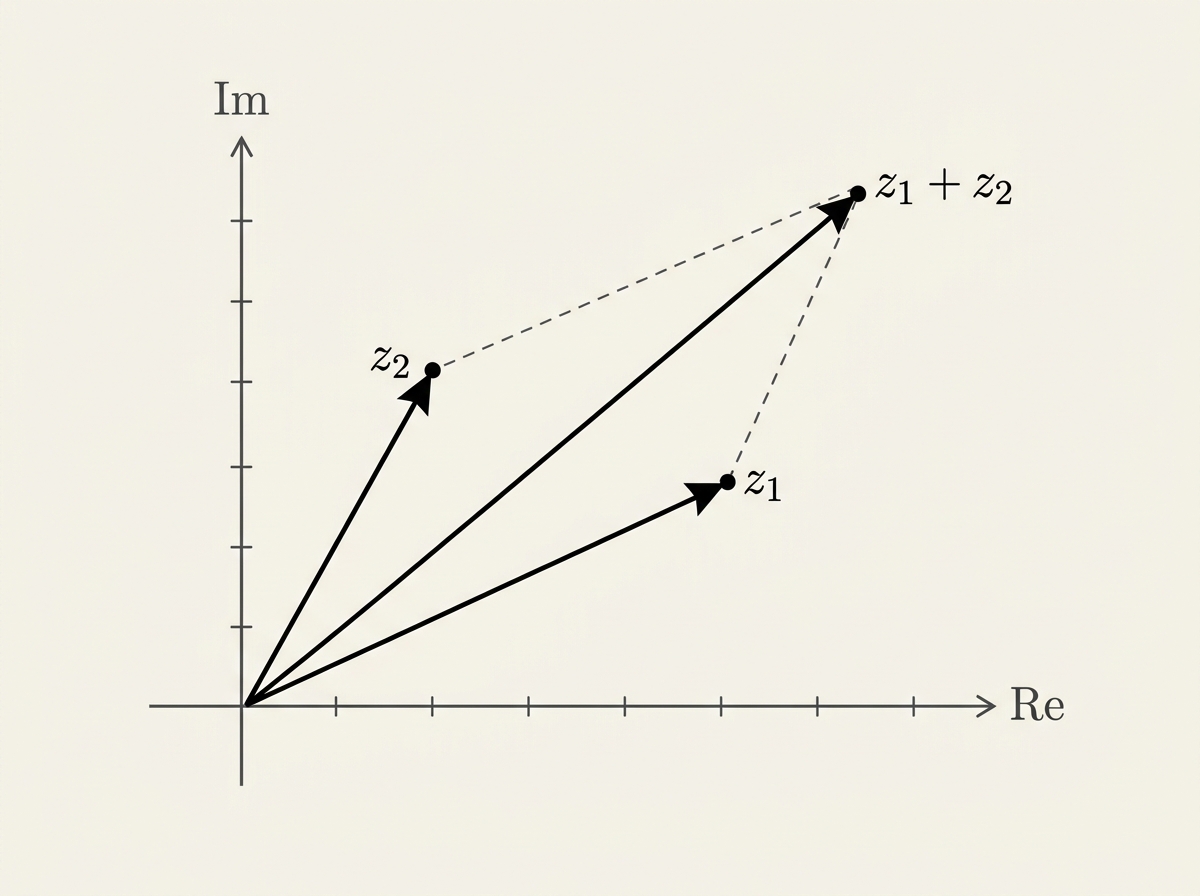
$z_1+z_2 = (2-1)+(3+1)i = 1+4i$. Plotting $z_1=(2,3)$ and $z_2=(-1,1)$, the point $1+4i=(1,4)$ is exactly the fourth vertex of the parallelogram formed with the origin, $z_1$ and $z_2$ — confirming the parallelogram (tip-to-tail) rule for vector addition.
$z_1-z_2 = 3+2i$. As a vector, this is the arrow that starts at the point $z_2=(-1,1)$ and ends at the point $z_1=(2,3)$: its horizontal and vertical components, $3$ and $2$, are exactly the differences in the coordinates.
In "show that" questions, examiners expect every use of $i^2=-1$ to be explicit and every real/imaginary part comparison to be shown as a separate line. Jumping straight to a final simplified answer without showing the substitution step typically costs a method mark, even if the final answer is correct.
Exam-style questions
Question 1 4 marks
Given that $z=4-3i$ and $w=-2+5i$, find $zw$ and $\dfrac{z}{w}$, giving each answer in the form $a+bi$.
$zw = (4-3i)(-2+5i) = -8+20i+6i-15i^2 = -8+26i+15 = 7+26i$ (M1 expand, A1)
$\dfrac{z}{w} = \dfrac{4-3i}{-2+5i}\times\dfrac{-2-5i}{-2-5i} = \dfrac{(4-3i)(-2-5i)}{4+25} = \dfrac{-8-20i+6i+15i^2}{29} = \dfrac{-23-14i}{29} = -\dfrac{23}{29}-\dfrac{14}{29}i$ (M1 multiply by conjugate, A1)
Question 2 5 marks
Solve the equation $2z^2+2z+13=0$, giving your answers in the form $a+bi$. Hence write down, without further calculation, the two roots of $2\bar z^2+2\bar z+13=0$.
(Hint: use the quadratic formula, then think about what conjugating the whole equation does.)
$z=\dfrac{-2\pm\sqrt{4-104}}{4}=\dfrac{-2\pm\sqrt{-100}}{4}=\dfrac{-2\pm10i}{4}=-\dfrac12\pm\dfrac52 i$ (M1 formula, M1 simplify √−100, A2 both roots)
Since the original equation has real coefficients, its roots already form a conjugate pair. Taking the conjugate of the whole equation just swaps $z\leftrightarrow\bar z$ throughout, so $\bar z=-\tfrac12+\tfrac52 i$ and $\bar z=-\tfrac12-\tfrac52 i$ solve the conjugated equation — i.e. the same two values, in the opposite order. (B1 correct reasoning)