Regions in the Argand Diagram
Turning locus equations into inequalities shades in whole areas of the complex plane — and finding the extremes of |z| on these regions is pure geometry.
From loci to regions
Replacing $=$ with $<,\ \leq,\ >,\ \geq$ in a locus equation turns a curve into a region. For example, $|z-a|<r$ describes every point inside the circle of radius $r$ centred at $a$ (strictly inside, boundary excluded); $|z-a|\leq r$ includes the boundary. A dashed boundary curve is used for strict inequalities, and a solid boundary for $\leq$ or $\geq$.
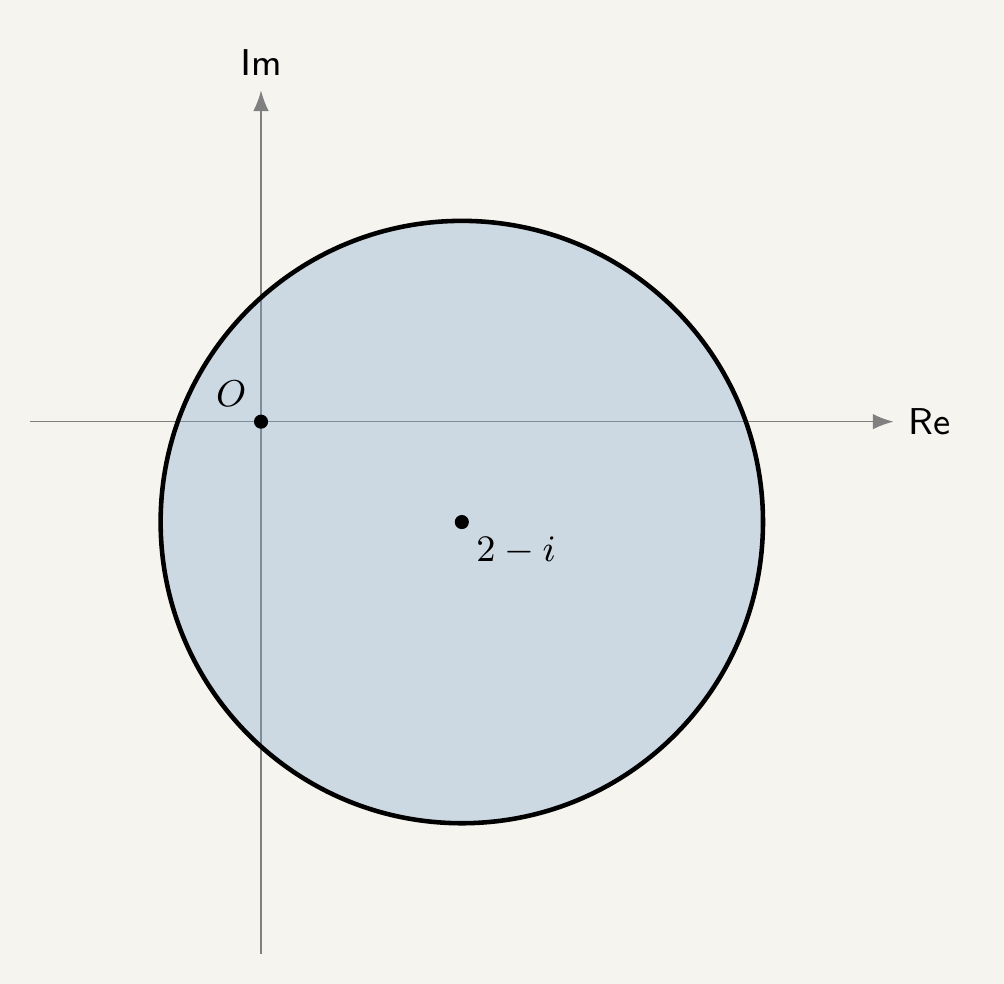
This is the disc (interior and boundary) of the circle centred at $(2,-1)$ with radius $3$. The boundary circle is drawn solid, since equality is included, and the interior is shaded.
Combining multiple conditions
When a question gives several conditions at once (e.g. a modulus inequality and an argument inequality), the required region is the intersection — sketch each boundary curve separately, then shade only the area satisfying every condition simultaneously.
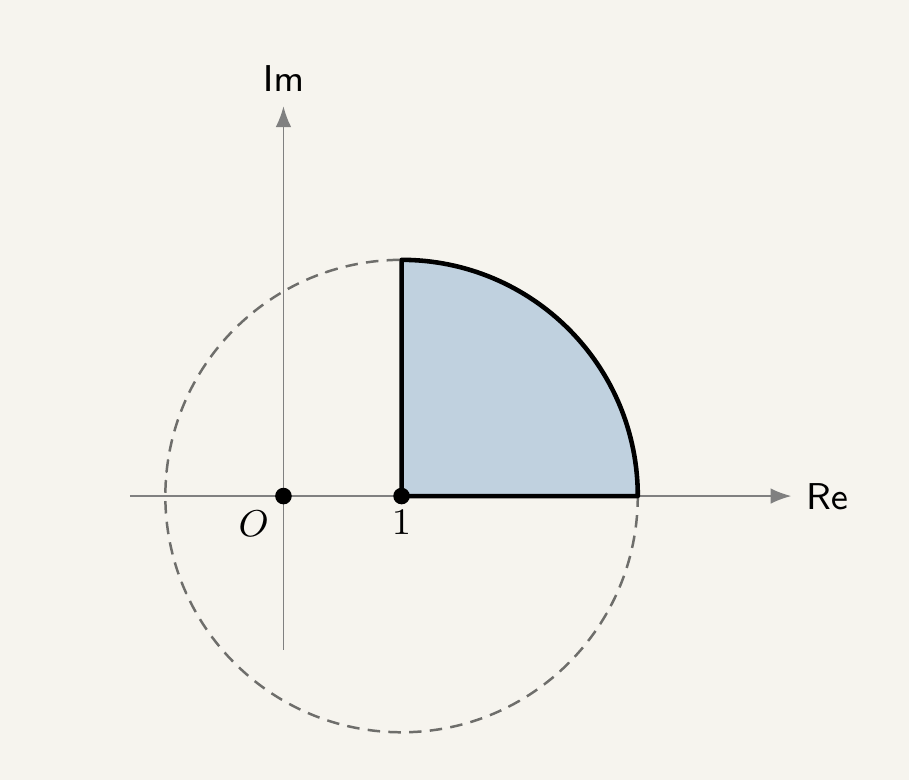
The first condition gives the closed disc of radius $2$ centred at $(1,0)$. The second restricts to the sector of angles between $0$ and $\dfrac{\pi}{2}$ measured from $(1,0)$ — i.e. the upper-right quarter of that disc, bounded by the two rays $\arg(z-1)=0$ (horizontal, to the right) and $\arg(z-1)=\dfrac{\pi}{2}$ (vertical, upward), both from $(1,0)$.
The region is this quarter-disc, including all three boundary edges (since all inequalities are $\leq$/$\geq$, non-strict).
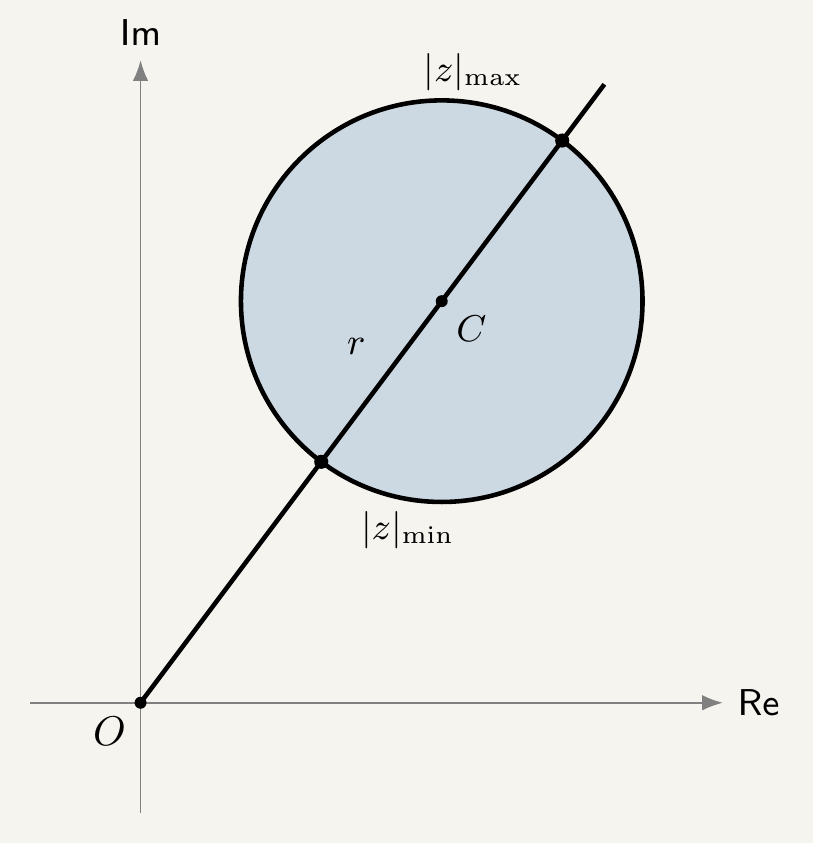
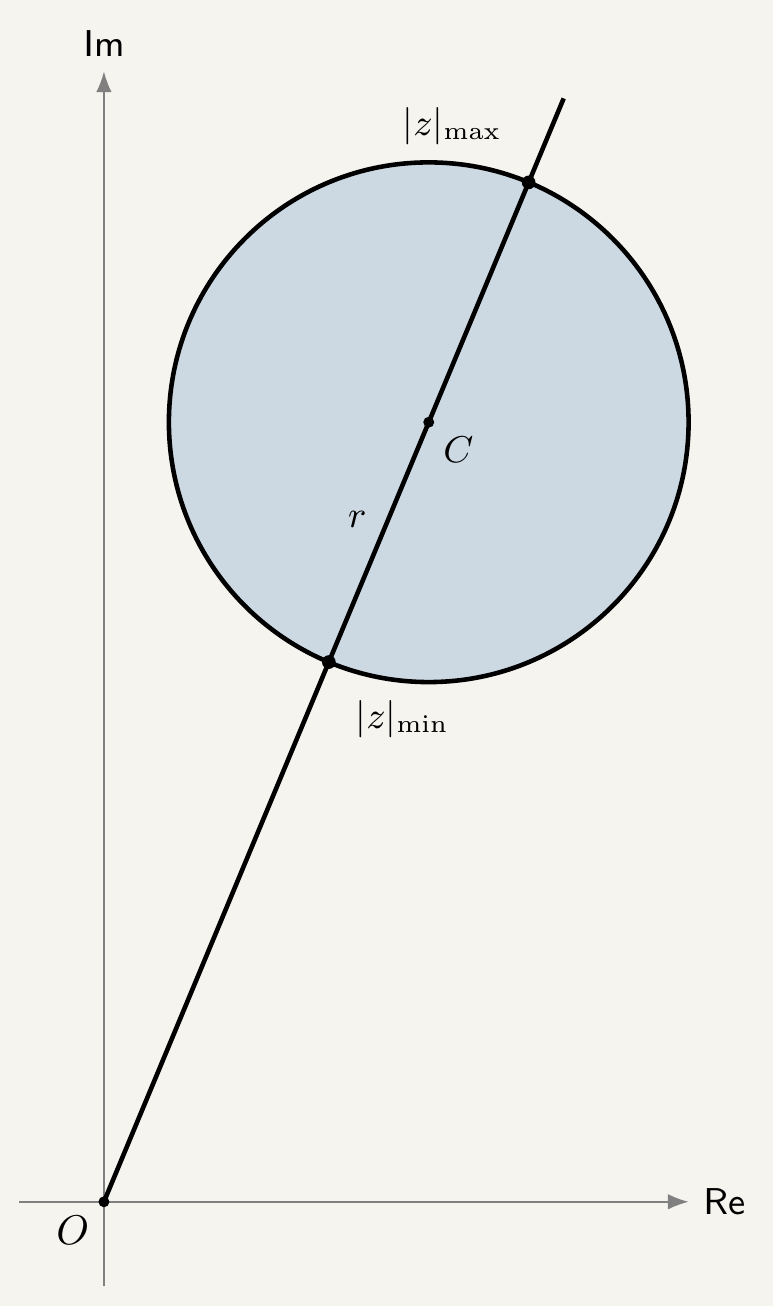
The region is a closed disc centred at $C=(3,4)$ with radius $2$. Since $|z|$ is the distance from the origin to $z$, and $|OC|=\sqrt{9+16}=5$, the greatest value of $|z|$ occurs at the point on the circle farthest from $O$ (along the line $OC$ extended), and the least at the nearest point.
Greatest $|z|=|OC|+r=5+2=7$. Least $|z|=|OC|-r=5-2=3$.
The intersection technique scales to any number of simultaneous conditions — modulus, perpendicular-bisector, and argument inequalities can all be combined at once. Sketch every boundary curve on the same diagram first, decide which side of each boundary is required, and shade only the area common to all of them. It helps to shade each region lightly in turn and look for where the shadings overlap, rather than trying to identify the final region by eye in one step.
$|z-5-3i|<3$ is the open interior of the circle centred at $(5,3)$ with radius $3$.
$|z-5|<|z-1|$ is the half-plane on the side of the perpendicular bisector of $(5,0)$ and $(1,0)$ closer to $(1,0)$ — this bisector is the vertical line $x=3$, so the region is $x<3$.
$0<\arg(z-3-3i)<\dfrac{\pi}{2}$ is the open sector between the two half-lines from $(3,3)$ at angles $0$ and $\dfrac{\pi}{2}$ — i.e. directly above and directly right of $(3,3)$.
The required region is wherever all three shaded areas overlap: part of the circle that also lies to the left of $x=3$ and within that angular sector from $(3,3)$. All boundaries are drawn dashed, since every inequality is strict.
Centre $C=6+8i$, radius $r=5$. Let $B$ be the foot of the perpendicular from $C$ to the real axis, so $OB=6$ and $BC=8$, with a right angle at $B$. Then $\beta=\arg(C)=\tan^{-1}\left(\dfrac86\right)=\tan^{-1}\left(\dfrac43\right)=0.927$ rad (3 s.f.).
$|OC|=\sqrt{6^2+8^2}=10$. Let $A$ be a tangent point; in the right-angled triangle $OAC$ (right angle at $A$), $\sin\alpha=\dfrac{r}{|OC|}=\dfrac{5}{10}=\dfrac12$, so $\alpha=\dfrac{\pi}{6}=0.524$ rad exactly.
Greatest $\arg(z)=\beta+\alpha=0.927+0.524=1.45$ rad (3 s.f.). Least $\arg(z)=\beta-\alpha=0.927-0.524=0.404$ rad (3 s.f.).
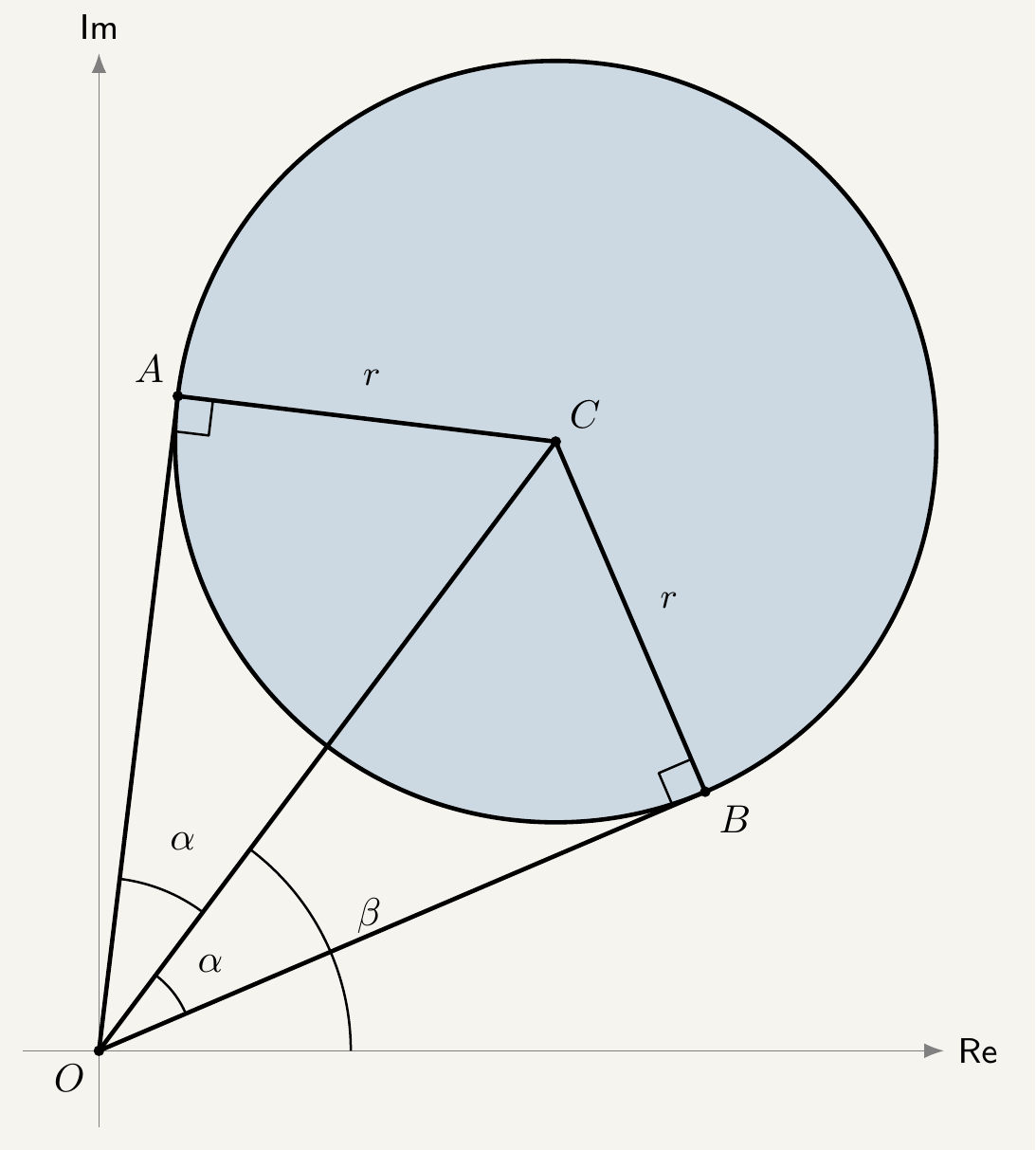
For a circle $|z-a|=r$ (or its interior), the greatest and least values of $|z|$ always occur where the line through the origin and the centre $a$ meets the circle, giving $|z|_{\max}=|a|+r$ and $|z|_{\min}=|a|-r$ (provided the origin lies outside the circle). The extreme values of $\arg(z)$ occur where a line from the origin is tangent to the circle. In general $a$ need not be real, so this takes two steps: let $\beta=\arg(a)$ be the direction from $O$ to the centre, and let $\alpha$ be the angle between $OC$ and each tangent line, found from the right-angled triangle formed by $O$, the centre $C$, and a tangent point $A$ (right angle at $A$, since a radius meets a tangent at $90°$): $\sin\alpha=\dfrac{r}{|a|}$. Since $OC$ bisects the angle between the two tangent lines, $$\arg(z)_{\max}=\beta+\alpha, \qquad \arg(z)_{\min}=\beta-\alpha$$ When $a$ is real and positive, $\beta=0$ and this reduces to the simpler $\sin\theta=\dfrac{r}{|a|}$ result on its own.
Exam-style questions
Question 1 5 marks
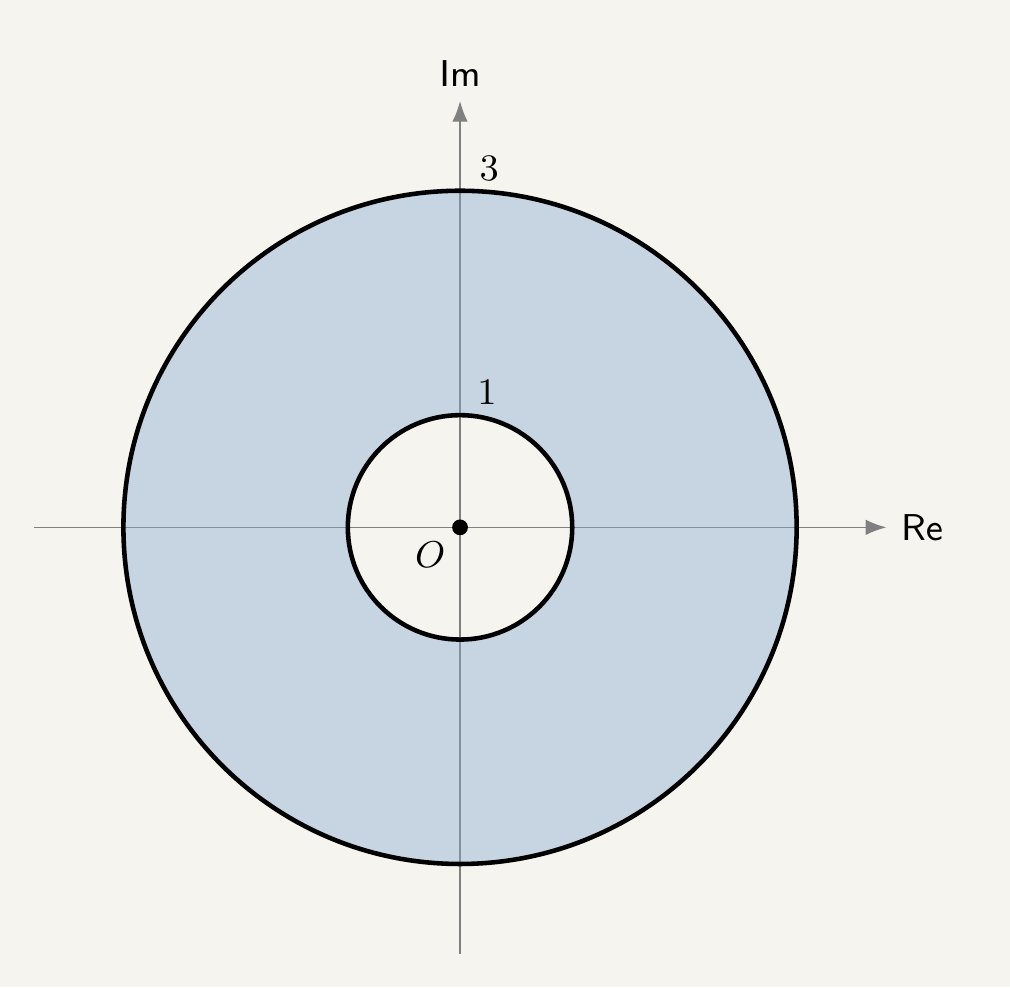
Sketch and describe fully the region satisfying $1\leq|z|\leq3$.
This is an annulus (ring) centred at the origin, bounded by the circle of radius $1$ (inner boundary) and the circle of radius $3$ (outer boundary), with both boundaries included (solid circles). (B1, B1, B1, B1, B1)
Question 2 6 marks
Given that $z$ satisfies $|z-5-12i|\leq4$, find the greatest and least possible values of $|z|$.
Centre $a=5+12i$: $|a|=\sqrt{25+144}=\sqrt{169}=13$ (M1, A1)
Greatest $|z|=13+4=17$; least $|z|=13-4=9$ (M1, A1, A1, A1)
Question 3 6 marks
Sketch, on the same diagram, the loci $|z-3|=|z-3i|$ and $|z|=6$, shading the region satisfying $|z-3|\leq|z-3i|$ and $|z|\leq6$.
$|z-3|=|z-3i|$ gives the perpendicular bisector of $(3,0)$ and $(0,3)$, which simplifies to $y=x$ (equidistant points from the two symmetric locations). (M1, A1)
$|z-3|\leq|z-3i|$ is the half-plane on the side of this line closer to $(3,0)$ than $(0,3)$, i.e. below the line $y=x$. (B1)
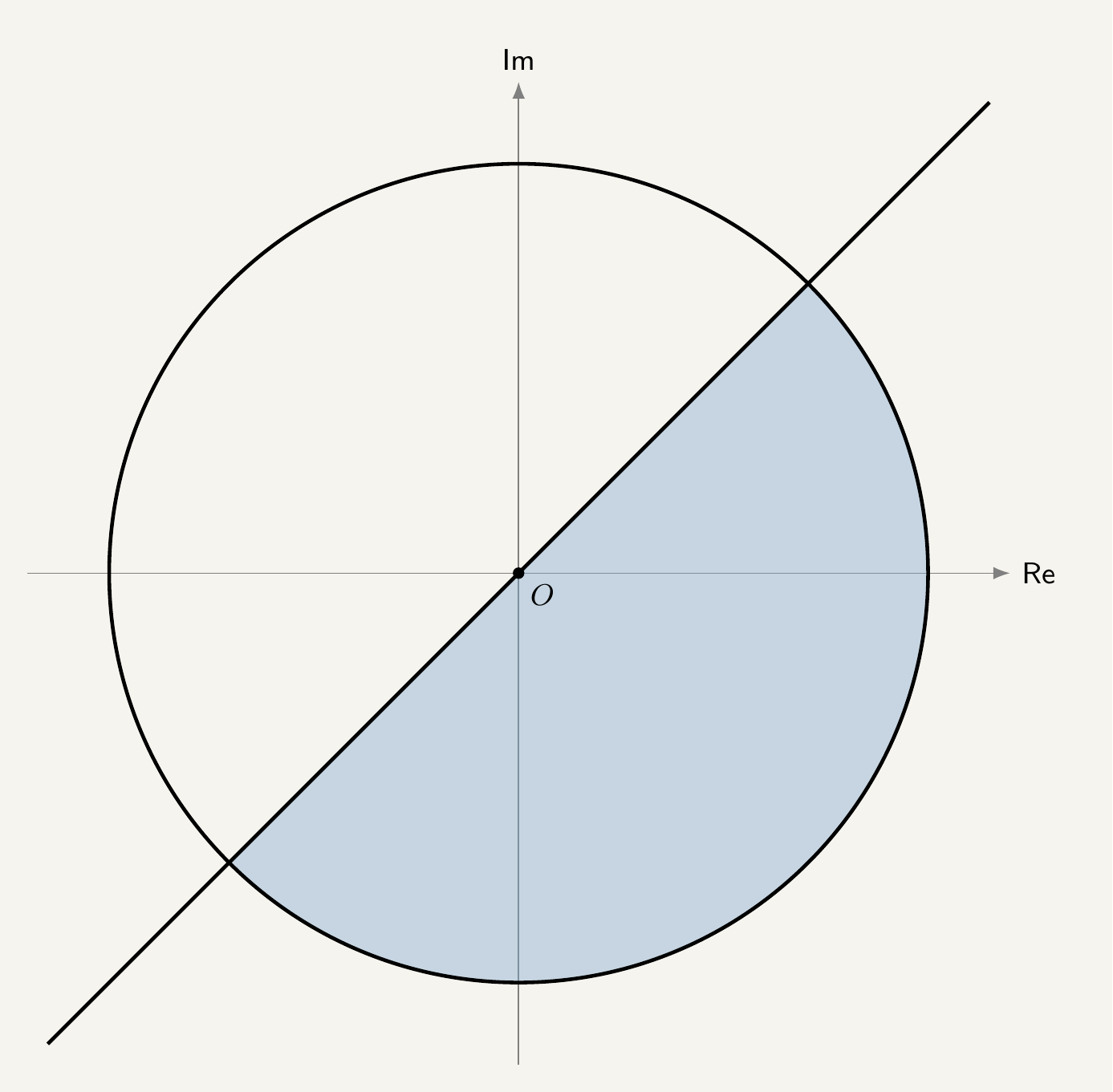
$|z|\leq6$ is the closed disc of radius $6$ centred at the origin. (B1)
The required region is the half of this disc below the line $y=x$, bounded by the solid circle and the solid line. (B1, B1)