Loci in the Argand Diagram
Conditions on |z − a| and arg(z − a) trace out circles, straight lines, and rays — geometry hiding inside algebraic equations.
Circles: |z − a| = r
The locus of points $z$ satisfying $|z-a|=r$ (where $a$ is a fixed complex number and $r>0$) is a circle centred at the point $a$ with radius $r$, since $|z-a|$ is precisely the distance from $z$ to $a$.
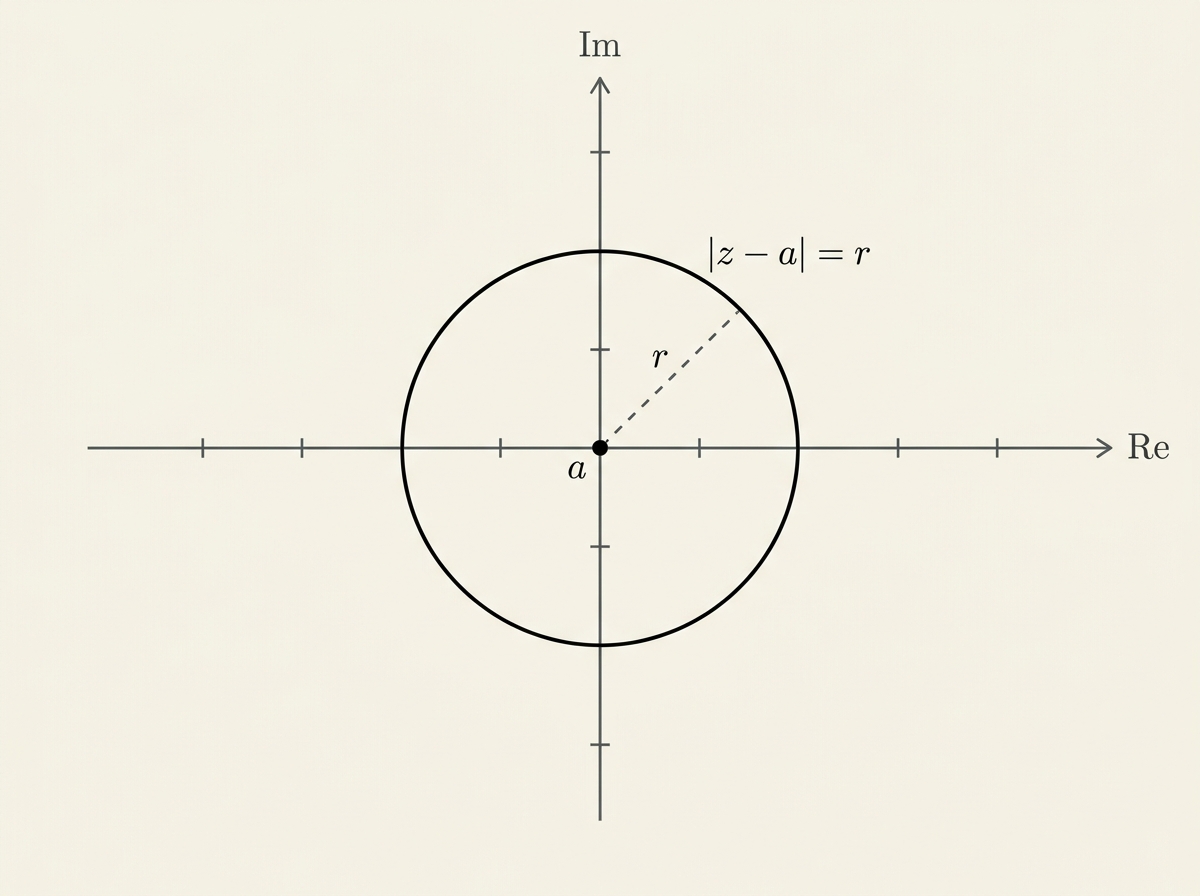
This is a circle centred at $(3,-2)$ with radius $4$.
Rewrite as $|z-(4-3i)|=5$: circle centred at $(4,-3)$, radius $5$. With $z=x+yi$: $|(x-4)+(y+3)i|=5 \Rightarrow (x-4)^2+(y+3)^2=25$.
At the origin: $(0-4)^2+(0+3)^2=16+9=25$ ✓. The origin lies on the circle.
A common question gives a circle locus $|z-a|=r$ together with a second condition, such as $\operatorname{Re}(z)=k$ or $\operatorname{Im}(z)=k$, and asks for the specific value(s) of $z$ satisfying both. Substitute the second condition directly into the Cartesian circle equation $(x-x_1)^2+(y-y_1)^2=r^2$ and solve — this reduces a two-condition locus problem to ordinary algebra.
The locus is a circle centred at $(6,0)$ with radius $5$, with Cartesian equation $(x-6)^2+y^2=25$.
Setting $\operatorname{Im}(z)=0$ means $y=0$, so $(x-6)^2=25\Rightarrow x-6=\pm5\Rightarrow x=11$ or $x=1$.
The values of $z$ are $z=11$ and $z=1$ (written as complex numbers, not coordinates).
Perpendicular bisectors: |z − a| = |z − b|
The locus of points $z$ satisfying $|z-a|=|z-b|$ is the set of points equidistant from $a$ and $b$ — this is the perpendicular bisector of the line segment joining $a$ and $b$.
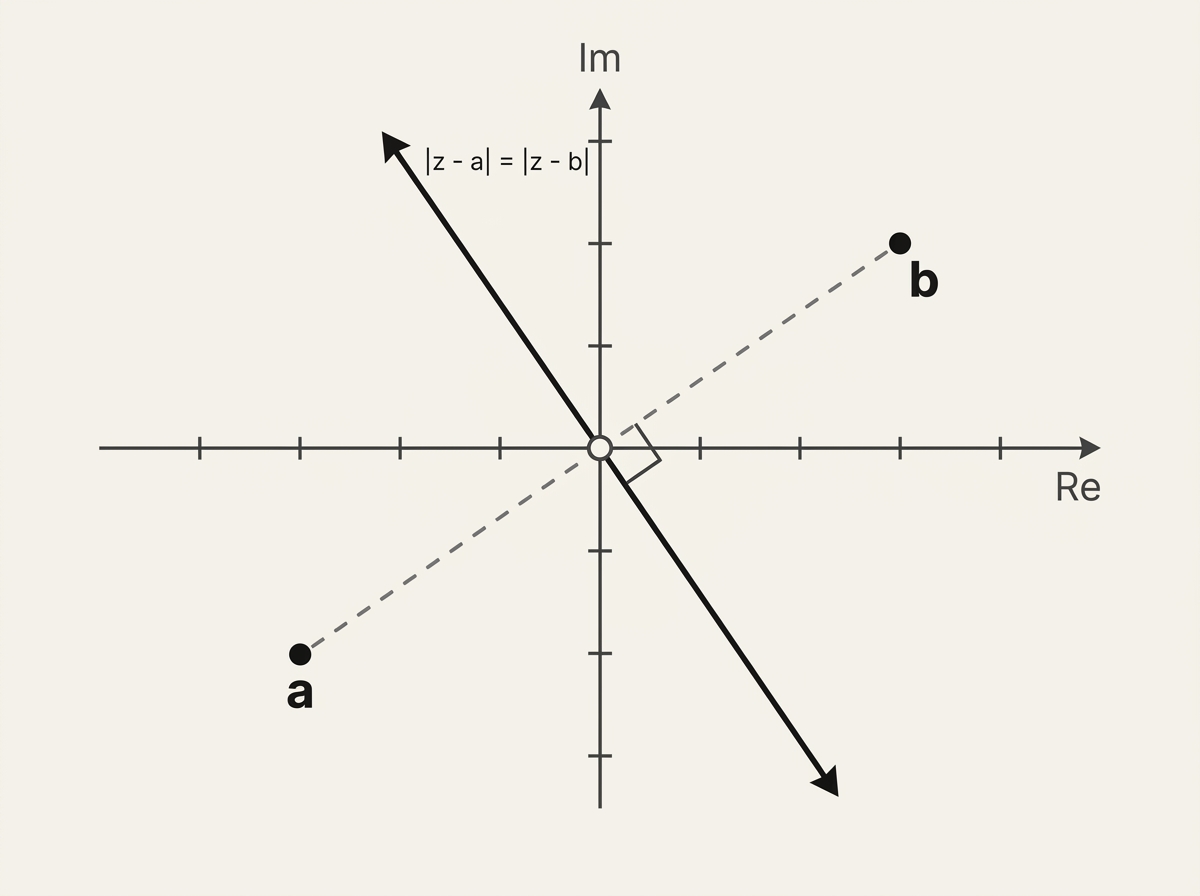
Let $z=x+yi$. LHS: $|(x-1)+(y-2)i|=\sqrt{(x-1)^2+(y-2)^2}$. RHS: $|(x+3)+yi|=\sqrt{(x+3)^2+y^2}$.
Squaring both sides: $(x-1)^2+(y-2)^2=(x+3)^2+y^2$.
$x^2-2x+1+y^2-4y+4=x^2+6x+9+y^2$
$-2x+1-4y+4=6x+9 \Rightarrow -8x-4y-4=0 \Rightarrow 2x+y+1=0$.
Half-lines: arg(z − a) = θ
The locus of points $z$ satisfying $\arg(z-a)=\theta$ (a fixed angle) is a half-line (ray) starting at, but not including, the point $a$, extending in the direction of angle $\theta$ from the positive real-axis direction.
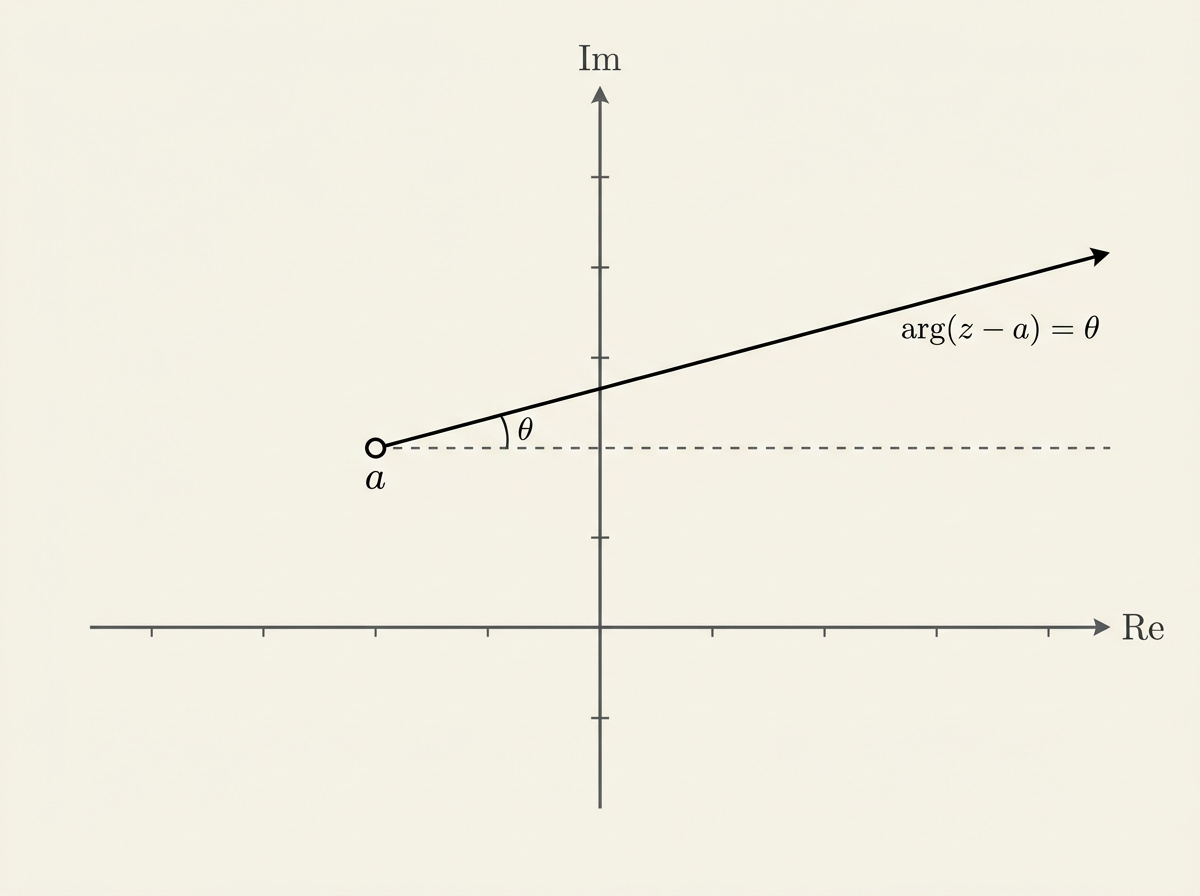
This is a half-line from the (excluded) point $(2,-1)$, at angle $\dfrac{\pi}{4}$ to the positive real direction.
Direction has gradient $\tan(\pi/4)=1$. Line: $y-(-1)=1(x-2) \Rightarrow y=x-3$, restricted to $x>2$ (since the ray only extends in the direction of increasing angle from the excluded point, matching the first-quadrant-like direction from $(2,-1)$).
A half-line locus is not a full straight line — only sketch the ray in the correct direction from $a$, with an open circle at $a$ itself to show it's excluded. Examiners specifically penalise diagrams that draw a complete line through $a$ in both directions.
Finding a point satisfying two loci at once
When a question gives both a circle locus $|z-a|=r$ and a half-line locus $\arg(z-a)=\theta$ from the same fixed point $a$, the point satisfying both is found geometrically: it's simply the point at distance $r$ from $a$, in the direction $\theta$. Using right-angled trigonometry (or $x=x_1+r\cos\theta,\ y=y_1+r\sin\theta$) avoids solving simultaneous equations entirely.
Both loci share the fixed point $(1,2)$. The circle has radius $6$; the half-line leaves $(1,2)$ at angle $\dfrac{\pi}{3}$ to the horizontal, so the required point is $6$ units from $(1,2)$ in that direction.
$x=1+6\cos\dfrac{\pi}{3}=1+6\left(\dfrac12\right)=4$
$y=2+6\sin\dfrac{\pi}{3}=2+6\left(\dfrac{\sqrt3}{2}\right)=2+3\sqrt3$
So $z=4+(2+3\sqrt3)i$.
If the circle and half-line are centred at different fixed points, the shortcut above doesn't apply. Instead, either substitute the half-line's Cartesian equation into the circle's Cartesian equation and solve simultaneously, or sketch both loci accurately and use the geometry of the diagram (e.g. isosceles triangles formed by radii) to find the intersection.
Exam-style questions
Question 1 4 marks
Describe fully the locus given by $|z+2-5i|=3$, stating the centre and radius.
Rewrite as $|z-(-2+5i)|=3$ (M1)
Circle centred at $(-2,5)$ with radius $3$. (A1, A1, A1)
Question 2 6 marks
Find the Cartesian equation of the locus $|z-6i|=|z-4|$, and describe it geometrically.
$z=x+yi$: $x^2+(y-6)^2=(x-4)^2+y^2$ (M1, A1)
$x^2+y^2-12y+36=x^2-8x+16+y^2$
$-12y+36=-8x+16 \Rightarrow 8x-12y+20=0 \Rightarrow 2x-3y+5=0$ (M1, A1, A1)
This is the perpendicular bisector of the segment joining $(0,6)$ and $(4,0)$. (B1)
Question 3 6 marks
The locus $L_1$ is given by $|z-3|=|z-3i|$ and the locus $L_2$ is given by $|z|=3$. Find the point(s) of intersection of $L_1$ and $L_2$.
$L_1$: $(x-3)^2+y^2=x^2+(y-3)^2 \Rightarrow -6x+9=-6y+9 \Rightarrow x=y$ (M1, A1)
$L_2$: $x^2+y^2=9$. Substituting $y=x$: $2x^2=9 \Rightarrow x=\pm\dfrac{3}{\sqrt2}$ (M1, A1)
Points: $\left(\dfrac{3}{\sqrt2},\dfrac{3}{\sqrt2}\right)$ and $\left(-\dfrac{3}{\sqrt2},-\dfrac{3}{\sqrt2}\right)$ (A1, A1)