Sums of Natural Numbers
A neat pairing trick collapses the sum 1 + 2 + ⋯ + n into a single closed formula, the building block for every other series result in this topic.
The sigma notation for sums
$\displaystyle\sum_{r=1}^{n}f(r)$ means $f(1)+f(2)+f(3)+\cdots+f(n)$: evaluate $f(r)$ at each integer $r$ from the lower limit to the upper limit, and add the results. Sigma notation is linear: $\displaystyle\sum_{r=1}^n\big(af(r)+bg(r)\big)=a\sum_{r=1}^nf(r)+b\sum_{r=1}^ng(r)$ for constants $a,b$.
The sum of the first n natural numbers
$$\sum_{r=1}^{n}r=1+2+3+\cdots+n=\frac{n(n+1)}{2}$$
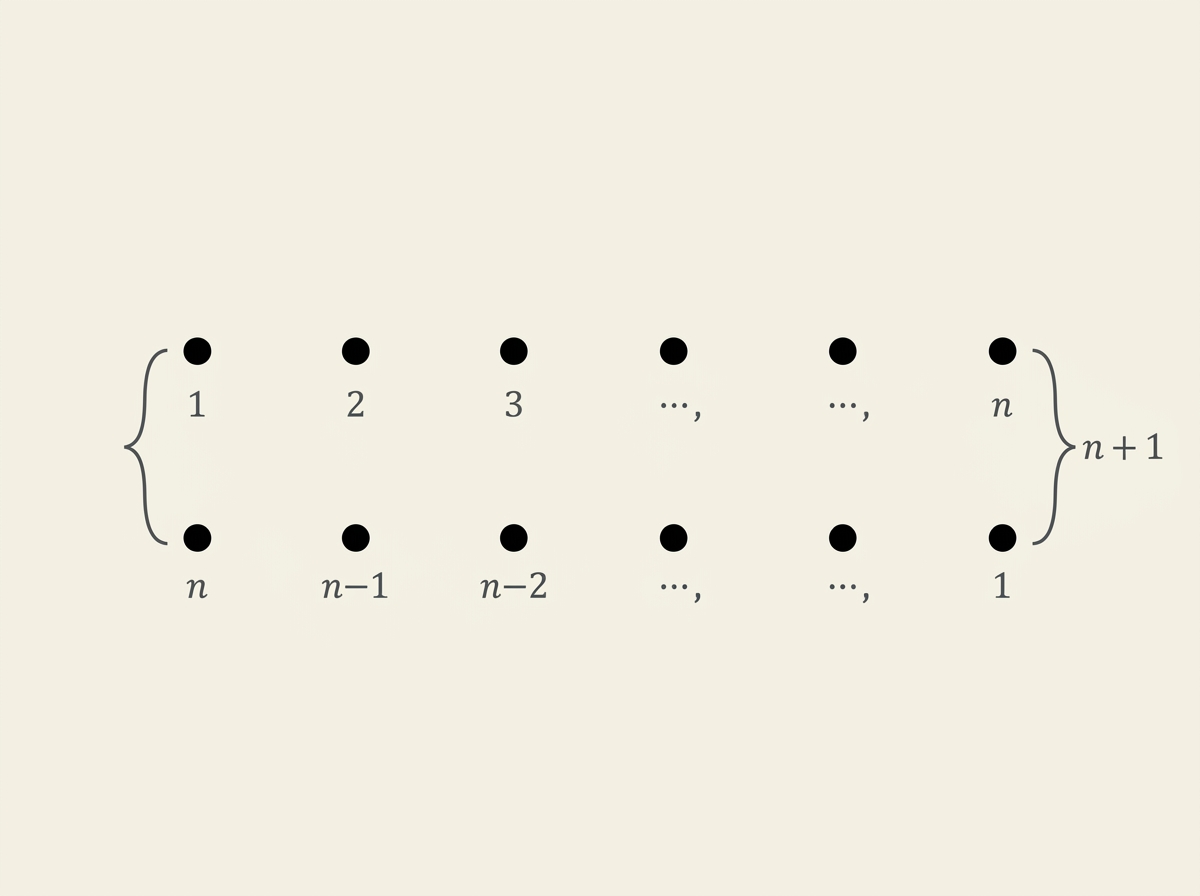
This formula can equally be proved by mathematical induction (basis $n=1$; assume true for $n=k$; add $(k+1)$ to both sides and simplify to match the $n=k+1$ case). Both proofs are acceptable in exams, but the Gauss pairing argument is faster to write out for this particular result.
$\dfrac{40(41)}{2}=\dfrac{1640}{2}=820$.
$\displaystyle\sum_{r=11}^{30}r=\sum_{r=1}^{30}r-\sum_{r=1}^{10}r=\dfrac{30(31)}{2}-\dfrac{10(11)}{2}=465-55=410$.
Example 2 above is a special case of a general rule worth memorising, since it comes up constantly once limits get more complicated: to sum $f(r)$ from $r=k$ up to $r=n$, take the sum from $1$ to $n$ and remove everything below the lower limit, i.e. the sum from $1$ to $k-1$.
$$\sum_{r=k}^{n}f(r)=\sum_{r=1}^{n}f(r)-\sum_{r=1}^{k-1}f(r)$$
The upper limit on the sum you subtract is $k-1$, not $k$ — the term at $r=k$ itself belongs in the sum you want, so it must not be removed. This off-by-one slip is one of the most common ways marks are lost on this technique.
Using Method 8.3 with lower limit $k=n+1$ and upper limit $3n$:
$\displaystyle\sum_{r=n+1}^{3n}r=\sum_{r=1}^{3n}r-\sum_{r=1}^{n}r=\frac{3n(3n+1)}{2}-\frac{n(n+1)}{2}$
$=\dfrac{1}{2}\Big[3n(3n+1)-n(n+1)\Big]=\dfrac{1}{2}\Big[9n^2+3n-n^2-n\Big]=\dfrac{1}{2}(8n^2+2n)=4n^2+n=n(4n+1)$, as required.
$\displaystyle\sum_{r=1}^n(4r-1)=4\sum_{r=1}^nr-\sum_{r=1}^n1=4\cdot\frac{n(n+1)}{2}-n=2n(n+1)-n=2n^2+2n-n=2n^2+n$.
Factorised: $n(2n+1)$.
$\dfrac{n(n+1)}{2}=210 \Rightarrow n(n+1)=420 \Rightarrow n^2+n-420=0$.
Factorising: $(n-20)(n+21)=0 \Rightarrow n=20$ or $n=-21$. Since $n$ must be a positive integer, $n=20$.
$\displaystyle\sum_{r=1}^n 1 = n$ (the constant $1$ added $n$ times), not $1$ — this term is easy to drop or mis-evaluate when splitting a linear combination like $\sum(4r-1)$ into separate sums.
Exam-style questions
Question 1 5 marks
(a) Prove that $\displaystyle\sum_{r=1}^{n}r=\dfrac{n(n+1)}{2}$. (b) Hence find $\displaystyle\sum_{r=1}^{60}r$.
(a) Full Gauss pairing proof as above, or induction proof (basis + inductive step + conclusion). (M1, A1, A1)
(b) $\dfrac{60(61)}{2}=1830$ (M1, A1)
Question 2 5 marks
Show that $\displaystyle\sum_{r=1}^{n}(6r-5)=n(3n-2)$.
$\displaystyle\sum_{r=1}^n(6r-5)=6\sum_{r=1}^nr-5n=6\cdot\frac{n(n+1)}{2}-5n$ (M1, A1)
$=3n(n+1)-5n=3n^2+3n-5n=3n^2-2n=n(3n-2)$ (M1, A1, A1)
Question 3 6 marks
Find $\displaystyle\sum_{r=15}^{45}(2r+3)$.
$\displaystyle\sum_{r=1}^{n}(2r+3)=2\cdot\frac{n(n+1)}{2}+3n=n^2+n+3n=n^2+4n$ (M1, A1)
$\displaystyle\sum_{r=15}^{45}(2r+3)=\sum_{r=1}^{45}(2r+3)-\sum_{r=1}^{14}(2r+3)=(45^2+4(45))-(14^2+4(14))$ (M1, A1)
$=(2025+180)-(196+56)=2205-252=1953$ (M1, A1)