Scientific Method & Communicating Physics
Every equation you'll learn this year arrived on the page by a long, often messy route — someone noticed something odd, guessed at an explanation, tested it, got it wrong a few times, and eventually convinced a community of sceptical colleagues they were onto something real. This lesson covers that process itself: how physics actually decides what's true.
How an idea actually becomes accepted physics
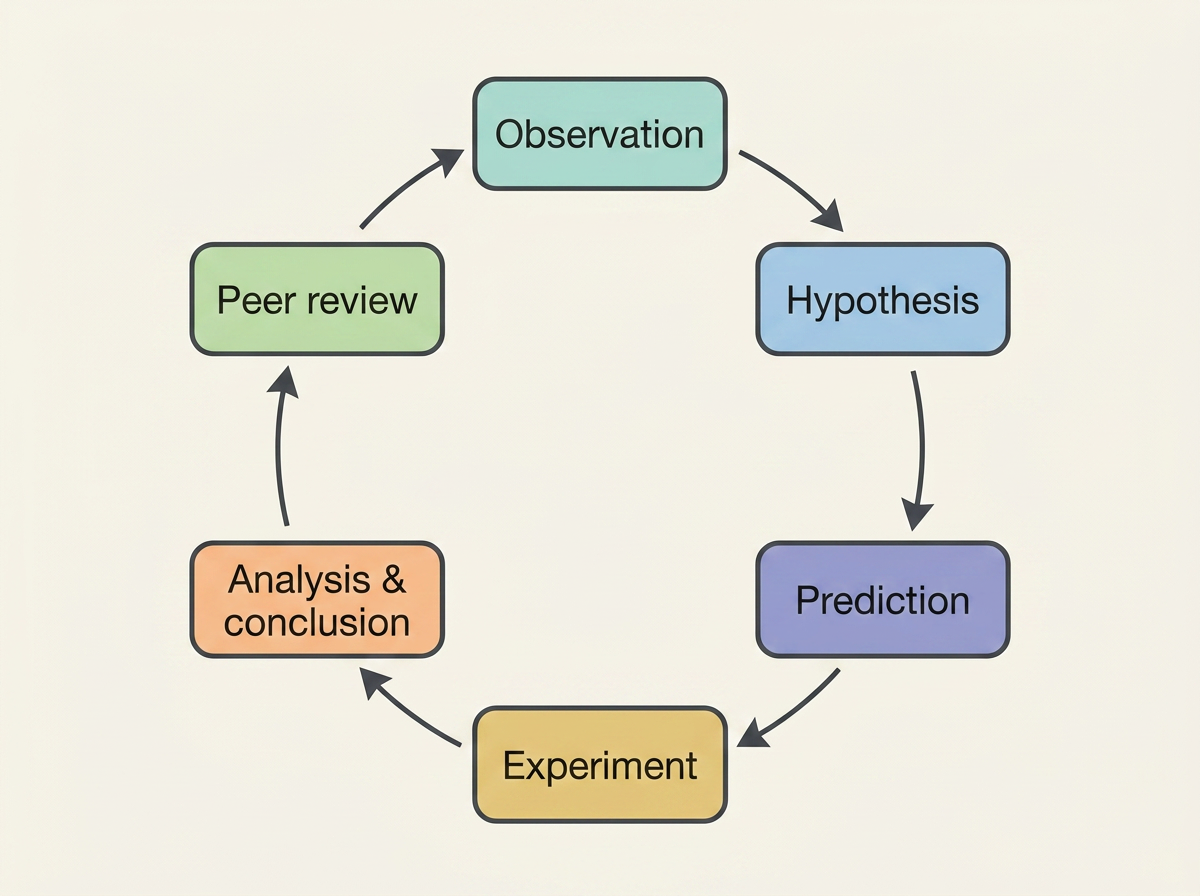
It's tempting to picture science as a straight line: someone has a clever idea, does an experiment, and the textbook gets updated. Real physics is messier, and moves in a loop rather than a line — every stage does a genuinely different job.
It usually starts with an observation — something noticed, often almost by accident, that doesn't quite fit what was expected. Maybe a planet's orbit wobbles slightly more than the maths predicts, or a metal glows a colour it shouldn't. From that comes a hypothesis: a proposed explanation, a guess dressed up in physical reasoning. A hypothesis on its own isn't worth much yet, though, since a good story and a true story can sound identical. What turns a hypothesis into something scientific is the next step — a testable prediction: if the hypothesis is correct, some specific, measurable thing should also be true, something nobody has checked yet.
That prediction gets put to an experiment, designed specifically to see whether the predicted effect shows up. The resulting data then goes through analysis, where a physicist asks the hard question: does this data actually support the hypothesis, once you've accounted for the uncertainty in every measurement involved? Out of that comes a conclusion — but even a strong one doesn't become "accepted physics" the moment one team reaches it.
Before that happens, the work has to survive peer review: other scientists, with every incentive to find a flaw if there is one, scrutinise the method, reasoning and data. Even after publication, the result typically needs to be replicated — repeated independently by other researchers, in other labs, and shown to hold up again. Only once an idea has survived all that scrutiny does it earn the confidence to appear in a textbook without a hedge — and even then, the loop doesn't stop; a surviving idea just becomes the new background against which the next odd observation gets noticed.
Laws, theories and models — three different jobs
Students often use "law" and "theory" as if one just means "more proven than the other." That's not the distinction physics draws — each of these three words does a genuinely different job.
A law is a concise, usually mathematical, statement of what happens, without necessarily explaining why. Newton's second law, $F=ma$, tells you exactly how force, mass and acceleration relate, with remarkable precision — but on its own it says nothing about why mass resists acceleration in the first place. A law is a compact, reliable description, not an explanation.
A theory, by contrast, is a broader explanatory framework accounting for why things happen, typically tying together a whole web of laws, observations and mechanisms into one coherent picture. Newtonian mechanics as a whole — not just the individual laws, but the underlying picture of forces acting on masses through absolute space and time — is a theory. In everyday speech "theory" often means "an unproven hunch," almost the opposite of how it's used in physics: a scientific theory is a well-tested, wide-reaching framework, not a guess.
A model is a deliberately simplified representation of something, built to make useful predictions without necessarily capturing every detail of the underlying reality — and a model is expected to be refined or replaced outright as better evidence comes in. The history of atomic models is the clearest example. J.J. Thomson's "plum pudding" model pictured the atom as a diffuse blob of positive charge studded with electrons. Ernest Rutherford's gold foil experiment then showed alpha particles occasionally bounced almost straight back off a thin gold foil — something plum pudding couldn't explain — leading to the nuclear model, with almost all the atom's mass and positive charge concentrated in a tiny central nucleus. Niels Bohr refined that further, placing electrons in specific, quantised orbits to explain why atoms only emit light at particular fixed wavelengths rather than a continuous smear of colours. Each model wasn't simply "wrong" then "right" — each was a genuine improvement, better matching the evidence at the time, and each was eventually superseded when new evidence turned up that it couldn't explain.
A law tells you what happens, usually as a compact equation. A theory tells you why, by tying laws and observations together into an explanatory picture. A model gives you a simplified, working picture of something, built to be useful now and expected to be replaced later as evidence improves. None of these three is simply "more true" than the others — they're doing different jobs, and physics needs all three.
Falsifiability: the line between science and everything else
What actually separates a scientific claim from a claim that just sounds scientific? The answer physics leans on is falsifiability — a scientific claim has to be one that could, at least in principle, be shown to be wrong by some observation or experiment. It doesn't have to actually be wrong. It just has to be the kind of claim where "wrong" is a possibility evidence could reveal.
"Objects with mass attract each other" is falsifiable — if you found two masses that reliably repelled each other under all conditions, gravity as we understand it would be in serious trouble. Compare that with "there's an invisible, undetectable force guiding every particle that leaves absolutely no measurable trace." However confidently that's stated, no experiment, even hypothetically, could ever show it false — which is exactly what makes it not a scientific claim, whatever else it might be. Falsifiability isn't about pessimism; it's what gives a claim any real content. A claim that can survive absolutely any possible observation isn't telling you anything about the world.
Validity and reliability
These two words get mixed up almost as often as accuracy and precision, and the distinction matters just as much. An experiment is valid if it actually tests what it claims to, with other variables that could affect the outcome properly controlled. If you're investigating how current through a wire affects its temperature rise but don't keep the wire's length and material constant between trials, your experiment isn't valid — you might be measuring the effect of the wire changing just as much as the current.
An experiment is reliable if it gives consistent results when repeated. Reliability and validity are genuinely independent: you could run a perfectly valid experiment with unreliable, poorly calibrated equipment giving inconsistent readings, or an extremely reliable experiment that's actually invalid, consistently measuring the wrong thing due to an uncontrolled variable. Good experimental design is an attempt to secure both at once.
Why peer review and replication actually matter
Scientists are human. They can make honest mistakes in method or statistics, fall in love with a hypothesis and unconsciously read their data more generously than it deserves, and — rarely — some have committed outright fraud. Peer review puts a result in front of people with no stake in it being true, whose job is to look for exactly these failure modes before the wider world starts relying on the conclusion.
Independent replication goes a layer further, since peer review alone can only scrutinise what's written down — it can't catch a subtly miscalibrated instrument quietly biasing every reading in one lab. When a different group, with their own equipment, gets essentially the same result, that's powerful evidence the effect is really there and not an artefact of one lab's quirks. This is why a single, dramatic, unreplicated result — however exciting the headline — is treated with real caution until other groups have confirmed it independently. It isn't stubbornness; it's the system doing the job it was built to do.
Communicating physics clearly
Doing good physics and communicating it clearly are not the same skill, but the second matters just as much — a brilliant piece of work that nobody can follow, verify or build on might as well not have been done.
Using correct terminology and notation
Precision in language is not pedantry in physics — it's the whole point. Using a symbol without defining it, or a word loosely that has a specific technical meaning, forces the reader to guess, and guessing is exactly what physics tries to eliminate. Good practice means defining every symbol the first time it appears (state what $v$, $u$, $a$, $t$ and $s$ each stand for before using them), and writing units in standard SI notation — $\text{m s}^{-1}$, not an abbreviation that shifts from line to line.
It also means respecting the distinction between a vector (magnitude and direction, like velocity or force) and a scalar (magnitude only, like speed or energy) — mixing these up, or dropping a direction a question depends on, is one of the most common ways marks are lost even when the underlying physics is understood. Stay consistent with your exam board's data sheet: if it defines $g$, $c$, $e$ or $N_A$ a particular way, use that same symbol and value rather than introducing your own notation.
Every professional physics paper defines its symbols and sticks rigidly to standard notation, so someone on the other side of the world can read the work without reverse-engineering what was meant. Building that habit now, in coursework and exam answers, is practice for the same discipline working physicists rely on every day.
Structuring a scientific report
A practical write-up follows a standard structure because it mirrors the scientific method itself — each section answers a different question a reader would otherwise have to ask.
The aim states, in a sentence or two, what the experiment is trying to find out. The method describes what was actually done, in enough detail for someone else to repeat it exactly — the write-up's contribution to reproducibility. The results present the data collected, with quantities recorded alongside their uncertainties, not as bare numbers. The analysis is where results are processed — calculations, graphs, gradients and their uncertainties — to answer the aim. The conclusion states explicitly what was found, referring back to the aim and any hypothesis tested. The evaluation is an honest look back at the method: what sources of random and systematic error were present, how large their effect plausibly was, and what could realistically improve the experiment if repeated.
Skipping the evaluation, or treating it as an afterthought, is a common mistake — it's often the section that shows most clearly whether you understand the limits of what your data can tell you, rather than having just followed a procedure.
Referencing and citing sources
Physics is a cumulative activity — almost nothing is discovered entirely from scratch, and every piece of work sits on top of results, methods and data that came before it. Citing a source makes that foundation visible, and serves several practical purposes beyond academic etiquette.
A citation lets a reader verify a claim independently, by going back to where it was originally established, rather than taking it on trust. It lets other researchers build directly on prior results without re-deriving or re-measuring everything from first principles every time — which is precisely what makes the cycle of science efficient rather than endlessly repetitive. And it helps the community avoid duplicating work already done, or repeating a mistake a citation would have flagged. Referencing is an extension of the same principle behind peer review and replication: physics relies on claims being traceable and checkable.
Key takeaways
- Science progresses as a cycle — observation, hypothesis, testable prediction, experiment, analysis, conclusion, then peer review and replication — that feeds back into fresh observation rather than stopping.
- A law is a concise mathematical description of what happens; a theory is a broader framework explaining why; a model is a simplified, useful representation expected to be refined or replaced as evidence improves.
- The history of atomic models — plum pudding, nuclear, Bohr — shows models being progressively refined as new evidence revealed what earlier models couldn't explain.
- A genuinely scientific claim must be falsifiable: it must be possible, at least in principle, for evidence to show it wrong.
- A valid experiment actually tests what it claims to, with other variables controlled; a reliable experiment gives consistent results on repetition — an experiment can have either property without the other.
- Peer review and independent replication exist to catch honest mistakes, unconscious bias, and occasional fraud before an idea is trusted by the wider scientific community.
- Clear communication means defining every symbol used, following standard SI unit notation, respecting the vector/scalar distinction, and staying consistent with your exam board's data sheet.
- A scientific report follows aim, method, results (with uncertainties), analysis, conclusion, and evaluation — each section answering a different question a reader would otherwise have to ask.
- Citing sources lets claims be verified independently, lets researchers build on prior results without re-deriving them, and helps the community avoid duplicating work already done.