Estimation & Orders of Magnitude
Not every question in physics needs a calculator, a data sheet and three decimal places. Sometimes what you need is a rough number, produced fast, that tells you whether an idea is even in the right ballpark — and building one is a skill in its own right.
What "order of magnitude" actually means
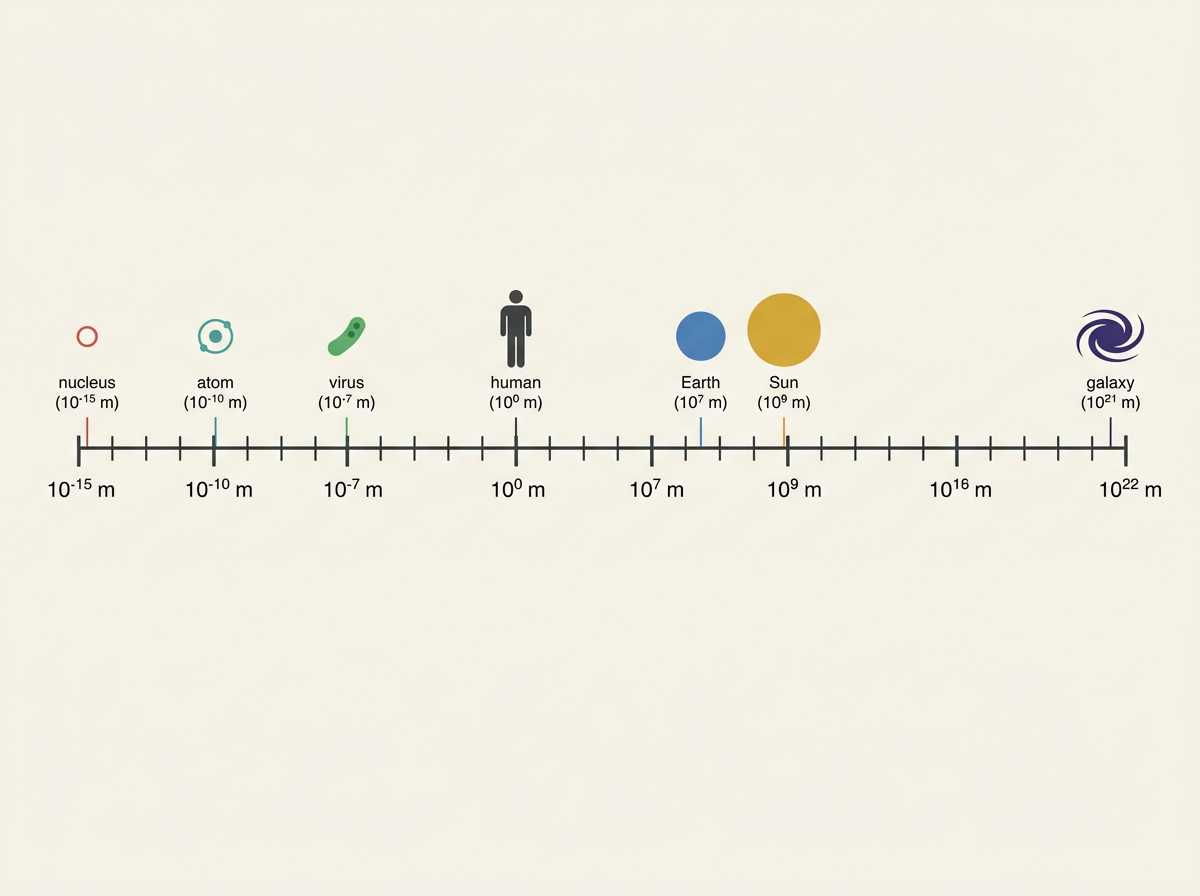
When physicists talk about the order of magnitude of a quantity, they mean the nearest power of ten to it — nothing more precise. The mass of a proton is roughly $10^{-27}\,\text{kg}$. The distance from the Earth to the Sun is roughly $10^{11}\,\text{m}$. A human hair is roughly $10^{-4}\,\text{m}$ across. None of these numbers are trying to be exact; they're placing a quantity on a map spanning dozens of powers of ten, from the inside of a nucleus to the edge of the observable universe.
This matters because physics deals with a genuinely enormous range of scales, and human intuition is hopeless at judging that range directly. Nobody has a gut feeling for the difference between $10^{20}$ and $10^{23}$ — both just sound like "a lot." Thinking in terms of orders of magnitude gives you a way of comparing wildly different scales that your intuition can actually grip.
Why bother estimating instead of just calculating?
You might wonder why you'd ever want a deliberately rough answer when a precise one is available. A few good reasons come up constantly, both in exams and in real physics.
The first is sanity-checking. Say you've used a calculator to work out the current through a circuit and it spits out $4.7\times10^{8}\,\text{A}$. Before writing that down, ask: does that even sound plausible for a school circuit? A rough mental estimate — a few volts, a few hundred ohms, so a current of a few thousandths of an amp — tells you instantly that something in your calculation has gone badly wrong, probably a decimal point or an exponent, long before hunting through your working line by line.
The second is feasibility. Engineers and physicists often need to know, roughly, whether an idea is even worth pursuing before investing time in a detailed calculation. Could a solar panel on this roof realistically power the building? Is it plausible a given radioactive source could deliver a lethal dose in the time available? A quick estimate, accurate to within a power of ten or so, is often all you need to answer "worth investigating further" or "not even close."
The third is simply that precise data isn't always available. Sometimes you're asked how many piano tuners work in a city, or how much water flows through a river each year, and nobody hands you a data sheet with the answer. What you have is everyday knowledge and the ability to combine it sensibly — often enough to get startlingly close to the true value.
The method: break it into a chain of easier factors
The trick to a good estimate is almost never to guess the final number directly. Instead, break the unknown quantity into a chain of smaller quantities, each easier to have a sensible gut feeling about, estimate each one on its own, and multiply (or divide) them back together.
Say someone asks you to estimate the number of grains of sand on a beach: rather than guessing outright, estimate the beach's rough volume — length times width times the depth of sand that matters — and separately the volume of a single grain, then divide one by the other. Each sub-estimate is something you can actually picture and put a sensible power of ten to, even though the final answer isn't something anyone could just guess.
At each stage, round aggressively — to the nearest power of ten, or at most the nearest small whole number multiplying a power of ten. Don't agonise over whether a room is 3 m or 3.4 m long; call it $3\,\text{m}$ and move on. Small errors in each factor tend to partially cancel when multiplied together, so obsessing over precision in any one step wastes effort without buying much extra accuracy in the final answer.
A good estimate isn't a failure to calculate properly — it's a different, faster tool for a different job. If your estimate for a beach's grain count comes out at $10^{21}$ and a more careful calculation later gives $3\times10^{21}$, your estimate did its job. Being out by a small factor is fine; being out by many powers of ten is the kind of error an estimate is specifically designed to catch.
Choosing sensible reference quantities
Estimation leans heavily on a mental library of everyday reference quantities you can reach for instantly: your own mass (around $70\,\text{kg}$), a comfortable walking speed (around $1$–$2\,\text{m s}^{-1}$), the height of a room (around $3\,\text{m}$), the density of water ($1000\,\text{kg m}^{-3}$), the length of a year in seconds (about $3\times10^{7}\,\text{s}$). None of these need to be looked up — they're things you already know from having lived in the world — and a huge fraction of estimation problems reduce to combining a handful of numbers like these.
Building this mental library is mostly practice: whenever you see an estimation-style question, notice which everyday quantities it leaned on, and file them away. Over time you build a toolkit of anchor values spanning many orders of magnitude, and estimating an unfamiliar quantity becomes a matter of finding the right chain linking it back to values you already carry in your head.
Key takeaways
- An order of magnitude is the nearest power of ten to a quantity — a coarse but genuinely useful way of placing wildly different scales on the same scale.
- Estimation is used to sanity-check a precise calculation, to judge whether an idea is even feasible before investigating it properly, and to get an answer when exact data simply isn't available.
- The core method is to break an unknown quantity into a chain of smaller, more familiar factors, estimate each one separately, then combine them.
- Round aggressively at each stage — to the nearest power of ten or so — since small rounding errors tend to partially cancel out across a multi-step estimate.
- Being out by a small factor in an estimate is expected and fine; being out by several powers of ten signals a real mistake worth hunting down.
- Building a mental library of everyday reference quantities (your own mass, walking speed, room dimensions, the density of water) makes future estimates much faster to construct.
- Chaining estimates works just as well for physical quantities as everyday ones — combining a volume, a density and a molar mass with the Avogadro constant can estimate a molecule count that's far beyond direct intuition.