The Ideal Gas Laws
Squeeze a gas and its pressure rises; heat it and either its pressure or its volume rises, depending on what's free to change. Three separate experimental laws capture these behaviours individually — but the real payoff comes from combining all three into one equation flexible enough to describe any gas process.
The three gas laws
Each of the following laws describes how two of pressure, volume and temperature relate to one another, while the third quantity is held fixed. All three were discovered experimentally, long before the kinetic theory model in the next lesson explained why they hold.
Boyle's law
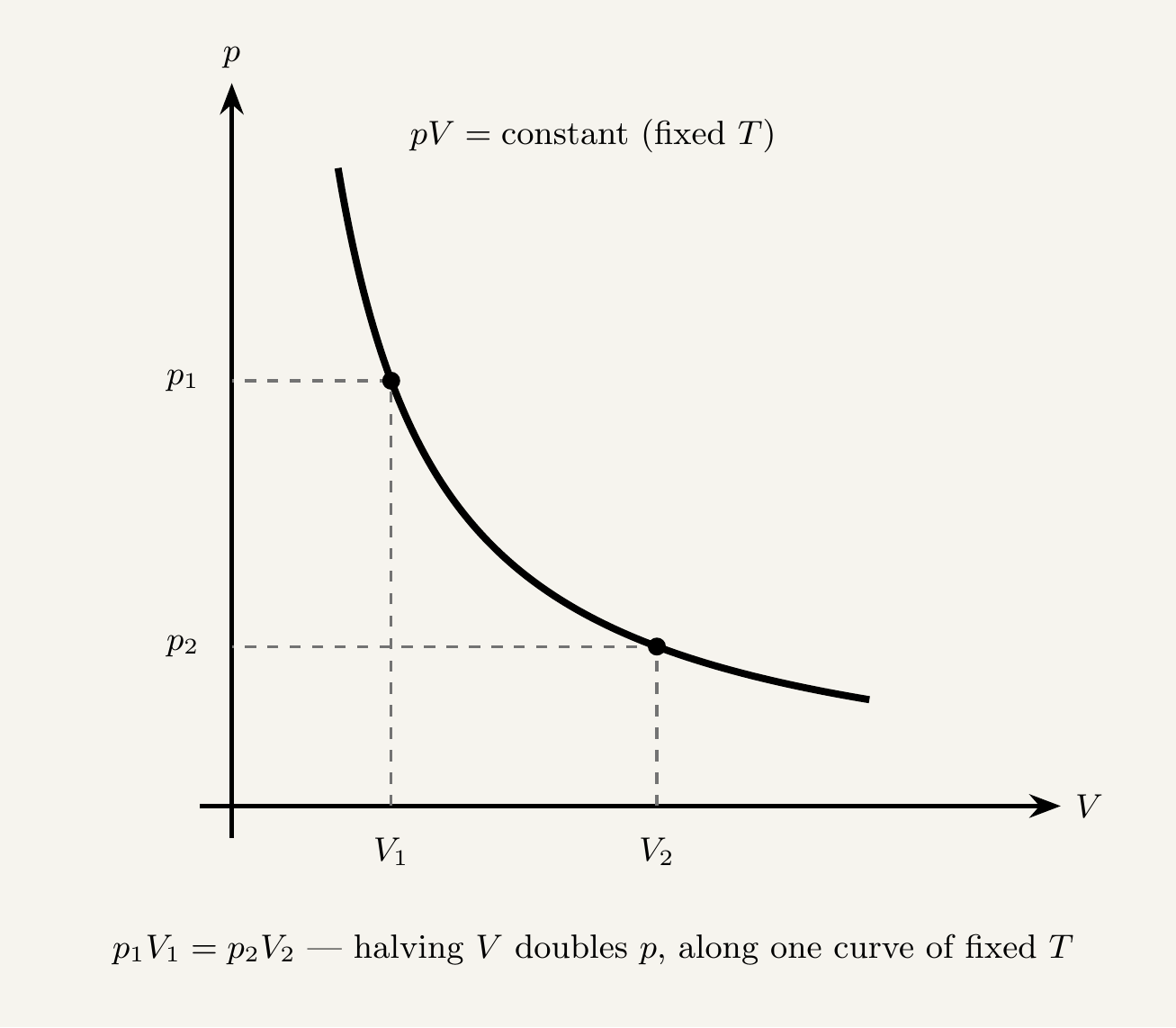
At constant temperature, the pressure of a fixed mass of gas is inversely proportional to its volume:
Equivalently, for a gas taken from one state to another at the same temperature, $p_1V_1 = p_2V_2$. Compressing a gas into a smaller volume without letting it cool increases its pressure in direct inverse proportion.
Charles's law
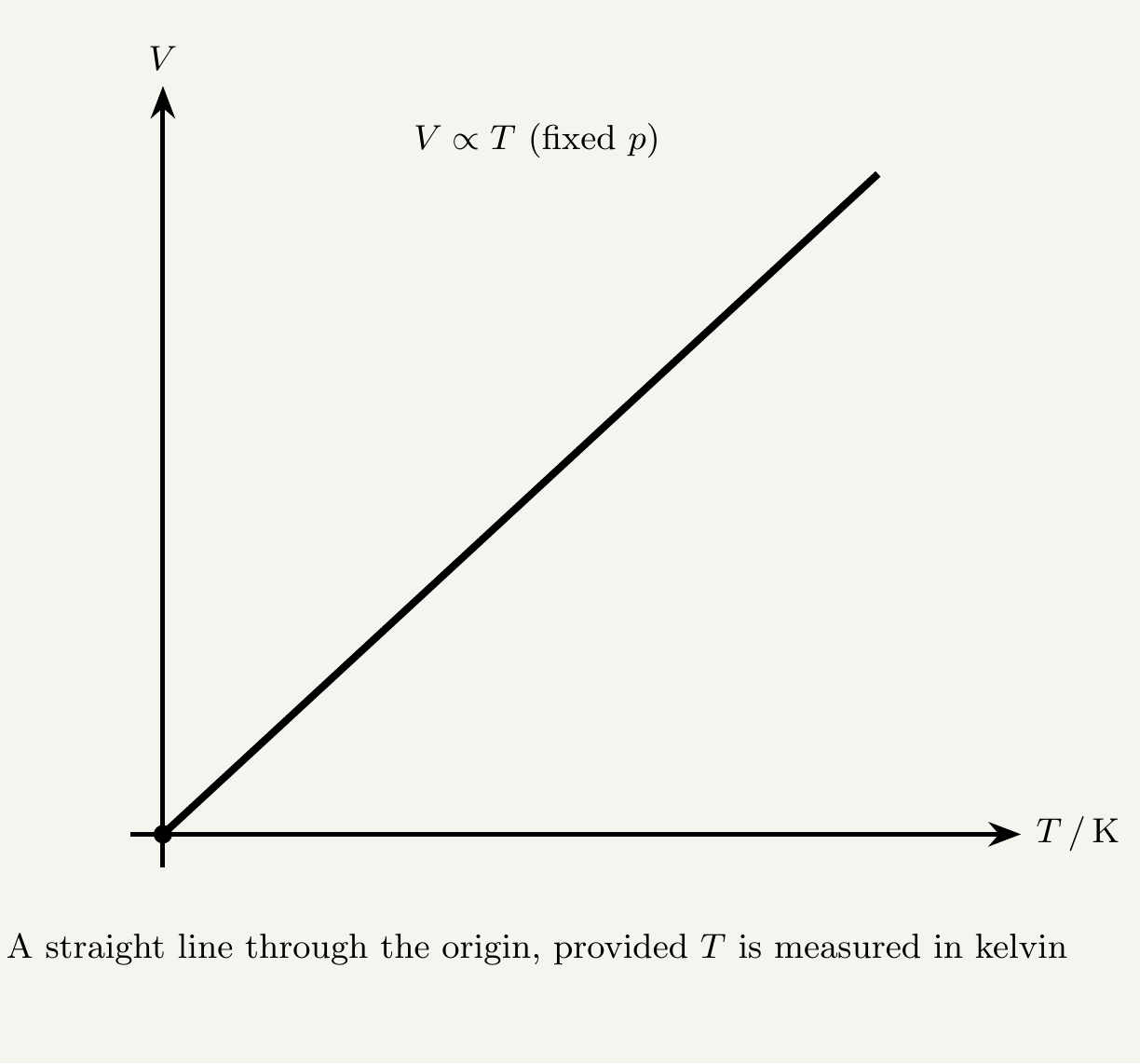
At constant pressure, the volume of a fixed mass of gas is directly proportional to its absolute (kelvin) temperature:
Equivalently, $\dfrac{V_1}{T_1} = \dfrac{V_2}{T_2}$. A gas allowed to expand freely as it's heated (e.g. in a cylinder with a freely-moving piston) increases its volume in direct proportion to its absolute temperature — this requires kelvin, not Celsius, since it's a genuine proportionality (doubling $T$ doubles $V$), which only holds measured from absolute zero.
The pressure law
At constant volume, the pressure of a fixed mass of gas is directly proportional to its absolute temperature:
Equivalently, $\dfrac{p_1}{T_1} = \dfrac{p_2}{T_2}$. A gas sealed in a rigid container increases in pressure in direct proportion to its absolute temperature as it's heated, since volume has no room to expand.
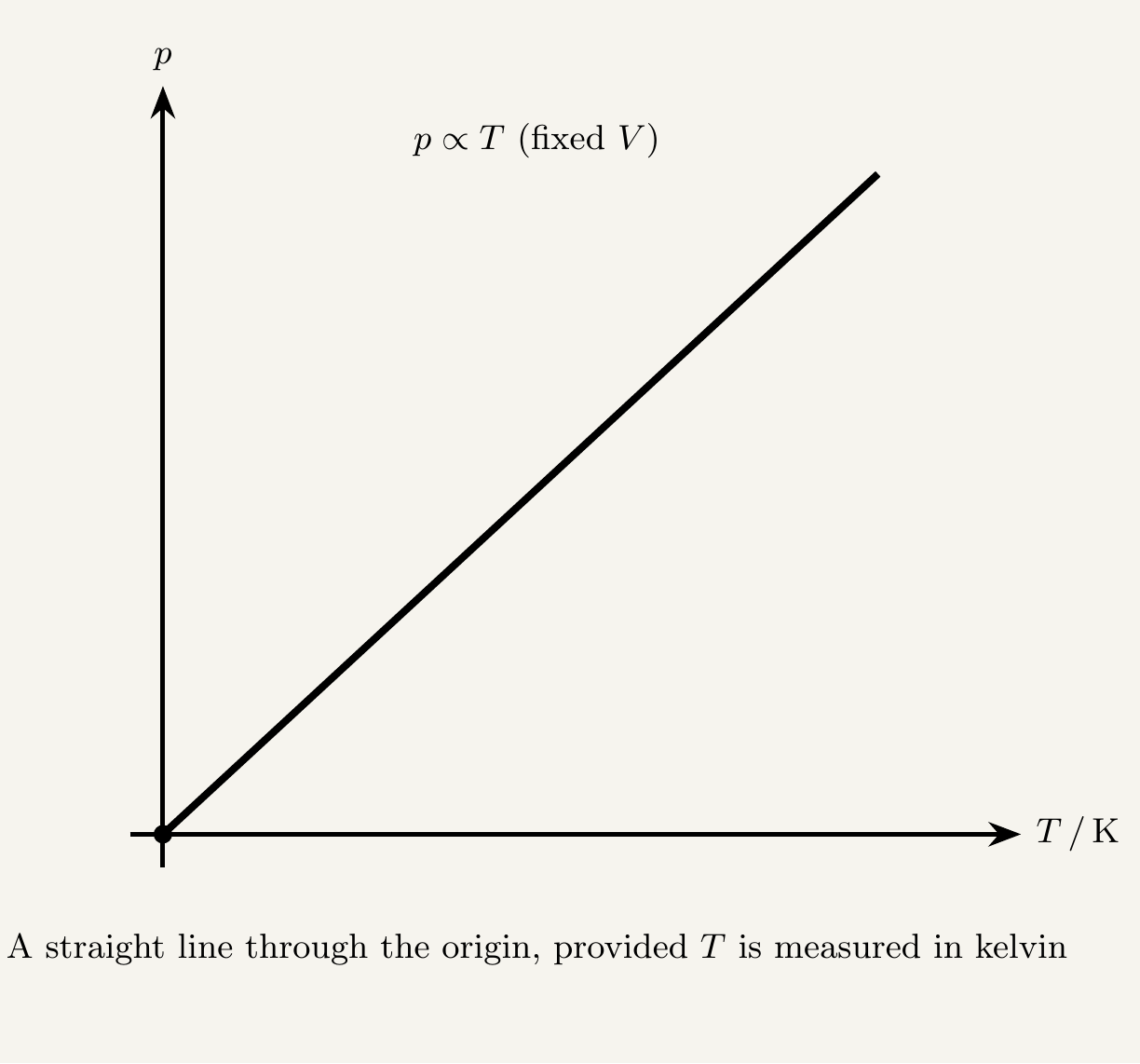
Charles's law and the pressure law are only straight lines through the origin when plotted against absolute temperature (kelvin). Plotted against Celsius instead, both are still straight lines, but intercept the axis at $-273\,°\text{C}$ rather than passing through the origin — one of the classic ways absolute zero was first identified experimentally: extrapolate the line back to where pressure (or volume) would reach zero.
Combining the laws: the ideal gas equation
All three experimental laws are special cases of a single, more general relationship. For a fixed mass of gas, combining Boyle's, Charles's and the pressure law gives:
That constant depends only on the amount of gas present, not which particular gas it is (provided it behaves ideally). Measuring the amount of gas in moles, $n$, the constant of proportionality is the same for every gas — the molar gas constant, $R = 8.31\,\text{J}\,\text{mol}^{-1}\,\text{K}^{-1}$. This gives the ideal gas equation:
where $p$ is pressure (Pa), $V$ is volume (m³), $n$ is the amount of gas (mol), $R$ is the molar gas constant, and $T$ is absolute temperature (K). A gas obeying this exactly is called an ideal gas — a theoretical model real gases approximate closely at everyday pressures and temperatures, away from extreme conditions (very high pressure, or close to condensing) where intermolecular forces and molecule size start to matter.
The molecules form of the equation
It's often more natural to think in terms of the actual number of molecules present, $N$, rather than moles. One mole of any substance contains $N_A = 6.02\times10^{23}$ particles — the Avogadro constant — so $N = nN_A$. Substituting into the ideal gas equation:
The quantity $R/N_A$ is a fundamental constant, the Boltzmann constant, $k = 1.38\times10^{-23}\,\text{J}\,\text{K}^{-1}$ — the gas constant "per molecule" rather than "per mole". This gives the equivalent molecules form:
Both forms describe the same physics; which to use depends on whether the quantity of gas in a question is given in moles or number of molecules.
Work done by an expanding or compressing gas
When a gas expands, it pushes back whatever is containing it — the surrounding piston, atmosphere, or walls — doing work in the process. When a gas is compressed, the reverse happens: something outside does work on the gas. For a gas held at constant pressure $p$ while its volume changes by $\Delta V$, the work done is simply:
where $p$ is the (constant) pressure in Pa and $\Delta V = V_2 - V_1$ is the change in volume in m³, giving $W$ in joules. If the gas expands ($\Delta V$ positive), the gas does work on its surroundings; if it's compressed ($\Delta V$ negative), work is done on the gas instead.
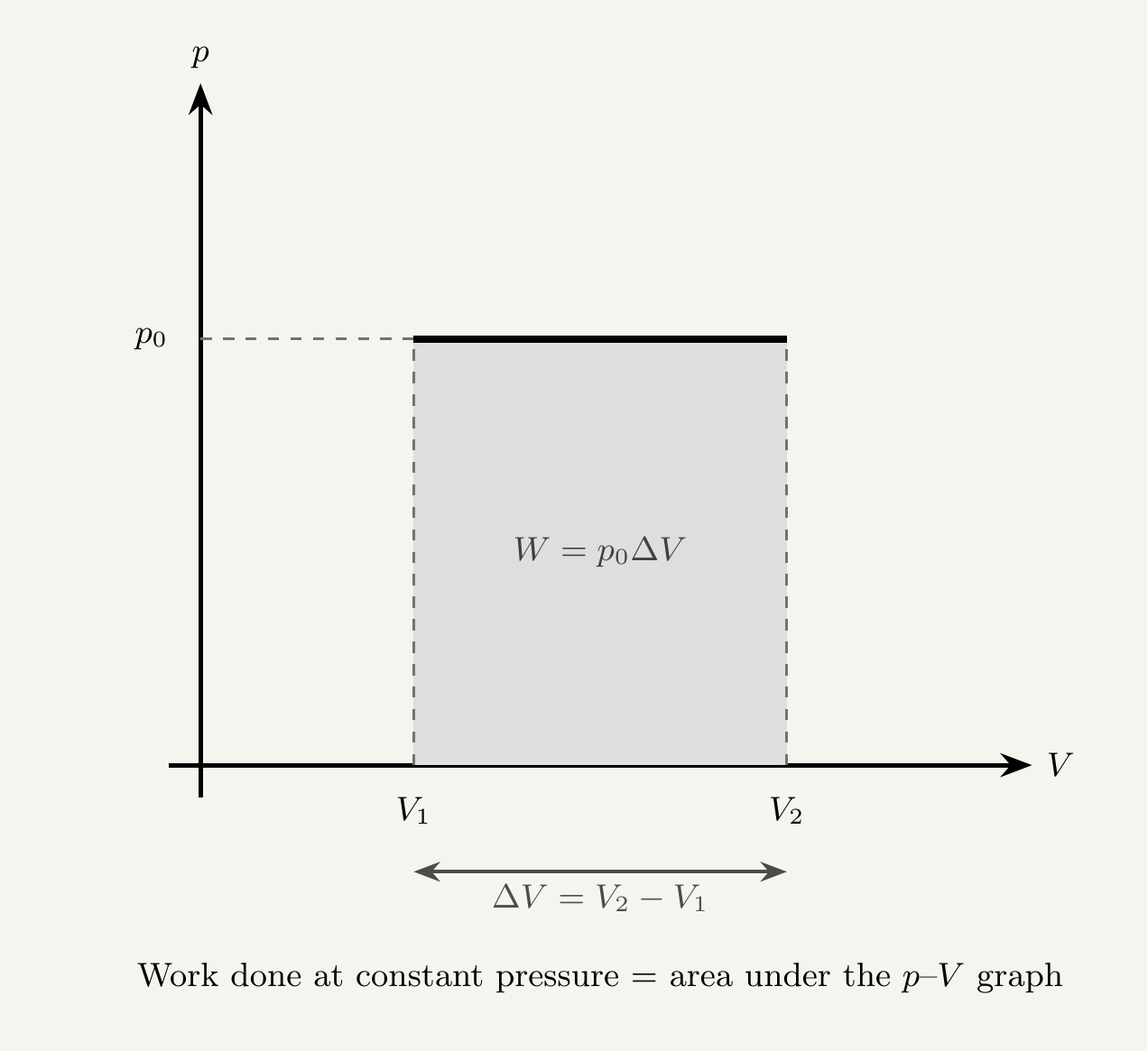
This isn't a coincidence specific to constant pressure — it's a general result. For any process, however the pressure varies, the work done by the gas equals the area between the $p$–$V$ curve and the $V$-axis, between the initial and final volumes. At constant pressure that area is just a rectangle, $p\Delta V$, which is why the formula is so simple in this case.
Required Practical: Boyle's Law and Charles's Law
This is AQA's Required Practical 8: investigating gas laws.
Equipment (Boyle's law)
| Equipment | Purpose |
|---|---|
| Sealed glass tube with trapped air column | Fixed amount of gas whose pressure and volume are varied |
| Bourdon gauge (or pressure sensor) | Measures the pressure applied to the trapped gas |
| Oil reservoir + foot pump | Varies the pressure on the trapped air column |
| Ruler (fixed alongside the tube) | Reads the air column's length, as a proxy for volume |
Method
Equipment (Charles's law)
| Equipment | Purpose |
|---|---|
| Capillary tube with trapped air column | Fixed amount of gas at constant (atmospheric) pressure |
| Concentrated sulfuric acid indicator (or similar) | A visible, free-moving bead sealing the air column |
| Ruler | Measures the trapped air column's length, as a proxy for volume |
| Water bath, thermometer, heater, stirrer | Varies and monitors the gas temperature, keeping it uniform |
Method
Sources of error and how to minimise them
A leak in the sealed tube or around the oil reservoir connection lets trapped gas escape, giving readings that drift systematically off the expected straight line as the experiment proceeds. Check the apparatus is properly sealed before starting, and work reasonably promptly.
Reading the air-column length too soon after each temperature change, before the trapped gas has caught up with the water bath, systematically understates the true expansion. Pause and stir at each new temperature, and only record once the reading has stabilised.
Read the ruler at eye level, in line with the meniscus or indicator bead, and use the same reference point on the column each time.
The sulfuric acid indicator is corrosive — handle the capillary tube with care and avoid direct skin contact. The heated water bath should be handled with tongs or insulated gloves, and spills avoided.
Both experiments turn a hard-to-measure quantity (volume of a thin gas column) into an easy-to-measure one (a length read off a ruler) by keeping the tube's cross-sectional area constant throughout. Whenever cross-sectional area is fixed, volume and length are directly proportional, so length can stand in for volume in any proportionality-based analysis without calculating an actual volume in m³.
Key takeaways
- Boyle's law (constant $T$): $pV = \text{constant}$. Charles's law (constant $p$): $V/T = \text{constant}$. Pressure law (constant $V$): $p/T = \text{constant}$. Temperature must be in kelvin for the latter two.
- Combining all three gives the ideal gas equation: $pV = nRT$ (moles form, $R = 8.31\,\text{J}\,\text{mol}^{-1}\,\text{K}^{-1}$) or equivalently $pV = NkT$ (molecules form, Boltzmann constant $k = R/N_A = 1.38\times10^{-23}\,\text{J}\,\text{K}^{-1}$).
- The Avogadro constant $N_A = 6.02\times10^{23}\,\text{mol}^{-1}$ links the number of molecules $N$ to the number of moles $n$: $N = nN_A$.
- An ideal gas obeys $pV=nRT$ exactly; real gases approximate this well except at very high pressure or near condensation.
- Work done by a gas at constant pressure: $W = p\Delta V$. More generally, work done equals the area under a $p$–$V$ graph between the initial and final volumes.
- AQA Required Practical 8: Boyle's law is confirmed by plotting $p$ against $1/V$ (straight line through the origin) using a sealed air column and pressure gauge; Charles's law is confirmed by plotting volume (as air-column length) against temperature in °C, extrapolating to find absolute zero near $-273\,°\text{C}$.