Specific Heat Capacity & Latent Heat
A kilogram of water and a kilogram of copper, given the same amount of heat, end up at wildly different temperatures — the copper streaks ahead while the water barely warms. This lesson pins down why some substances resist a temperature change far more stubbornly than others, and why a substance mid-boil resists it completely.
Specific heat capacity
Different materials need different amounts of energy to raise their temperature by the same amount, even for equal masses. This is captured by specific heat capacity, $c$: the energy required to raise the temperature of $1\,\text{kg}$ of a substance by $1\,\text{K}$ (equivalently $1\,°\text{C}$, since the scales share a degree size).
where $Q$ is heat energy transferred (J), $m$ is mass (kg), $c$ is specific heat capacity (J kg⁻¹ K⁻¹), and $\Delta\theta$ is temperature change (K or °C — interchangeable as a difference). A large $c$ means a substance needs a lot of energy to change temperature much; a small $c$ the opposite. Water's specific heat capacity, $4200\,\text{J}\,\text{kg}^{-1}\,\text{K}^{-1}$, is unusually large compared with most solids — copper's is only about $390\,\text{J}\,\text{kg}^{-1}\,\text{K}^{-1}$ — which is why a kettle of water takes so much longer to heat than an equal mass of metal, and why coastal climates are more temperature-stable than inland ones.
Why temperature stops rising during a phase change
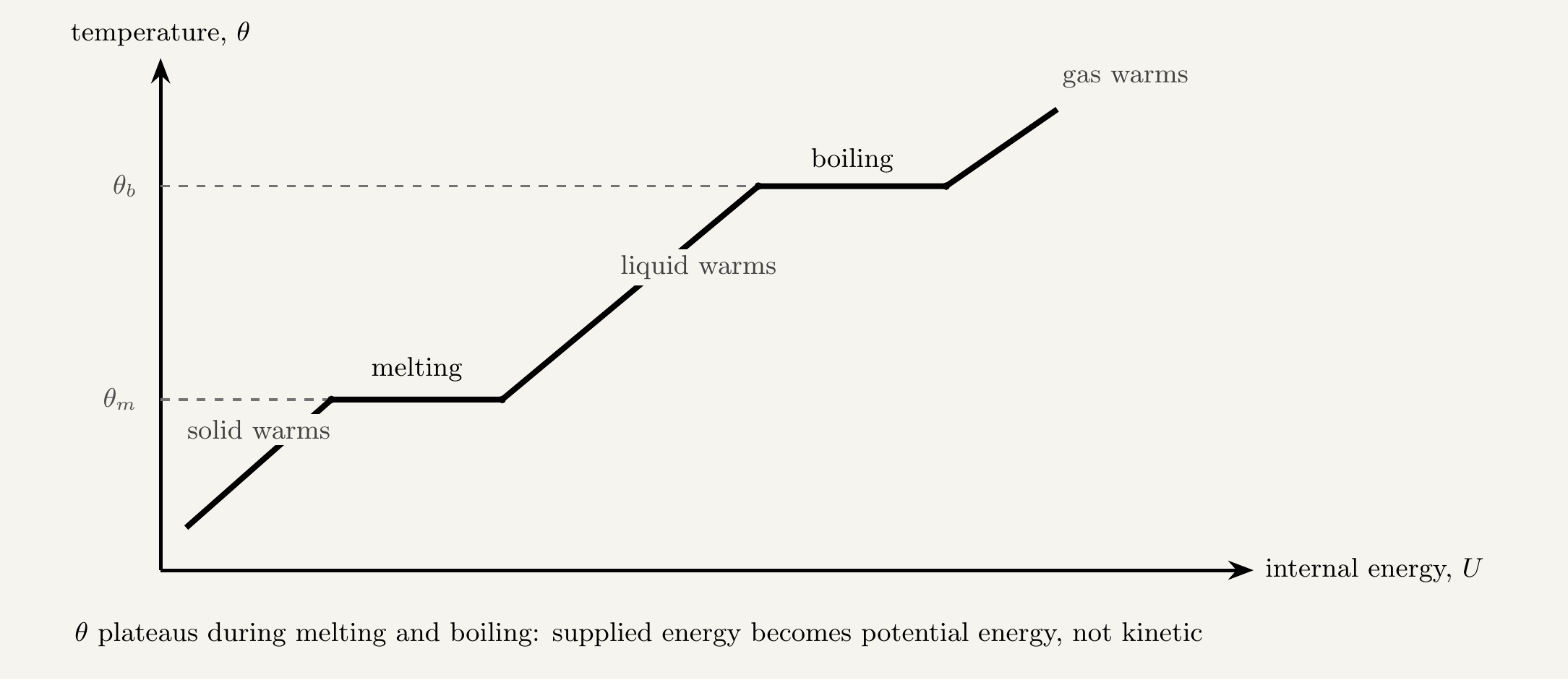
Heat a solid steadily and its temperature climbs smoothly — until it reaches its melting point, where the temperature plateaus completely even though heating continues. The same happens again at the boiling point. This connects back to the internal-energy/temperature distinction from the previous lesson: while melting or boiling, every joule supplied goes into potential energy, pulling particles apart against the intermolecular forces holding them in a more ordered arrangement, rather than into kinetic energy. Since temperature only tracks average kinetic energy, and that isn't changing, temperature doesn't move — even though internal energy keeps rising.
A graph of temperature against internal energy supplied to a substance, taken from solid to gas, shows three sloped sections (solid, liquid, gas warming) separated by two flat plateaus (melting, then boiling). The plateaus are wider or narrower depending on the substance's latent heat relative to its specific heat capacities — a wide plateau means a lot of energy is needed just to change state, comparatively little to change temperature within a single phase.
Specific latent heat
Specific latent heat, $L$, is the energy required to change the state of $1\,\text{kg}$ of a substance, with no change in temperature.
where $Q$ is heat energy transferred (J), $m$ is the mass changing state (kg), and $L$ is the specific latent heat (J kg⁻¹). There's no $\Delta\theta$ term — by definition, temperature doesn't change during this process.
There are two distinct versions of $L$, and a phase-change equation must use the one matching the actual change taking place:
- Specific latent heat of fusion, $L_f$ — for the solid ⇌ liquid change (melting or freezing).
- Specific latent heat of vaporisation, $L_v$ — for the liquid ⇌ gas change (boiling/evaporating or condensing).
$L_v$ is almost always considerably larger than $L_f$ for the same substance — for water, $L_f \approx 3.3\times10^{5}\,\text{J}\,\text{kg}^{-1}$ against $L_v \approx 2.3\times10^{6}\,\text{J}\,\text{kg}^{-1}$, nearly seven times as much. This makes physical sense: melting only loosens the rigid, ordered structure of a solid into a liquid where particles still touch and interact strongly, while boiling must pull particles apart almost entirely, against the full strength of their mutual attraction, to create a gas where they barely interact.
Measuring $c$ and $L$ experimentally
Two broad families of method are used to measure specific heat capacity and specific latent heat: the method of mixtures and electrical methods.
Method of mixtures
A hot object of known mass and temperature (often a heated metal block, or hot water) is combined with a cooler substance of known mass and temperature — for instance, a hot metal block plunged into cool water in an insulated container. Assuming no energy is lost to the surroundings, energy lost by the hot object equals energy gained by the cool one, so measuring the final equilibrium temperature lets you solve for whichever of $m$, $c$ or $\Delta\theta$ is unknown, via $Q_{\text{lost}} = Q_{\text{gained}}$. In practice, the container is well insulated (often a calorimeter), and results are slightly skewed by unavoidable heat loss and the container's own heat capacity — both worth flagging as systematic errors.
Electrical methods
A known mass of the substance is heated with an electrical heater of known power (or measured via voltmeter and ammeter, $P=IV$), for a measured time $t$. The electrical energy supplied, $Q=IVt$ (or $Q=Pt$), is set equal to $mc\Delta\theta$ (to find $c$) or $mL$ (to find $L$, once the substance is already changing state). This has the advantage of a directly measurable energy input, rather than an assumption about heat transfer between objects — though heat loss during heating is still a systematic error, usually reduced with lagging/insulation.
Continuous-flow method (for liquids)
For precisely measuring a liquid's specific heat capacity, a continuous-flow calorimeter passes the liquid steadily past an electrical heater at a constant flow rate, measuring the temperature rise between inlet and outlet once steady state is reached. Because the apparatus stays at constant temperature once flow is steady, its own heat capacity no longer matters — the experiment is repeated at a second flow rate and heater power, and comparing the two readings eliminates the (constant, unknown) rate of heat loss algebraically, rather than just minimising it with insulation. This makes it more precise than a single-run method-of-mixtures experiment, at the cost of more complex apparatus.
Key takeaways
- Specific heat capacity: $Q = mc\Delta\theta$, the energy needed to change the temperature of 1 kg of a substance by 1 K (units J kg⁻¹ K⁻¹). Water's is unusually high (4200 J kg⁻¹ K⁻¹).
- Specific latent heat: $Q = mL$, the energy needed to change the state of 1 kg of a substance with no temperature change (units J kg⁻¹) — use $L_f$ for melting/freezing, $L_v$ for boiling/condensing.
- Temperature stays constant during a phase change because the energy supplied goes entirely into potential energy (breaking/forming intermolecular bonds), not kinetic energy — internal energy still rises even though temperature doesn't.
- $L_v$ is typically much larger than $L_f$ for the same substance, since vaporisation must overcome much stronger, more complete intermolecular separation than melting.
- The method of mixtures (energy lost = energy gained) and electrical methods ($Q=IVt$, or $Q=Pt$) are the two standard experimental approaches; the continuous-flow method allows heat losses to be eliminated algebraically by comparing two flow rates.