Free & Forced Oscillations
Flick a wine glass and it rings at its own note, briefly, then fades. Push a child on a swing at just the wrong rhythm and nothing much happens; push at just the right rhythm and the swing climbs higher with every push. The difference between these two situations is the difference between a free oscillation and a forced one — and it sets up everything the next lesson has to say about resonance.
Free oscillations
A free oscillation occurs when a system is displaced from equilibrium and left to oscillate under its own internal restoring force alone, with no external driving force. A plucked guitar string, a struck tuning fork, or a pendulum given one push and released are all free oscillators once the initial disturbance is over.
A free oscillator vibrates at a characteristic frequency determined by its own physical properties — mass, stiffness, length — called its natural frequency, $f_0$. For a mass-spring system, this is fixed by $m$ and $k$; for a pendulum, by its length $l$. The natural frequency doesn't depend on how the oscillation was started, or on its amplitude.
In a truly free oscillation with no resistive forces, amplitude would stay constant forever, since total energy is conserved. In reality some damping is almost always present, so a genuinely free oscillation's amplitude gradually decays as energy is lost to resistive forces, even though the frequency stays essentially at $f_0$ throughout.
Forced oscillations
A forced oscillation occurs when a system is driven continuously by an external periodic force, oscillating at whatever frequency the driver imposes — the driving frequency, $f$. Pushing a child on a swing repeatedly, shaking one end of a spring rhythmically, or a loudspeaker cone vibrating in response to an electrical signal are all forced oscillations: an external agent supplies periodic energy input, and the system's oscillation frequency locks to that external rhythm rather than its own natural frequency.
Once a forced oscillation has settled (after any initial transient), the system oscillates steadily at the driving frequency $f$ — which may be lower than, equal to, or higher than $f_0$, depending on the driver.
What happens as the driving frequency approaches the natural frequency
The amplitude of a forced oscillation depends on how close $f$ is to $f_0$. When $f$ is far from $f_0$, the response is small: the system is pushed at a rhythm that doesn't match how it "wants" to oscillate. As $f$ approaches $f_0$, amplitude grows — often dramatically — reaching a maximum when the driving frequency nearly matches the natural frequency.
This is the qualitative picture of resonance: a large-amplitude response that emerges when a system is driven at (or near) its own natural frequency, because energy is fed in at exactly the rhythm the system already tends to oscillate at, letting it accumulate cycle after cycle. The precise shape of this response, and the role damping plays in limiting it, is the subject of the next lesson.
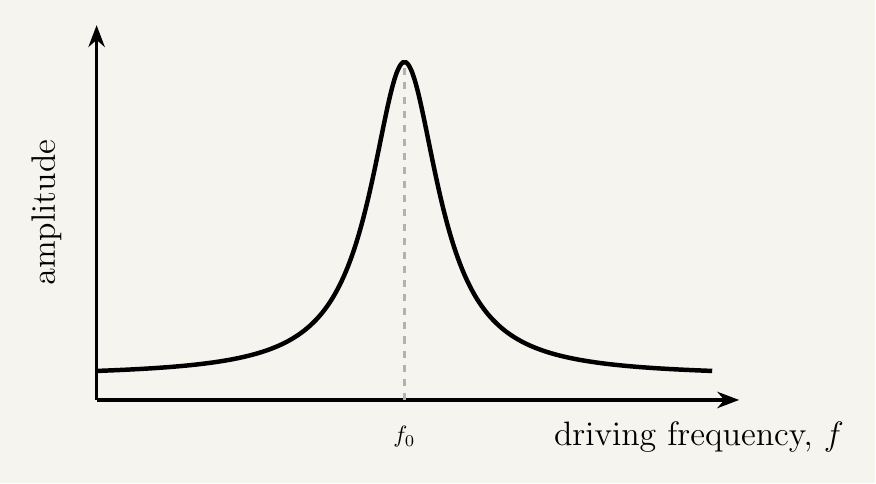
Keep two frequencies distinct: the natural frequency $f_0$ (fixed by the system, unrelated to any driving) and the driving frequency $f$ (set by whatever is forcing the system). Resonance is specifically the special case $f \approx f_0$ — the match between the two.
Key takeaways
- A free oscillation happens when a displaced system oscillates under its own restoring force alone, with no continuing external driving force, at its natural frequency $f_0$ — a fixed property of the system's own physical characteristics.
- A forced oscillation happens when a system is driven continuously by an external periodic force at a driving frequency $f$, which can differ from the system's natural frequency.
- The amplitude of a forced oscillation grows as the driving frequency $f$ approaches the natural frequency $f_0$, reaching a maximum when the two are equal (or very close) — the qualitative onset of resonance.
- Natural frequency and driving frequency are two conceptually distinct quantities; resonance is specifically the condition where they coincide.