Types of Radioactive Decay
A sheet of paper stops one kind of radiation dead. A few millimetres of aluminium stops another. Several centimetres of lead is needed for the third. This lesson pins down exactly what alpha, beta and gamma decay emit, and why their wildly different penetrating power follows directly from what each particle is.
Alpha decay
An unstable, typically very heavy nucleus can reduce its size by emitting an alpha particle — a tightly bound cluster of two protons and two neutrons, identical to a helium-4 nucleus. This reduces the parent's proton number by 2 and nucleon number by 4, transforming it into a different element two places lower in the periodic table.
Alpha particles are emitted with a well-defined, discrete kinetic energy (typically a few MeV), because the decay is a two-body process — conservation of energy and momentum together fix the alpha particle's energy uniquely for each decay. Because an alpha particle is relatively massive and carries a large charge ($+2e$), it interacts strongly with any material it passes through, losing its energy over a very short distance — typically a few centimetres in air, stopped completely by a single sheet of paper or the outer dead layer of skin.
Beta-minus decay
Beta-minus ($\beta^-$) decay occurs in neutron-rich nuclei: a neutron transforms into a proton, emitting an electron and an antineutrino:
This increases proton number by 1 while nucleon number stays unchanged, transforming it into a different element one place higher. This process is mediated by the weak interaction, with the neutron emitting a virtual W⁻ boson that decays into the electron and antineutrino.
Unlike alpha decay, beta-minus decay is a three-body process — the energy released is shared, in varying proportions, between the emitted electron and antineutrino. The electron's kinetic energy varies continuously between zero and some maximum, producing a continuous energy spectrum rather than the single fixed energy seen in alpha decay.
Beta-plus decay
Beta-plus ($\beta^+$) decay occurs in proton-rich nuclei: a proton transforms into a neutron, emitting a positron and a neutrino:
This decreases proton number by 1 while nucleon number stays unchanged, transforming it into a different element one place lower. As with beta-minus decay, this is a weak-interaction process (mediated by a virtual W⁺ boson) and produces a continuous energy spectrum for the same three-body reason.
Beta particles ($\beta^-$ or $\beta^+$) are far less massive and carry only a single elementary charge, so they interact with matter much less strongly than alpha particles and penetrate correspondingly further — typically tens of centimetres in air, stopped by a few millimetres of aluminium.
Gamma decay
After alpha or beta decay, the daughter nucleus is often left in an excited state — correctly rearranged into the new element, but with excess internal energy. The nucleus loses this excess energy by emitting a gamma-ray photon:
where the asterisk denotes the excited state. Since a photon has no mass and no charge, gamma emission changes neither nucleon number nor proton number — it isn't a transmutation, only a release of excess energy from a nucleus whose composition was already fixed by the preceding decay.
Gamma rays are electromagnetic radiation, interacting with matter far more weakly than alpha or beta particles (mainly through relatively rare photoelectric, Compton-scattering or pair-production interactions rather than continuous ionising collisions). This is why gamma radiation is so much more penetrating: several centimetres of dense material such as lead are needed to absorb most of an incident beam, and even then the intensity is only reduced, never brought to a sharp stop.
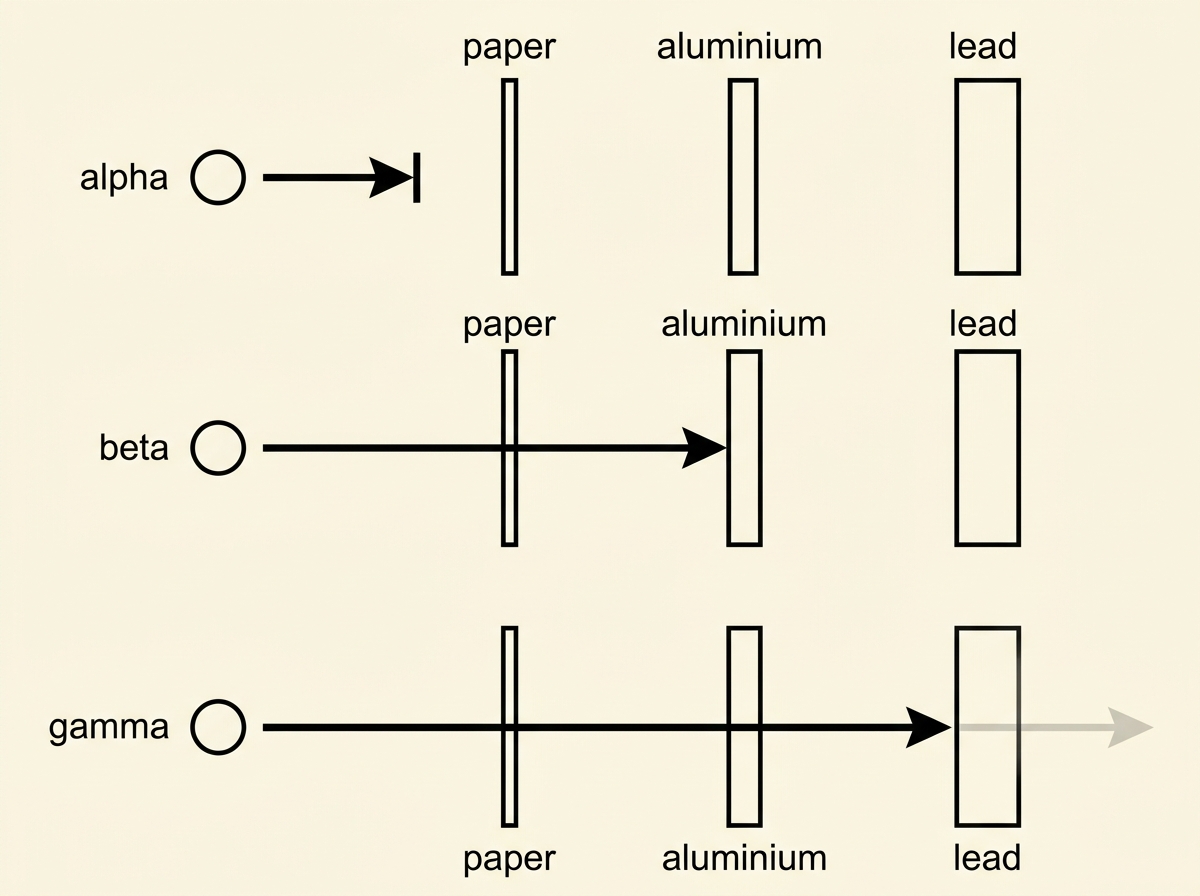
It's easy to assume the most penetrating radiation is also the most dangerous or strongly interacting, but the relationship runs the other way. Alpha particles are most strongly ionising — large charge, large mass, interacting with almost every atom along a short path — which is why they lose energy so quickly and are stopped after only a few centimetres in air. Gamma rays are least ionising, interacting only occasionally, which is why they travel so far before substantial absorption. A highly ionising source is dangerous at short range or if ingested/inhaled (alpha sources are especially hazardous internally), while a penetrating source is dangerous because it can affect tissue from a distance or through shielding.
| Radiation | Emitted as | Charge | Typical range in air | Stopped by |
|---|---|---|---|---|
| Alpha (α) | ${}^4_2\text{He}$ nucleus | +2e | A few cm | Paper / skin |
| Beta (β⁻/β⁺) | Electron / positron | ∓e / ±e | Tens of cm to ~1 m | A few mm of aluminium |
| Gamma (γ) | High-energy photon | 0 | Metres (never fully stopped) | Several cm of lead (reduced, not stopped) |
Beta-minus decay is really a single down quark inside a neutron converting to an up quark, emitting a virtual W⁻ boson that decays into the electron and antineutrino; beta-plus decay is the mirror-image process with an up quark converting to a down quark and a virtual W⁺ — the same quark-level picture, now applied to what's physically emitted and how far it travels through matter.
Key takeaways
- Alpha decay emits a helium-4 nucleus (2p + 2n); nucleon number falls by 4, proton number by 2; discrete energy, since it's a two-body decay.
- Beta-minus decay ($n \rightarrow p + \beta^- + \bar\nu_e$) increases proton number by 1; beta-plus decay ($p \rightarrow n + \beta^+ + \nu_e$) decreases it by 1; nucleon number is unchanged in both. Both give a continuous beta-particle energy spectrum, since energy is shared with the (anti)neutrino in a three-body decay.
- Gamma decay releases excess energy from an already-formed excited nucleus as a photon; it changes neither nucleon number nor proton number.
- Penetrating power increases alpha → beta → gamma, while ionising ability decreases in the same order — the two properties are inversely related, both following from how strongly each type of radiation interacts with matter.