Nuclear Equations
Writing a nuclear equation correctly is really a bookkeeping exercise — but one you need to be completely fluent in, since a single slipped number changes the whole meaning of the reaction. This lesson sets out the notation, the two balancing rules, and works through every type of decay you'll be asked to balance in an exam.
Nuclide notation
A nucleus (or nuclide) is written as:
where $X$ is the chemical symbol, $Z$ is the proton number (atomic number) — written as a subscript to the lower-left — and $A$ is the nucleon number (mass number) — the total protons plus neutrons, written as a superscript to the upper-left. The neutron number isn't written explicitly; it's simply $A-Z$.
This notation extends to particles emitted in radioactive decay, each given its own nucleon and proton number for balancing equations:
| Particle | Notation | A | Z |
|---|---|---|---|
| Alpha particle | ${}^{4}_{2}\text{He}$ (or $\alpha$) | 4 | 2 |
| Beta-minus (electron) | ${}^{0}_{-1}\beta$ (or $e^-$) | 0 | −1 |
| Beta-plus (positron) | ${}^{0}_{+1}\beta$ (or $e^+$) | 0 | +1 |
| Gamma photon | ${}^{0}_{0}\gamma$ | 0 | 0 |
| Neutron | ${}^{1}_{0}\text{n}$ | 1 | 0 |
| Proton | ${}^{1}_{1}\text{p}$ | 1 | 1 |
An electron isn't a nucleon, so giving it $A=0$ makes sense — it contributes nothing to nucleon number. Its proton-number-style label of $-1$ (or $+1$ for a positron) is purely a bookkeeping device: it lets the equation balance using the same two rules that work for every other decay, without a special case for beta decay.
The two balancing rules
Every nuclear equation, whatever kind of decay it represents, must satisfy two conservation rules:
- The nucleon numbers ($A$) on both sides must sum to the same total.
- The proton numbers ($Z$) on both sides must sum to the same total.
These rules are independent and must both be checked separately — balancing one doesn't guarantee the other.
Worked example: alpha decay
Worked example: beta-minus decay
Worked example: beta-plus decay
Worked example: gamma decay
Gamma emission is the simplest case — since a photon has $A=0$ and $Z=0$, emitting one leaves both totals unchanged. A nucleus left in an excited state after alpha or beta decay, e.g. ${}^{234}_{90}\text{Th}^{*}$, simply de-excites:
Nucleon and proton number stay identical before and after — the same nuclide just drops to a lower energy state, with a photon carrying away the difference.
Nuclear energy-level diagrams
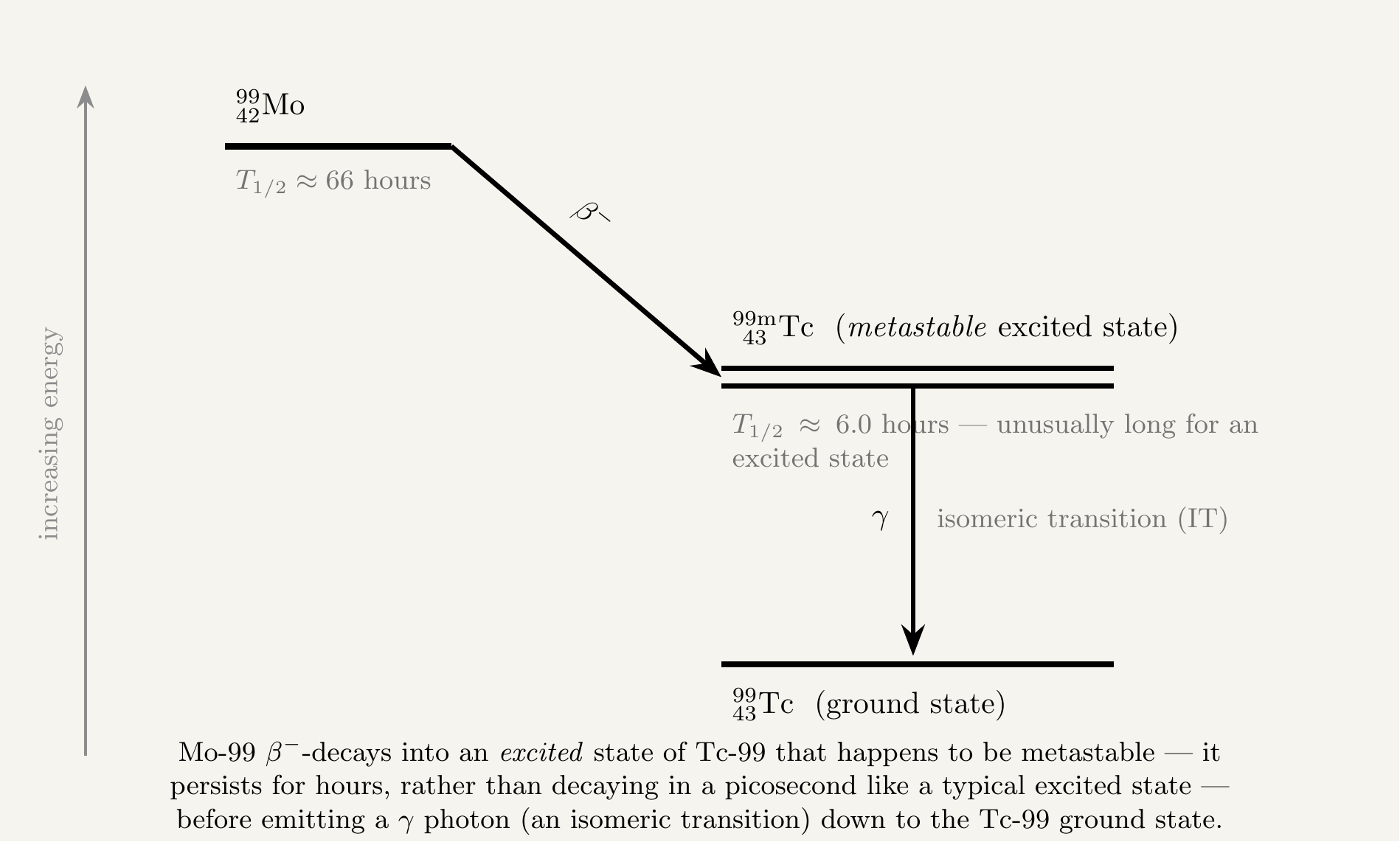
Just as an atom's electrons can only occupy certain discrete energy levels, a nucleus itself has a set of discrete internal energy levels — a ground state, and a series of excited states above it. An alpha or beta decay doesn't necessarily leave the daughter nucleus in its ground state: it's often left in one of these higher, excited levels instead, with the parent-to-daughter transition shown as a diagonal arrow dropping to that level, and the subsequent gamma photon shown as a vertical arrow dropping further, down to a lower level. The photon's energy is fixed exactly by the gap between the two nuclear levels it connects, which is why gamma emission — unlike beta emission — produces photons of sharp, discrete energies rather than a continuous spectrum.
Most excited nuclear states are extremely short-lived, dropping to a lower level by gamma emission within about $10^{-12}\,\text{s}$ of being formed. Occasionally, though, the transition from a particular excited state down to a lower one is much less likely to happen quickly — often because it would require a large change in the nucleus's angular momentum — so that state instead persists for a measurably long time, from microseconds up to many hours, before it finally does decay. A state like this is called metastable, and a nuclide sitting in one is labelled with a lower-case "m" after its nucleon number, to distinguish it from the same nuclide in its ordinary ground state.
The clearest example is technetium-99m ($^{99\text{m}}_{\ \ 43}\text{Tc}$), formed when molybdenum-99 beta-decays into an excited state of technetium-99. That excited state is metastable, with its own well-defined half-life of about six hours, and only then does it drop to the technetium-99 ground state by emitting a gamma photon — a transition between two states of the same nuclide, called an isomeric transition, rather than a transmutation into a different element. This deliberately long-lived intermediate state is exactly what makes Tc-99m so useful in medicine, covered in the next lesson.
Decay series
A single decay doesn't always produce a stable nuclide — the daughter product can itself be radioactive, decaying again through a chain of successive alpha and beta decays until a stable nuclide is reached. This is called a decay series. The uranium-238 series, for instance, passes through more than a dozen intermediate radioactive nuclides before reaching stable lead-206. You aren't expected to memorise any specific series, but each step balances individually using the same two rules, one decay at a time.
Key takeaways
- Nuclide notation ${}^A_ZX$: $A$ is nucleon number (superscript), $Z$ is proton number (subscript); this extends to alpha (${}^4_2\text{He}$), beta ($^0_{-1}\beta$ or $^0_{+1}\beta$) and gamma ($^0_0\gamma$).
- Every nuclear equation must balance nucleon number and proton number separately and independently — both totals must match on each side.
- Alpha decay: $A$ falls by 4, $Z$ falls by 2. Beta-minus: $A$ unchanged, $Z$ rises by 1. Beta-plus: $A$ unchanged, $Z$ falls by 1. Gamma: neither changes.
- A nuclear energy-level diagram shows a decay as a drop from a parent level to an excited daughter level, followed by a further drop (via gamma emission) to a lower or ground-state level; the gamma photon's energy is fixed by the gap between the two levels it connects.
- A metastable state is an excited nuclear state that persists for a measurably long time (rather than the usual $\sim\!10^{-12}\,\text{s}$) before decaying by gamma emission — an isomeric transition. Technetium-99m, formed from molybdenum-99, is the key example.
- A decay series is a chain of successive decays through intermediate radioactive nuclides until a stable nuclide is reached, each individual step balanced using the same two rules.