The Nuclear Atom & Rutherford Scattering
In 1909, two of Ernest Rutherford's students fired alpha particles at gold foil thinner than a fingernail, expecting them to sail straight through a uniform, evenly-spread mass of positive charge. Almost all of them did. But a tiny fraction bounced almost straight back — a result so unexpected that Rutherford compared it to firing a shell at tissue paper and having it rebound. That single experiment demolished the accepted model of the atom overnight.
The plum pudding model it replaced
Before 1909, the accepted picture of the atom was J. J. Thomson's plum pudding model: a sphere of positive charge, spread fairly uniformly across the atom's volume, with negatively-charged electrons studded through it like plums in a pudding, held by electrostatic attraction to the surrounding positive "dough". Crucially, this model has no concentrated mass or charge anywhere — everything is smeared out evenly, and the atom is solid and continuous throughout.
If this picture were correct, fast, heavy, positively-charged alpha particles fired at a thin sheet of atoms should experience only weak, gradual electrostatic forces as they pass through — the charge they interact with at any instant is spread thin, never concentrated. The expectation was that every alpha particle would pass through with at most a small, gentle deflection.
The Geiger–Marsden alpha-scattering experiment
Working under Rutherford's direction, Hans Geiger and Ernest Marsden directed a narrow, collimated beam of alpha particles at an extremely thin sheet of gold foil — gold was chosen because it can be hammered into a foil only a few hundred atoms thick, thin enough that most alpha particles interact with at most one nucleus on the way through. A rotatable detector — a zinc sulfide screen that flashes (scintillates) whenever an alpha particle strikes it — could be positioned at any angle around the foil, including beyond 90°, to record how many particles emerged in each direction.
What was observed
- The overwhelming majority of alpha particles passed straight through the foil, or were deflected through only very small angles.
- A small fraction — roughly 1 in 8000 for the original experiment — were deflected through large angles, some greater than 90°.
- An extremely small fraction bounced back almost the way they had come, at angles close to 180° (backscattering).
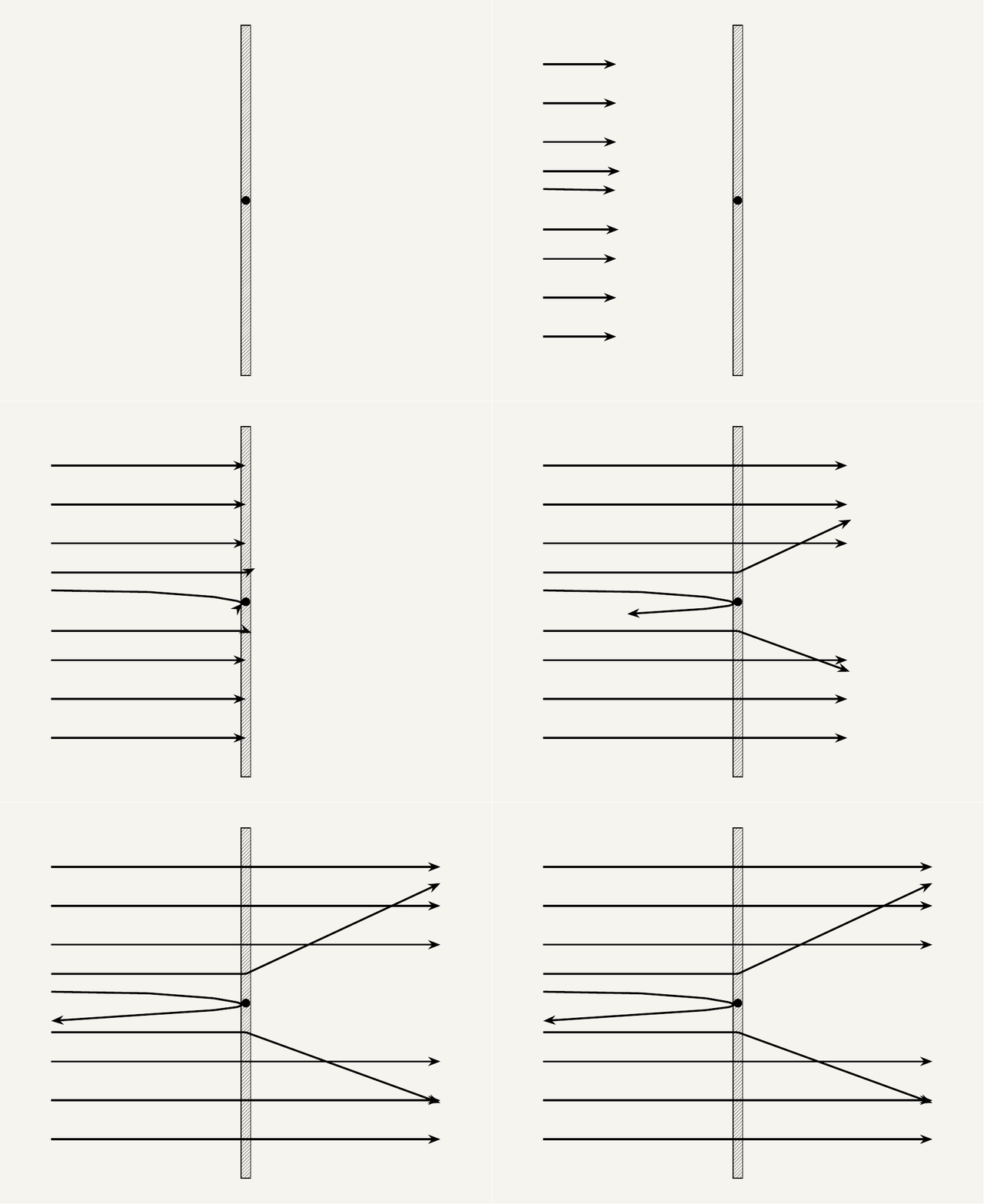
What the observations imply
Each of the three observations rules out the plum pudding model and points toward a different atomic structure.
- Most alpha particles pass straight through — the atom is mostly empty space. If positive charge and mass were spread evenly throughout, every alpha particle would feel a comparable force throughout its passage and none would travel through undeflected.
- A small number are deflected through large angles — this can only happen if an alpha particle occasionally passes very close to a concentration of positive charge intense enough to repel it strongly. This implies the atom's positive charge (and essentially all its mass, since alpha particles are far lighter than a whole atom but easily deflected) is concentrated in a tiny volume.
- A very small number bounce almost straight back — for a fast alpha particle to reverse direction almost entirely, it must experience an enormous repulsive force, momentarily overcoming all its kinetic energy. This could only happen on a rare near head-on approach to a positive charge comparable to or greater than the alpha particle's own mass, concentrated in a region small enough for the force to become that large.
Putting the three observations together gives the nuclear model: almost all of an atom's mass and all of its positive charge are concentrated in a tiny, dense nucleus at the centre, with the rest of the atom — many thousands of times larger in radius — essentially empty space through which much lighter, negatively-charged electrons are arranged.
Estimating the size of the nucleus
The closest a head-on alpha particle gets to the nucleus before its kinetic energy is entirely converted into electrostatic potential energy — the distance of closest approach — gives an upper estimate for the nuclear radius. At that instant the alpha particle is momentarily at rest, so all its initial kinetic energy has transformed into electric potential energy of the alpha–nucleus system.
This calculation assumes the alpha particle only ever feels electrostatic (Coulomb) repulsion from the nucleus — a good approximation as long as it never gets close enough to feel the short-range strong nuclear force. If it did, the result would depart from the smooth $1/r$ curve predicted by Coulomb's law, and this departure — first seen with higher-energy alpha particles — was itself evidence for the existence and range of the strong nuclear force.
Why the plum pudding model couldn't survive this
It wasn't that alpha particles were deflected at all — a smeared-out positive charge could, in principle, produce very slight deflections through gentle, cumulative nudges as the alpha particle passed through many atoms. What was fatal was the existence of any large-angle scattering events, however rare. A diffuse charge distribution cannot produce the enormous, localised force needed to reverse an alpha particle's direction in a single close encounter. Only a model with a small, dense, highly-charged core can explain even one such event, and Geiger and Marsden observed enough of them, at a high enough rate, to make the conclusion unavoidable.
Key takeaways
- The plum pudding model pictured the atom as a uniform sphere of positive charge with embedded electrons — no concentrated mass or charge anywhere.
- In the Geiger–Marsden experiment, alpha particles were fired at thin gold foil: most passed straight through, a small fraction deflected through large angles, and a very small fraction backscattered almost the way they came.
- These observations imply the atom is mostly empty space, with almost all its mass and positive charge concentrated in a tiny, dense central nucleus — the nuclear model of the atom.
- The distance of closest approach, found from equating an alpha particle's kinetic energy to the electric potential energy at the point it momentarily stops, $E_k = \dfrac{2Ze^2}{4\pi\varepsilon_0 r_0}$, gives an upper-bound estimate for the nuclear radius — of order $10^{-14}\,\text{m}$, thousands of times smaller than the atom itself.
- This estimate assumes purely electrostatic repulsion; departures from it at very close approach were early evidence for the strong nuclear force.