Nuclear Radius & Density
Alpha-particle scattering only ever gives an upper bound on how big a nucleus is. This lesson covers the more precise method — electron diffraction — the empirical formula that comes out of it, $R=r_0A^{1/3}$, and the striking fact that follows: every nucleus, light or heavy, has essentially the same density.
A better probe than alpha particles: electron diffraction
The distance-of-closest-approach method from the previous lesson only ever gives an upper bound on the nuclear radius — the alpha particle got no closer than that, but might not have reached the nuclear surface at all. A more precise, direct measurement comes from firing very high-energy electrons at nuclei and studying how they diffract.
Electrons are a better probe than alpha particles for two reasons. First, electrons interact with the nucleus only through the electromagnetic force, not the strong nuclear force, so there's no ambiguity about which force is responsible for what's observed. Second, accelerating electrons to very high energies gives them a very large momentum $p$, and hence — by the de Broglie relation $\lambda = h/p$ — a very short wavelength, small enough to resolve nuclear-scale detail the way a microscope needs short-wavelength light to resolve small objects.
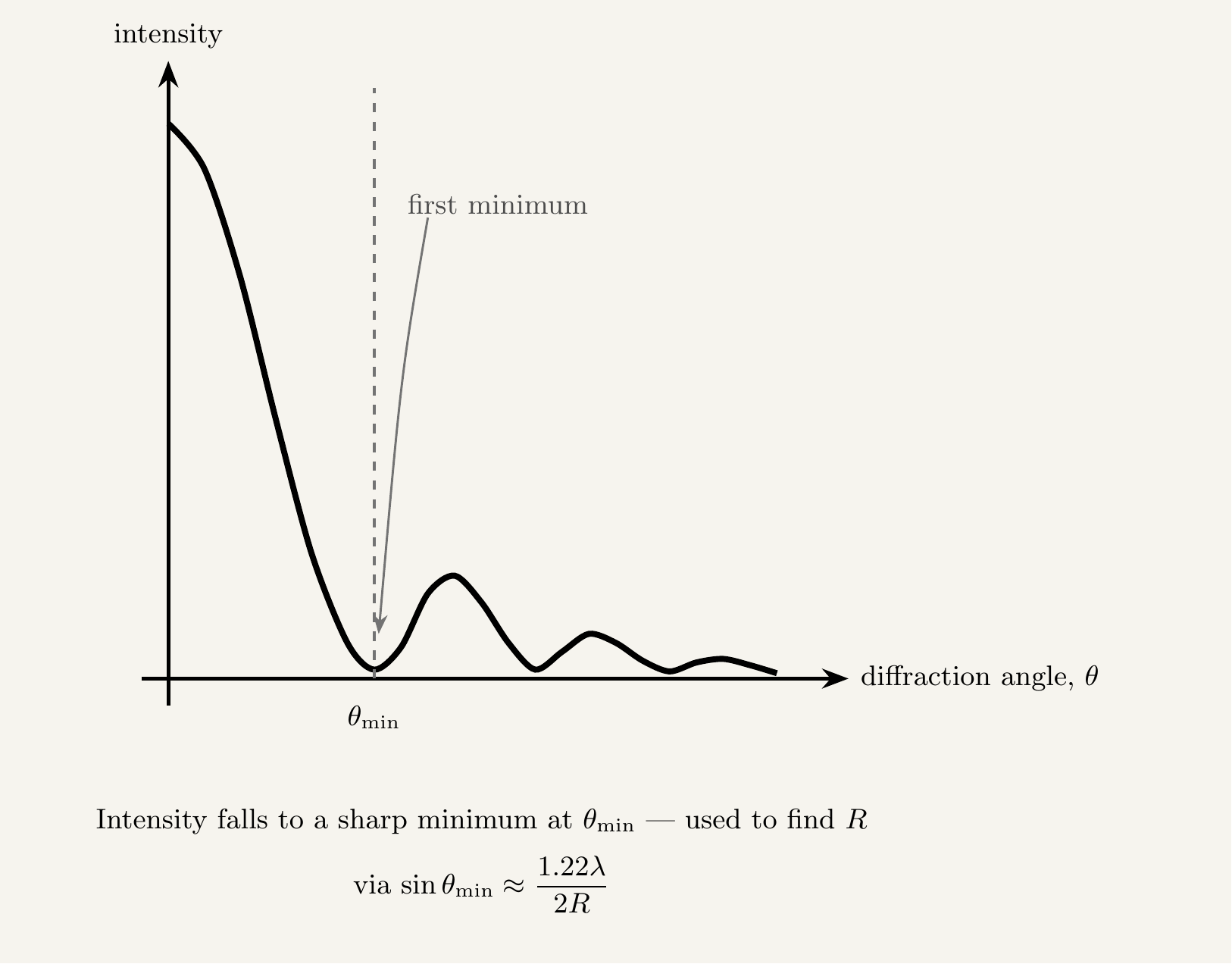
When a beam of these high-energy electrons passes a nucleus, it diffracts, producing an intensity pattern with a first minimum at some angle $\theta_{\min}$ from the original beam direction — closely analogous to diffraction of light around a small circular obstacle. The nuclear radius is related to this angle by:
where $\lambda$ is the electron's de Broglie wavelength and $R$ is the nuclear radius. A smaller nucleus diffracts the beam through a larger angle for the same wavelength, so measuring $\theta_{\min}$ for a beam of known $\lambda$ gives $R$ directly, without the "upper bound only" caveat of the alpha-scattering method.
The nuclear radius formula
Carrying out electron diffraction measurements across many different nuclides and plotting the measured radius $R$ against $A^{1/3}$ (where $A$ is nucleon number) gives a striking result: a straight line through the origin. This means nuclear radius obeys a simple empirical law:
where $r_0$ is an empirical constant, found from the gradient of that graph, with an accepted value of $r_0 \approx 1.2\times10^{-15}\,\text{m}$ (1.2 fm) across essentially the whole periodic table.
It's easy to confuse this $r_0$ with the distance-of-closest-approach $r_0$ from the previous lesson — they're conventionally given the same symbol, but they mean different things. The closest-approach $r_0$ is a one-off result for a specific alpha particle's energy and a specific nucleus, and only an upper bound. The $r_0$ in $R=r_0A^{1/3}$ is a single universal constant, found from precise measurements across many nuclides, that lets you predict the radius of any nucleus just from its nucleon number.
Why nuclear density is the same for every nucleus
$R=r_0A^{1/3}$ has a striking consequence once you compute the density it implies. Treating the nucleus as a sphere of radius $R$, its volume is $V = \tfrac{4}{3}\pi R^3 = \tfrac{4}{3}\pi r_0^3 A$ — directly proportional to $A$, the number of nucleons. Since the nucleus's mass is also directly proportional to $A$ (each nucleon has approximately the same mass, $u \approx 1.66\times10^{-27}\,\text{kg}$), the factor of $A$ cancels when you compute density:
A constant density means nucleons are packed together at essentially the same "spacing" inside every nucleus, however many nucleons there are — much like an incompressible liquid, where adding more molecules increases the volume but not the density. This is one of the pieces of evidence that the strong nuclear force is short-ranged and saturating: each nucleon only really interacts with its nearest neighbours, not with every other nucleon in the whole nucleus, so packing more nucleons in doesn't squeeze the existing ones any closer together.
Key takeaways
- Electron diffraction gives a direct, precise measurement of nuclear radius (unlike alpha-scattering closest-approach, which only gives an upper bound), via $\sin\theta_{\min} \approx \dfrac{1.22\lambda}{2R}$, where $\lambda$ is the electron's de Broglie wavelength and $\theta_{\min}$ is the angle of the first diffraction minimum.
- Nuclear radius obeys the empirical law $R = r_0A^{1/3}$, with $r_0 \approx 1.2\times10^{-15}\,\text{m}$ — a different quantity from (though conventionally sharing the same symbol as) the alpha-scattering closest-approach distance.
- Since nuclear volume $\propto A$ and nuclear mass $\propto A$, the factor of $A$ cancels in density: $\rho = \dfrac{3u}{4\pi r_0^3} \approx 2.3\times10^{17}\,\text{kg}\,\text{m}^{-3}$, the same for every nuclide regardless of size.
- Constant nuclear density is evidence that the strong nuclear force is short-ranged and saturating — each nucleon interacts only with its near neighbours, so nuclear matter behaves like an incompressible liquid.